The Anatomy of Restraint: A Couture Analysis of Queen Victoria’s Neckline Study
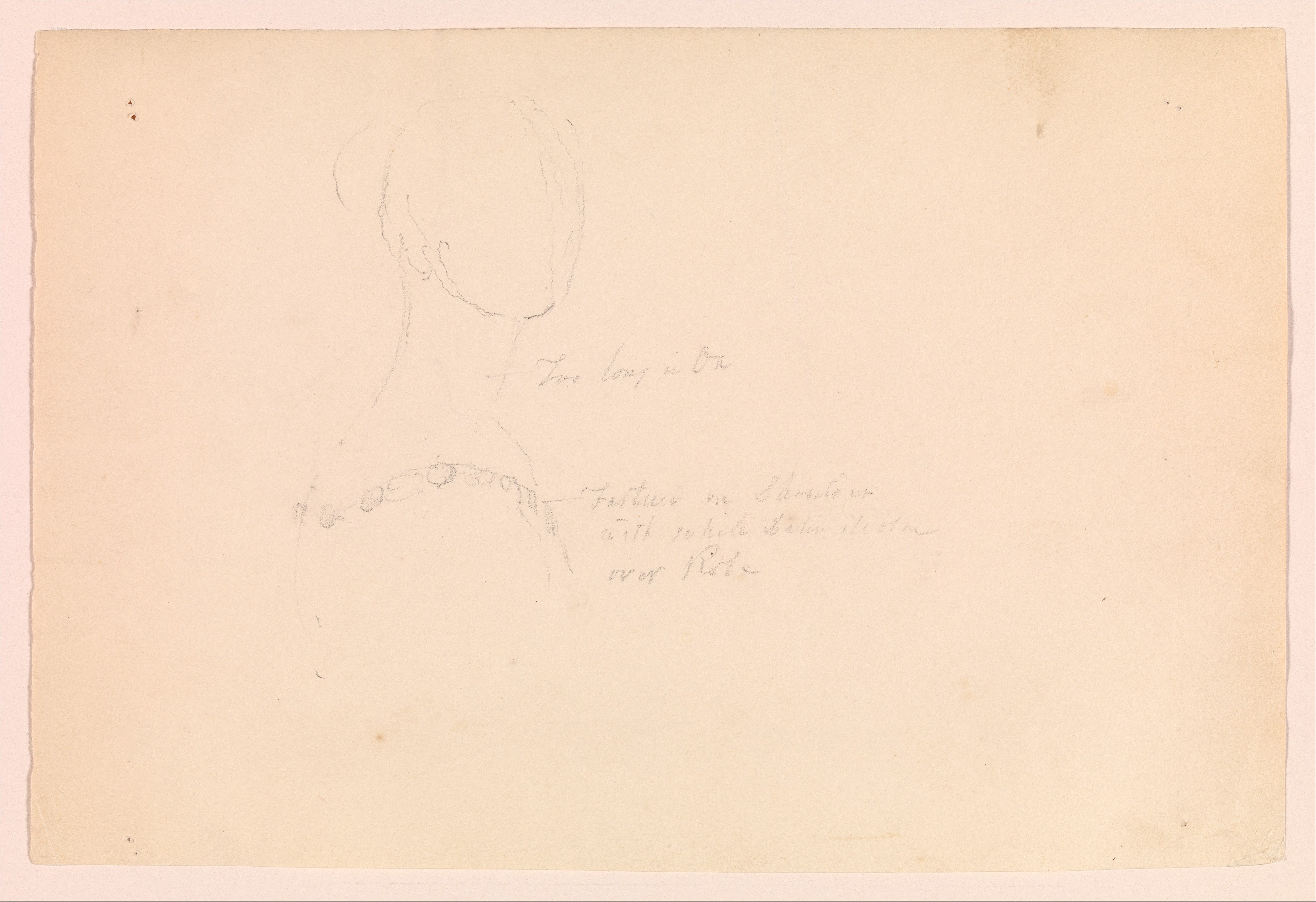
In the rarefied world of high fashion, where the ephemeral is often mistaken for the eternal, the study of a garment’s structural essence offers a profound counterpoint. Katherine Fashion Lab’s acquisition and subsequent analysis of the Study for Portrait of Queen Victoria—a standalone American work in graphite on paper—presents a masterclass in the architecture of modesty. This is not merely a sketch of a collar; it is a blueprint of imperial authority, a cartography of social control, and a testament to how a single line can delineate the boundary between the sovereign and the subject. For the couture house, this study is not a historical relic but a living thesis on the power of negative space and the eloquence of silence in design.
The Materiality of Power: Graphite as a Couture Tool
The choice of graphite is deceptively modest, yet in the hands of an American artist, it becomes a tool of extraordinary precision. Unlike the theatricality of oil or the softness of pastel, graphite offers a metallic, almost industrial clarity. This medium aligns perfectly with the Victorian ethos of controlled display—a society that prized the visible evidence of discipline. In our atelier, we speak of “the hand of the designer,” and here, the hand is steady, unapologetic, and analytical. The graphite’s silvery sheen mimics the sheen of a tightly woven silk faille or a starched batiste, suggesting a fabric that is less about draped softness and more about architectural rigidity.
This study, in its standalone context, strips away the narrative distractions of a full portrait. There is no crown, no orb, no ceremonial robe. Instead, the viewer is confronted with the essential geometry of the neckline. It is a deliberate act of reduction, akin to a couturier’s toile—a preliminary structure upon which the final garment’s identity is built. The paper’s texture, likely a fine-toothed wove, allows for a hairline precision that captures the subtle compression of fabric against the sternum. This is not a drawing of a neckline; it is a specification for one.
The Architectural Line: Deconstructing the Victorian Collar
The Victorian neckline, particularly in the context of a mourning or day dress, was a study in contradictions. It was simultaneously a shield and a cage. The study reveals a high, rounded band that encircles the base of the throat, rising to a point beneath the chin. This is the iconic “bertha” or the more severe “chemisette” collar—a piece designed to obliterate any suggestion of the décolletage. In our contemporary vocabulary, we would call this a “power collar,” a term that resonates deeply with our current collections.
What the graphite study illuminates with astonishing clarity is the line’s relationship to the jawline. The artist has drawn a series of subtle, almost imperceptible hatching marks that suggest the collar’s edge is not a hard line but a transitional zone of pressure. The fabric, likely a heavy velvet or a stiffened linen, is shown to fold slightly inward, creating a shadow that functions as a visual moat—protecting the sovereign’s body from the gaze of the public while simultaneously elevating her chin to a position of haughty defiance. This is the couture principle of “controlled exposure,” where the designer understands that what is hidden is infinitely more powerful than what is revealed.
The American Lens: Reinterpreting Imperial Modesty
That this study is of American origin is not an incidental detail; it is a critical interpretive lens. An American artist, working in the shadow of European monarchy, would approach this subject with a particular tension—a mixture of republican skepticism and a fascination with aristocratic form. This tension manifests in the drawing’s clinical, almost scientific detachment. There is no romanticism here, no soft-focus reverence. Instead, the artist treats the Queen’s neckline as an object of anthropological study, a specimen of a bygone power structure.
This American perspective allows Katherine Fashion Lab to engage with the garment not as a piece of nostalgia but as a critical commentary on authority. The neckline becomes a metaphor for the American relationship with inherited power—a structure that is admired for its engineering but ultimately rejected for its constraints. In our design language, we translate this into garments that feature high, architectural necklines that do not constrict but rather frame the wearer as an autonomous agent. We borrow the silhouette of the Victorian collar but strip it of its punitive rigidity, reimagining it in breathable technical wools and laser-cut leathers that offer the same visual fortress without the physical suffocation.
The Couture Application: From Study to Silhouette
For the modern couturier, this study offers a rich lexicon of techniques. The first is the principle of “the frame within the frame.” The neckline is not merely a termination point for the garment; it is a separate, load-bearing element. In our upcoming Autumn/Winter collection, we have developed a jacket where the collar is constructed as a separate, detachable piece—a direct homage to the study’s suggestion that the neckline is a distinct architectural entity. It is made from a molded horsehair and silk blend, stiffened to hold its shape against the collarbone, creating a shadow that mimics the graphite hatching in the drawing.
Secondly, the study teaches us about the power of negative space as a narrative device. The area between the collar and the chin is not empty; it is charged with meaning. In our atelier, we now speak of the “Victoria Gap”—a deliberate distance between the garment and the skin that suggests an untouchable aura. We achieve this through engineered shoulder seams that push the fabric away from the neck, creating a cantilevered effect. The result is a garment that appears to float around the wearer’s throat, a modern-day armor that is both protective and profoundly elegant.
Finally, the study reinforces the importance of line quality over surface decoration. In an era of maximalist embellishment, this graphite drawing is a reminder that the most potent fashion statement is often a single, perfectly executed line. The artist’s stroke is confident, unbroken, and devoid of ornamentation. This is the ultimate luxury: the confidence to say more with less. Our couture pieces, inspired by this study, therefore avoid excessive beading or embroidery at the neckline. Instead, we invest in the perfection of the seam, the precision of the cut, and the integrity of the material.
Conclusion: The Eternal Neckline
The Study for Portrait of Queen Victoria is far more than a preparatory sketch; it is a philosophical treatise on the nature of dress. It demonstrates that clothing is not merely a covering but a system of beliefs made visible. The neckline, in its stark simplicity, communicates a worldview—one of hierarchy, discipline, and the profound power of restraint. For Katherine Fashion Lab, this study serves as a perpetual touchstone. It reminds us that true couture is not about following trends but about understanding the structural grammar of elegance. As we translate the graphite’s lines into fabric and form, we honor not the Queen’s monarchy, but the artist’s eye—and the enduring, silent authority of a well-drawn line.