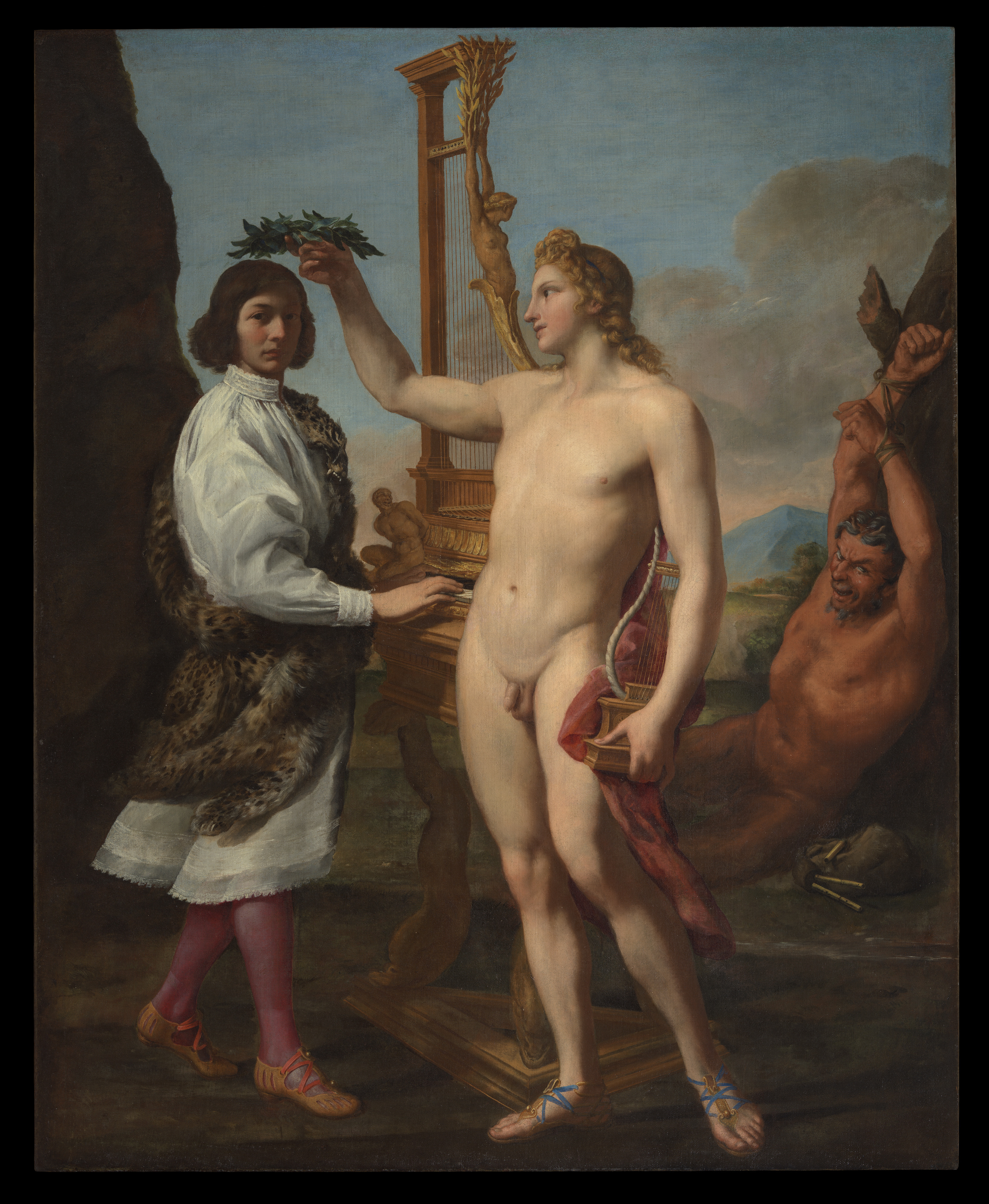
Executive Heritage Analysis: Marcantonio Pasqualini Crowned by Apollo
This strategic research paper examines the 17th-century oil on canvas, Marcantonio Pasqualini (1614–1691) Crowned by Apollo, attributed to the circle of Andrea Sacchi. While the subject is ostensibly a portrait of a celebrated castrato singer, the work functions as a sophisticated allegory of divine artistic investiture. For Katherine Fashion Lab, this painting offers a profound case study in the semiotics of coronation, the materiality of celestial favor, and the translation of spiritual authority into contemporary luxury narratives. The analysis proceeds through four lenses: symbolic power, historical adornment, spiritual meaning, and a projected 2026 high-end strategy.
Symbolic Power: The Mechanics of Apotheosis
The central motif—Apollo placing a laurel wreath upon Pasqualini’s head—is not a passive gesture but a deliberate transfer of creative sovereignty. In Greco-Roman tradition, the laurel (sacred to Apollo) signified victory, purification, and poetic immortality. By depicting the singer as the recipient, the artist elevates a mortal performer to the status of an oracle. The wreath is not merely a decorative accessory; it is a crown of authority, transforming personal talent into sanctioned cultural power. For a luxury house, this represents the ultimate brand endorsement: not a celebrity collaboration, but a mythological validation. The positioning of Apollo’s hand—poised, yet not fully releasing the crown—suggests an eternal state of becoming, a perpetual negotiation between divine gift and human achievement. This tension is a potent metaphor for high-end brands that must balance heritage with innovation.
Furthermore, the composition’s verticality—Apollo descending from a luminous cloud—implies a hierarchy of realms. Pasqualini is grounded, yet his upward gaze and the crown’s placement create a diagonal axis of aspirational movement. This visual rhetoric is directly applicable to luxury marketing: the consumer is not buying a product; they are purchasing a position within a celestial hierarchy. The power dynamic is not coercive but charismatic, rooted in the belief that art, like music, can mediate between the earthly and the divine.
Historical Adornment: The Grammar of Garments and Props
Adornment in this painting is meticulously coded. Pasqualini wears a sumptuous, dark velvet tunic with a white lace collar—a marker of courtly status, yet subdued to foreground his face and the wreath. The velvet’s deep absorption of light contrasts sharply with Apollo’s radiant, golden drapery, creating a dialectic of restraint versus radiance. The singer’s attire is not ostentatious; it is the blank canvas upon which the crown’s significance is projected. This is a critical lesson for 2026 luxury: adornment must not compete with the symbol of investiture. Instead, the base garment should serve as a quiet substrate, allowing a singular, powerful accessory to become the focal point.
Apollo’s attributes—the lyre, the sun rays, and the flowing robe—are not mere props but iconographic amplifiers. The lyre’s curved form echoes the shape of the laurel wreath, visually rhyming music with victory. The sun rays, painted in gold leaf or impasto, suggest that Apollo’s presence is not ambient but irradiating. For Katherine Fashion Lab, this suggests a strategy of material storytelling: using metallic threads, luminous silks, or sculptural embroidery to create "light-bearing" elements within a collection. The historical accuracy of the garments matters less than their psychological accuracy—they must communicate status, temporality, and divine proximity.
Spiritual Meaning: The Voice as Sacred Relic
Pasqualini was a castrato—a figure whose physical sacrifice was believed to preserve a prelapsarian vocal purity. The painting, therefore, encodes a spiritual paradox: the crown is not for the body but for the incorporeal voice. This is a profound meditation on the immateriality of luxury. In an era of tangible goods, the painting reminds us that the highest value often resides in the ephemeral—a melody, a scent, a moment of aesthetic rapture. The laurel wreath, in this context, becomes a relic of the immaterial, a physical token of an otherwise fleeting performance.
Spiritually, the scene evokes the Neoplatonic idea that beauty is a ladder to the divine. Apollo’s crown is not a reward for technical skill but a recognition of the singer’s ability to channel harmonia mundi—the music of the spheres. For a luxury brand, this translates into a mandate for transcendental craftsmanship: the product must be an offering, not a commodity. The spiritual meaning is not overtly religious but deeply numinous; it asks the wearer to consider their own body as a vessel for artistic expression. This aligns with the 2026 consumer’s search for authenticity and ritualistic value, moving beyond sustainability into sacred consumption.
2026 High-End Luxury Strategy: The Crown as Brand Architecture
Drawing from this heritage analysis, Katherine Fashion Lab can formulate a three-pillar strategy for 2026, centered on the concept of the “Crown of Investiture.”
Pillar One: The Limited Edition "Apollo’s Favor" Collection
Launch a capsule collection featuring a single, dominant accessory—a laurel-inspired headpiece or brooch—crafted in recycled gold and hand-set with lab-grown diamonds. The garments will be deliberately minimal, using high-twist wool or matte silk in deep, absorbent colors (charcoal, midnight blue) to create a visual silence that allows the crown piece to radiate. This mirrors the painting’s composition, where the singer’s velvet tunic provides the dark ground for Apollo’s light. Each piece will be numbered and accompanied by a certificate referencing the 1614–1691 provenance, transforming a commercial object into a collectible relic.
Pillar Two: Experiential "Investiture Rituals"
Move beyond traditional retail by hosting private, invitation-only events in acoustically resonant spaces (e.g., chapels or concert halls). During these events, a commissioned composer will perform a new work for solo voice, after which each client will be personally "crowned" by a brand ambassador dressed in a contemporary interpretation of Apollo’s drapery. This ritualizes the purchase, aligning with the painting’s spiritual meaning of divine transfer. The event is not a product launch but a ceremony of creative validation, allowing the client to feel like Pasqualini—a mortal elevated by artistic grace.
Pillar Three: Narrative-Driven Digital Heritage
Develop an immersive digital experience using augmented reality (AR) that allows users to "enter" the painting. Through a smartphone lens, the user’s own reflection can be overlaid with Pasqualini’s laurel crown, while a voice-over narrates the history of the castrato’s sacrifice and Apollo’s blessing. This serves a dual purpose: it educates a younger, tech-native demographic on the painting’s symbolic power, and it creates a shareable, viral moment that reinforces the brand’s association with mythological depth. The AR filter will not be a gimmick but a pedagogical tool, emphasizing the weight of the crown—both its physical weight and its historical gravitas.
Finally, the strategy must emphasize scarcity as a form of respect. The collection will be limited to 1,614 units—a direct reference to Pasqualini’s birth year—and each piece will be engraved with the artist’s name. This numerical homage creates a chronological anchor, inviting the consumer to participate in a 400-year-old lineage of artistic coronation. In a market saturated with logos, this strategy offers something rarer: a provenance of transcendence.
Conclusion: The Crown as a Living Heritage
Marcantonio Pasqualini Crowned by Apollo is not a static artifact but a strategic blueprint for luxury’s future. It teaches that true power is conferred, not claimed; that adornment must serve the symbol, not overshadow it; and that spirituality is the ultimate differentiator in a secular marketplace. By adopting the painting’s visual logic—restraint, radiance, and ritual—Katherine Fashion Lab can position itself not merely as a purveyor of goods, but as a curator of coronations. The crown, once placed upon a singer’s head, now rests upon the brand’s identity, promising that every client who wears its creations is, for a moment, touched by Apollo’s immortal hand.