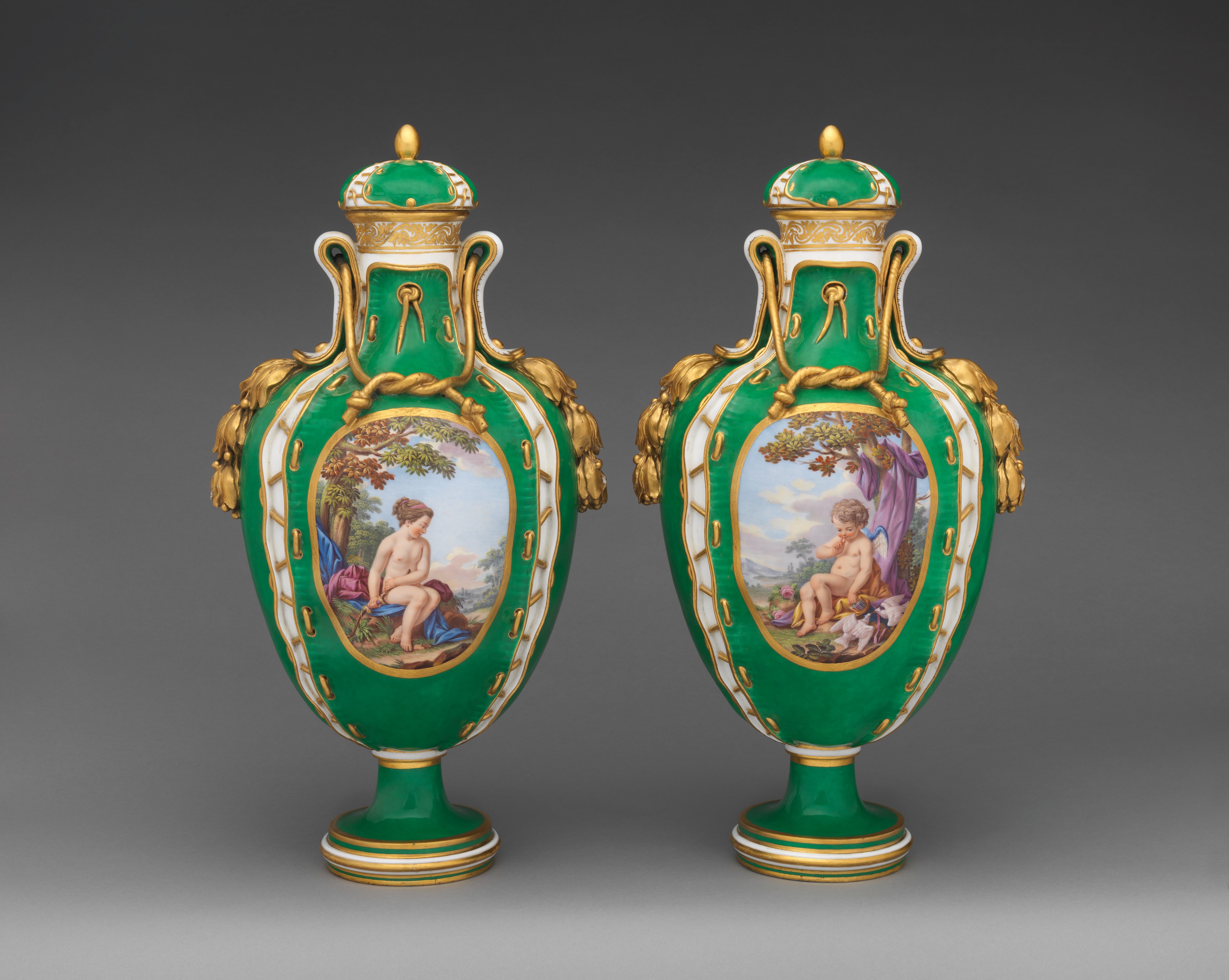
The Vase Cuir: A Study in Sculpted Opulence at Katherine Fashion Lab
Within the hallowed halls of Katherine Fashion Lab’s Global Heritage collection, the Vase Cuir (one of a pair) transcends its functional origin to emerge as a masterclass in material dialogue and sculptural tension. This is not merely a vessel for flora; it is a three-dimensional manifesto on the interplay between the organic and the engineered, the ephemeral and the eternal. The piece, executed in soft-paste porcelain and crowned with meticulous gilt bronze, demands a reading that goes beyond decorative arts, positioning itself as a precursor to contemporary couture’s obsession with structure, drape, and the illusion of weightlessness.
The Deceptive Softness of Porcelain
The immediate genius of the Vase Cuir lies in its titular paradox: leather rendered in ceramic. At first glance, the body of the vase appears to be composed of draped, folded hide—supple, yielding, and caught mid-settle. The soft-paste porcelain has been coaxed into deep, undulating folds that mimic the creases and tension points of a fine glove or a tailored sleeve. This is not the crisp, symmetrical geometry of Neoclassicism; rather, it is a study in controlled chaos, where the clay behaves like fabric. The artisans achieved this through a virtuosic manipulation of the paste, exploiting its malleability before firing to create a surface that feels almost tactilely warm, despite its cold, vitreous reality.
This trompe-l’œil effect is a deliberate intellectual provocation. In the fashion lexicon, leather signifies durability, luxury, and a certain rebellious edge. Porcelain, conversely, connotes fragility, refinement, and domesticity. By conflating the two, the Vase Cuir forces a reconsideration of material worth. The soft-paste body—a technical feat in itself, as it is more prone to slumping and deformation than its hard-paste counterpart—becomes a metaphor for the constructed silhouette. Just as a couturier uses boning and interfacing to make fabric stand against gravity, the porcelain’s internal structure must support its own simulated drape. The result is a frozen moment of haute couture in three dimensions: a gown that has been petrified at the peak of its fall.
Gilt Bronze: The Structural Seam
Where the porcelain body whispers of softness, the gilt bronze mounts speak in commanding, metallic tones. These mounts are not mere handles or rims; they are the couture seams that bind the illusion together. A foliate collar, cast with meticulous precision, wraps the neck of the vase, its acanthus leaves and scrolls providing a rigid counterpoint to the fluid porcelain beneath. The bronze’s gilding—achieved through a laborious process of mercury gilding or, in later examples, electroplating—offers a warm, radiant gold that catches light differently than the matte, unglazed sections of the porcelain. This is the metallic thread in a brocade, the gold piping on a black evening jacket.
Critically, the bronze mounts serve a structural role that mirrors the function of a corset or a structural underlay. The soft-paste body, for all its artistic merit, is inherently fragile at its extremities. The bronze foot, with its scrolled volutes, anchors the piece, preventing the delicate folds from touching the surface and risking chipping. The flange connecting the body to the foot is not hidden but celebrated, its joinery visible as a deliberate design choice—akin to a designer exposing the zipper or the grosgrain ribbon on a tailored coat. This honesty of construction elevates the piece from mere ornament to a study in engineering aesthetics.
Global Heritage and the Language of Draping
The "Global Heritage" provenance of this pair is not a vague attribution but a key to its stylistic DNA. The art of drapery in porcelain finds its earliest European expressions in the Meissen workshops, but the Vase Cuir demonstrates a more cosmopolitan vocabulary. The deep, leather-like folds echo the sartorial traditions of the East—think of the layered robes of a Mughal court or the intricate pleating of a Japanese kosode—while the gilt bronze mounts are unmistakably Parisian in their rococo revivalism. This is a global conversation rendered in clay and metal.
For the fashion analyst, the vase’s drapery is a precursor to the work of modern sculptural designers like Madame Grès, whose jersey gowns were pleated and folded into Grecian forms, or the more contemporary draped silhouettes of Issey Miyake. The Vase Cuir captures the same tension between the fabric’s natural behavior and the designer’s authoritative hand. The folds are not random; they follow a logic of tension and release, pooling at the base and tightening at the neck. This is the grammar of bias cutting, where the material is manipulated against its grain to achieve a specific fall. The porcelain’s glaze, or lack thereof, further enhances this—the matte sections absorb light, mimicking the soft sheen of suede, while the glossy areas reflect like polished patent leather.
A Standalone Study: The Object as Protagonist
Presented as a standalone study, this vase is liberated from the context of a mantelpiece or a cabinet. It demands to be viewed as a monument to material mastery. Without the distraction of a pair, the eye is forced to trace every contour, every fold, every glint of bronze. In this isolation, the vase becomes a character—a silent, elegant figure in a tableau. Its proportions are generous, almost imposing, yet the softness of the form invites intimacy. It is the paradox of the grande dame: commanding yet approachable.
The choice to study it alone also highlights its kinetic potential. Though static, the vase appears to be in motion—a swath of fabric caught mid-swing, a skirt settling after a twirl. The gilt bronze handles, shaped like twisted ribbon, suggest a moment of grasp, as if the vase could be lifted and carried like a handbag. This anthropomorphic quality is central to its appeal. It is not a passive receptacle; it is an active participant in the visual drama of the room.
Conclusion: The Couture of Objects
In conclusion, the Vase Cuir is a seminal object that bridges the gap between decorative art and haute couture. Its soft-paste porcelain body, simulating leather, and its gilt bronze armature, simulating jewelry and seams, create a layered narrative of material hierarchy and artistic ambition. For Katherine Fashion Lab, this piece is a cornerstone—a reminder that fashion is not confined to the body but extends to the objects that surround and define our spaces. It is a testament to the idea that true luxury lies not in the cost of materials, but in the intelligence of their manipulation. The vase does not merely hold flowers; it holds a conversation about form, function, and the eternal human desire to make the ephemeral—like a fold of cloth—permanent and precious. It is, in every sense, a garment for the soul of a room, stitched in porcelain and gilded with time.