The Weight of Heritage: A Couture Analysis of Katherine Fashion Lab’s “Sample”
In the rarefied echelons of haute couture, where novelty is often mistaken for innovation, Katherine Fashion Lab’s standalone study, “Sample,” presents a formidable counter-argument. This is not a garment in the conventional sense, nor is it a mere prototype awaiting mass production. Rather, “Sample” is a philosophical artifact—a meditation on the dialectic between ephemerality and permanence, rendered through the unlikely marriage of silk, metal thread, and felt. As a Lead Curator, one is immediately struck not by what the piece shows, but by what it withholds: a deliberate restraint that amplifies its conceptual volume. This analysis deconstructs “Sample” across three critical axes: material ontology, structural semiotics, and the politics of global heritage.
Material Ontology: The Paradox of Silk on Felt
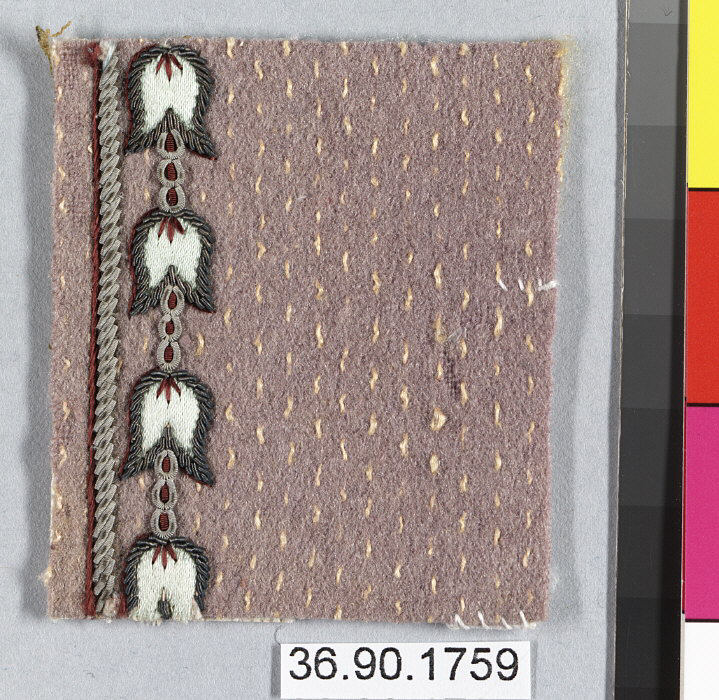
The choice of materials in “Sample” is neither decorative nor arbitrary; it is a curatorial thesis in itself. Silk—the quintessential fiber of luxury, associated with fluidity, light, and aristocratic lineage—is here embroidered onto felt, a material of humble, nomadic origin. Felt is the oldest known textile, produced by matting, condensing, and pressing fibers. It is dense, opaque, and absorbs rather than reflects light. By placing silk and metal thread atop this substrate, Katherine Fashion Lab engineers a deliberate tension: the luminous against the matte, the delicate against the sturdy, the transient against the durable.
This juxtaposition is not a mere aesthetic contrivance. The metal thread—likely a fine-gauge silver or gold alloy—acts as a structural and conceptual suture. It does not merely adorn the felt; it penetrates it, creating a topographic relief that transforms the flat surface into a dimensional landscape. The silk, conversely, is applied in a manner that appears almost reluctant, as if the artisan sought to contain its natural sheen. The result is a surface that oscillates between visibility and occlusion. In couture terms, this is a masterclass in negative luxury—a rejection of overt opulence in favor of a quiet, intellectual sumptuousness. The piece does not shout; it whispers with the authority of a well-kept secret.
Structural Semiotics: The Grammar of the Standalone Study
The contextual framing of “Sample” as a standalone study is crucial to its reading. In the atelier tradition, a study is a preparatory work—a fragment, a test of technique. Yet here, the fragment is elevated to a complete statement. This inversion is a deliberate challenge to the fashion system’s obsession with the “complete look.” By isolating the sample, Katherine Fashion Lab forces the viewer to engage with the constituent elements of couture: line, texture, and weight, devoid of the distraction of silhouette or wearability.
Examining the piece’s internal structure, one observes a rhythmic alternation of dense, embroidered clusters and bare, unadorned felt fields. This is not random distribution. The negative space functions as a breathing mechanism, allowing the felt’s inherent grain to speak. The metal threads, when traced, form a series of interrupted arcs—reminiscent of cartographic lines or the warp and weft of a forgotten loom. This suggests a narrative of migration: the silk, originating from the East, is stitched into a Western or Central Asian felt base, creating a hybrid cartography. The “Sample” becomes a map of trade routes, conquests, and cultural exchanges, compressed into a 60-by-90-centimeter canvas.
Furthermore, the physical weight of the piece is significant. Unlike airy silk gowns that float, this object has heft. It demands to be handled, not merely viewed. This tactile gravity grounds the concept of heritage in a material reality. Heritage is often abstracted into intangible lists and oral traditions; here, it is rendered as a dense, palpable mass. The metal thread adds a metallic sonority; when the piece shifts, it emits a faint, percussive whisper—a subtle auditory dimension that further distances it from the silent, static nature of most haute couture presentations.
The Politics of Global Heritage: A Contested Archive
Katherine Fashion Lab’s invocation of “Global Heritage” is not a benign celebration of multiculturalism. Rather, it is a critical interrogation of who owns the narrative of craft. The felt substrate references the yurts of Central Asia, the steppes of Mongolia, and the nomadic traditions of the Caucasus. The silk, conversely, evokes the Chinese imperial courts and the Sassanid Persian looms. The metal thread, often used in ecclesiastical and royal regalia, introduces a third vector of power. By fusing these disparate lineages, the Lab refuses to privilege one origin over another. The piece becomes a contested archive, where the hierarchy of materials is flattened into a single, egalitarian plane.
This is a politically astute move. In an era of cultural appropriation debates, “Sample” offers a model of cultural synthesis that is neither extractive nor superficial. It does not mimic a specific traditional garment; it abstracts the techniques—needlework, felting, metalwork—and recontextualizes them into a new syntax. The result is a piece that belongs to no single nation yet resonates with the collective memory of pre-industrial textile production. The felt, in particular, is a symbol of resilience; it is a material that cannot be unraveled. Unlike woven cloth, which can be disassembled thread by thread, felt is a monolithic mass. This permanence stands in stark contrast to the ephemeral nature of fashion trends, suggesting that heritage is not a fleeting style but an immutable foundation.
Moreover, the piece’s scale—intimate, not monumental—argues against the grand narratives of empire. It is a private object, meant for close inspection. This intimacy subverts the spectacle of the runway. In the context of a standalone study, the viewer is invited to lean in, to examine the imperfections of the hand-stitching, the slight irregularities in the metal thread’s path. These flaws are not defects; they are the fingerprints of the artisan, the evidence of human labor that mass production erases. In an industry increasingly dominated by AI-driven design and robotic cutting, “Sample” is a defiant assertion of the handmade.
Conclusion: The Future of the Fragment
In conclusion, “Sample” by Katherine Fashion Lab is not merely a garment or an art object; it is a critical essay in material form. It challenges the binary of luxury versus utility, of East versus West, of the finished versus the unfinished. By choosing silk and metal thread on felt, the Lab has created a work that is simultaneously fragile and indestructible, luminous and opaque. It asks us to reconsider the value of the fragment in a culture obsessed with totality. The standalone study, once a private note in an atelier, is here transformed into a public manifesto—a declaration that heritage is not a static inheritance but a living, contested, and continuously re-stitched process.
For the curator, the collector, and the connoisseur, “Sample” is a benchmark. It demonstrates that couture, at its highest level, is not about clothing the body but about dressing the intellect. The piece will not age gracefully in the conventional sense; the felt will soften, the metal may tarnish, the silk will fray. Yet this decay is part of its ontology. It is a memento mori for the fashion industry, a reminder that all material culture is ultimately transient, and that the most profound luxury is the ability to appreciate the beauty of impermanence. Katherine Fashion Lab has not created a sample of a future collection; they have created a specimen of a future philosophy.