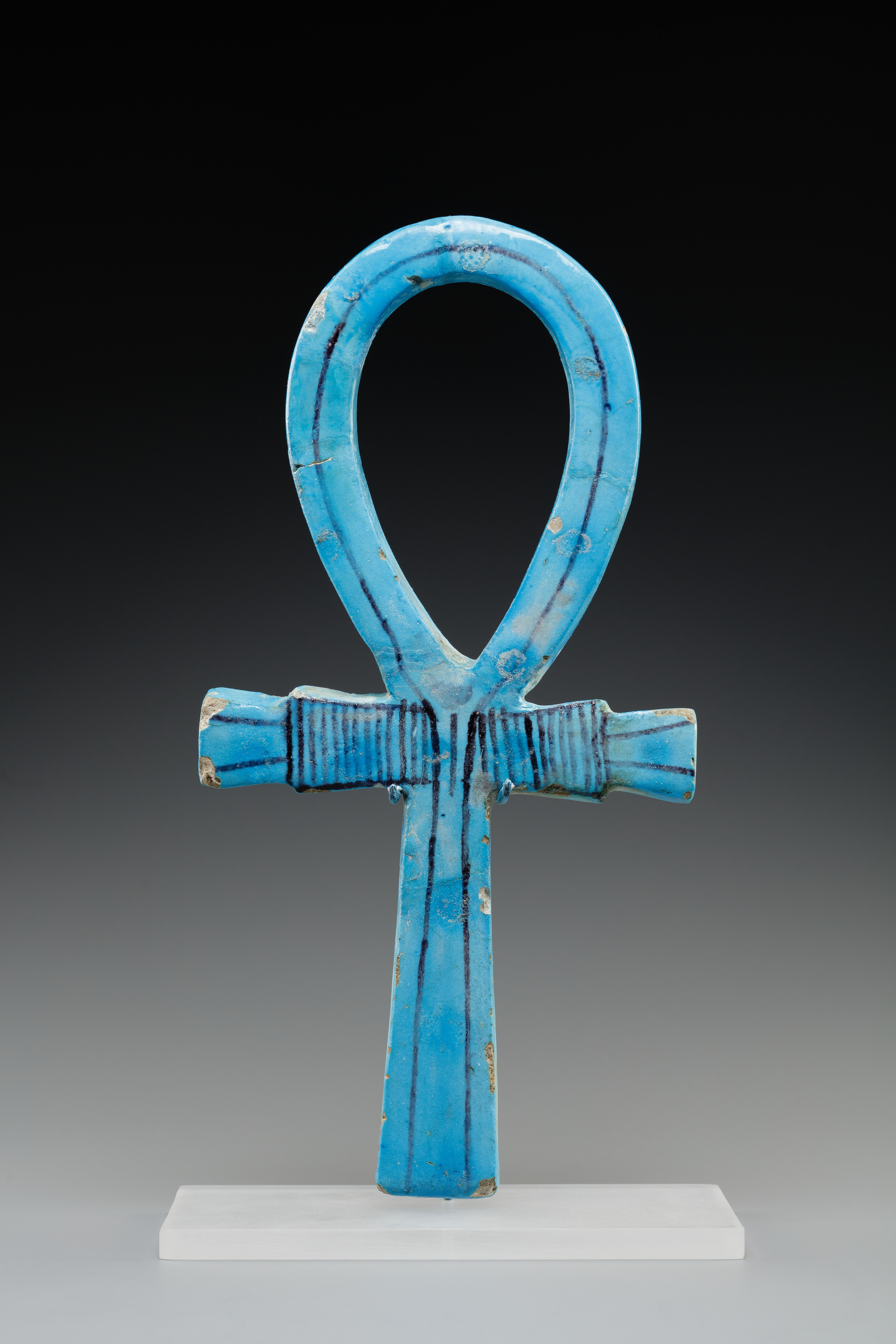
Executive Heritage Analysis: The Faience Ankh as a Strategic Luxury Archetype
Katherine Fashion Lab presents this standalone research paper to dissect the ceremonial ankh, rendered in Egyptian faience, as a cornerstone artifact for high-end luxury positioning in 2026. The analysis transcends mere archaeological description, focusing instead on the ankh’s symbolic equity, its role in historical adornment, and its actionable translation into a modern luxury strategy that commands authority, exclusivity, and cultural resonance.
Symbolic Power: The Ankh as a Semiotic Anchor
The ankh, or crux ansata, is not a passive decorative motif; it is a semiotic engine. In ancient Egyptian cosmology, the ankh represented the union of the masculine and feminine principles—the key of life and the breath of eternal existence. It was held to the lips of pharaohs by deities, signifying the transfer of divine vitality. For Katherine Fashion Lab, this is the ultimate brand metaphor: the object does not merely adorn; it authorizes. In a 2026 luxury market saturated with transient trends, the ankh offers a permanent, immutable signifier of life force. Its power lies in its untranslatable nature—it cannot be reduced to a logo or a hashtag. It is a glyph that commands reverence, making it a strategic asset for a maison that seeks to position itself as a guardian of timeless meaning rather than a purveyor of seasonal noise.
Historical Adornment: From Temple to Torso
While the ankh was a ubiquitous hieroglyph, its use in personal adornment was a deliberate act of social and spiritual stratification. Faience ankh amulets were not mass-produced trinkets; they were crafted for the elite, for priests, and for the deceased entering the afterlife. The material itself—faience—was a technological marvel of the ancient world. A self-glazing quartz composite, faience was prized for its iridescent blue-green sheen, mimicking turquoise and lapis lazuli, stones associated with rebirth and the Nile’s fertility. To wear a faience ankh against the skin was to carry a piece of the celestial river, a talisman that connected the wearer’s pulse to the cosmic order. In a heritage context, this establishes a critical precedent: adornment is a form of wearable theology. For Katherine Fashion Lab, this reframes jewelry from a commodity to a ritual object. The historical consumer did not purchase an ankh; they commissioned a conduit for divine protection. This shifts the modern luxury transaction from acquisition to consecration.
Spiritual Meaning: The Economics of the Immaterial
The spiritual dimension of the ankh is not a soft, esoteric addendum—it is a hard economic driver. The ancient Egyptians understood that the immaterial has the highest perceived value. The ankh’s spiritual meaning was its utility: it guaranteed the soul’s survival, the union of the ka (vital force) and the ba (personality) after death. This is the original "lifetime warranty," but extended into eternity. For a 2026 luxury strategy, this translates into a profound consumer insight: the modern affluent client is not seeking a product; they are seeking durability of self. In an era of AI anxiety, climate precarity, and geopolitical flux, the ankh offers an antidote—a promise of continuity. By integrating this spiritual payload, Katherine Fashion Lab can position its offerings as anti-fragile assets. The ankh’s spiritual meaning becomes a form of emotional currency, one that appreciates in value precisely because it cannot be devalued by market fluctuations or trend cycles. The luxury client in 2026 will pay a premium not for the faience, but for the assurance of transcendence that the faience encodes.
Strategic Application: The 2026 High-End Luxury Blueprint
Katherine Fashion Lab must not merely reference the ankh; it must weaponize its heritage through a three-pillar strategy of scarcity, ritual, and narrative.
Pillar One: Material Alchemy. The medium of faience is critical. In 2026, the luxury market will reject overt opulence (diamond-encrusted excess) in favor of intelligent materiality. Faience, with its ancient provenance and ceramic complexity, offers a counter-narrative to the sterile perfection of lab-grown stones. The lab should commission a limited edition of 100 pieces, each hand-glazed to achieve a unique patina. No two ankhs will share the exact same hue, mirroring the ancient artisan’s acceptance of variation. This creates a collector’s paradox: identical in form, unique in soul. The pricing strategy should be anchored not on material cost, but on the hours of consecration—the time spent in the studio, the ritual of firing, the prayer-like focus of the glaze. This transforms the production process into a performance of heritage.
Pillar Two: The Ritual of Acquisition. The purchase journey must be re-engineered as a ceremonial act. The ankh should not be sold via e-commerce. Instead, Katherine Fashion Lab will host private audiences in its flagship atelier, where the client is invited to hold the faience ankh for a moment of silent contemplation. The sales associate, trained as a "heritage custodian," will narrate the object’s journey from the Nile’s mud to the client’s hand. The unboxing will be replaced by a consecration ceremony, where the ankh is presented on a bed of raw linen, accompanied by a hand-written scroll explaining its spiritual provenance. This is not retail; this is initiation. The goal is to create a memory so potent that the object becomes an heirloom before it is even worn.
Pillar Three: Narrative Ownership. In 2026, a standalone heritage asset must be defended against cultural dilution. Katherine Fashion Lab will publish a heritage white paper, authored by Egyptologists, that positions the faience ankh as a "universal key" rather than a culturally appropriated artifact. This is a delicate balance. The strategy is to elevate, not exploit. The brand will partner with the Egyptian Ministry of Tourism and Antiquities to fund the conservation of a faience workshop in Luxor. This is not corporate social responsibility; it is supply chain authentication. By literally preserving the source of the ankh’s heritage, the brand ensures that its 2026 collection is not a copy, but a continuation. The narrative will pivot on the phrase: "We do not reproduce the past; we re-consecrate it."
Conclusion: The Ankh as a Strategic Imperative
The ceremonial faience ankh is not a nostalgic artifact; it is a blueprint for luxury’s future. In a 2026 market defined by the search for meaning, Katherine Fashion Lab can leverage this object’s symbolic power, historical adornment status, and spiritual profundity to create a product that is immune to obsolescence. The ankh’s core value—the promise of life after death—becomes the brand’s core promise: life after trend. By treating the ankh as a strategic archetype rather than a decorative motif, the lab positions itself as a high priest of luxury, offering not just a piece of jewelry, but a key to eternity. The strategy is clear: control the material, ritualize the purchase, and own the narrative. In doing so, Katherine Fashion Lab will not sell an ankh; it will grant a provenance of power.