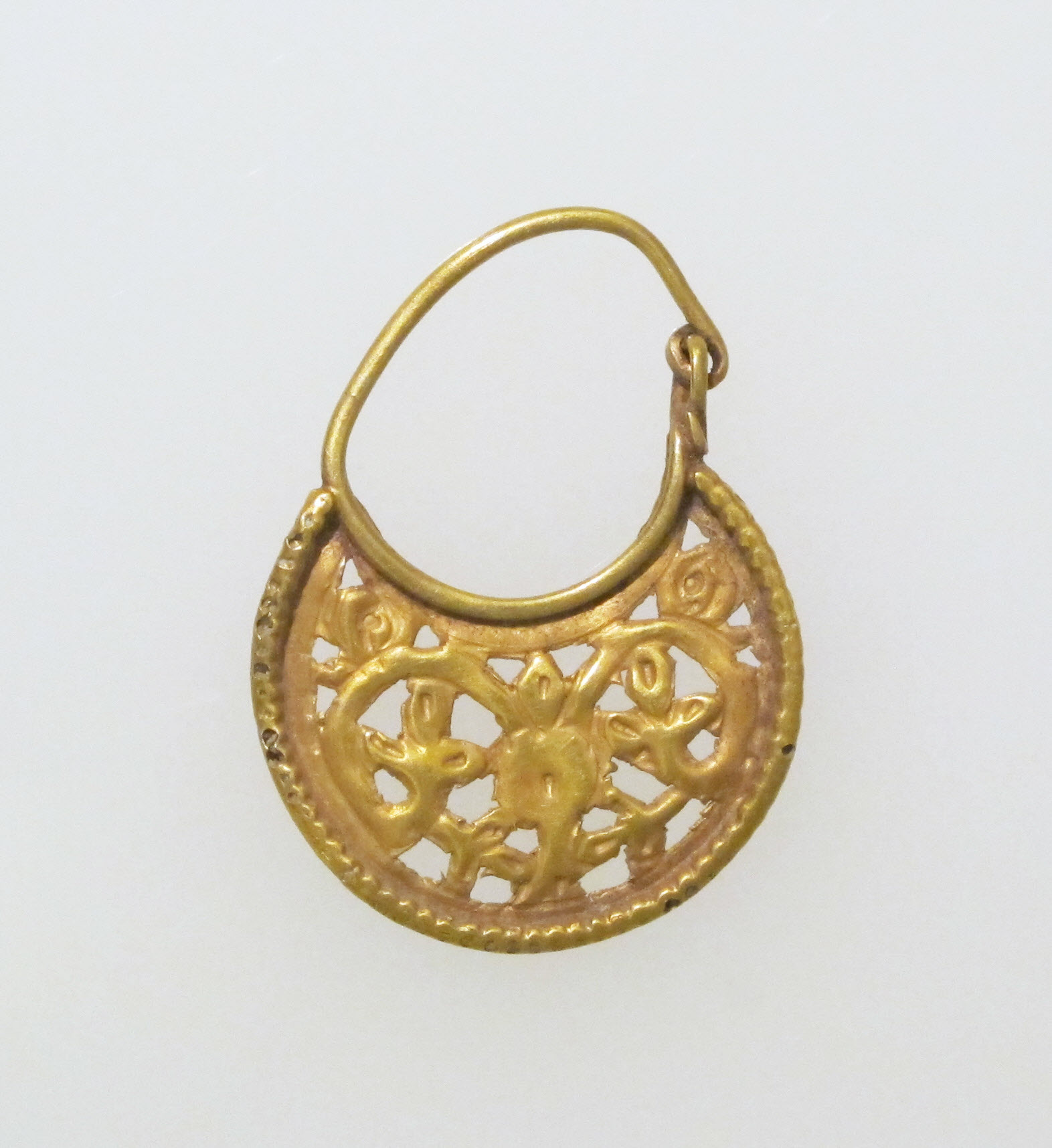
Heritage Analysis: The Byzantine Gold Lunate Earring and Its Resonance for Katherine Fashion Lab
The Byzantine gold lunate earring, adorned with intricate scrolls, is not merely an artifact of ancient metallurgy; it is a distilled manifesto of imperial power, celestial devotion, and the enduring human desire to frame the visage within a narrative of divine order. For Katherine Fashion Lab, this object serves as a critical DNA strand, linking our contemporary explorations—particularly the dialectic between the mirrored surface and the carved narrative—to a lineage of adornment that transcends mere decoration. This analysis deconstructs the earring’s symbolic power, its role in historical adornment, its spiritual architecture, and translates these findings into a decisive 2026 high-end luxury strategy.
I. Symbolic Power: The Lunar Crescent as Imperial Cosmogram
The lunate, or crescent, form is the earring’s foundational grammar. In the Byzantine context, this shape was not a passive ornament but an active cosmogram. It referenced the lunar cycle, which governed agricultural, liturgical, and fiscal calendars. More critically, the crescent was a talisman of protection, warding off the evil eye—a pervasive anxiety in the late antique world. The scrolls, rendered in delicate gold filigree or repoussé, amplify this protective function. They are not random flourishes; they are stylized acanthus and vine motifs, symbols of eternal regeneration and the incorruptibility of paradise. When worn, the crescent framed the wearer’s face, effectively creating a sacred halo that declared the individual’s alignment with cosmic order and imperial stability.
This symbolic layering is crucial for our brand. The earring’s power lies in its simultaneous opacity and clarity. To an initiate, it spoke of astrological and Christian syncretism; to a foreign envoy, it signaled unassailable Byzantine wealth and technical virtuosity. For Katherine Fashion Lab, this teaches us that true luxury is encoded complexity. Our 2026 pieces must not be immediately legible. They must demand a second glance, a closer inspection, to reveal their narrative depth—just as the lunate earring rewards the careful observer with its scrollwork’s theological density.
II. Historical Adornment: The Body as a Chassis for Light
Byzantine adornment was governed by a principle of hieratic radiance. Gold was not chosen for its monetary value alone; it was chosen for its optical properties. Under the flickering candlelight of a basilica or the harsh sun of the Hippodrome, gold’s reflective surface created a kinetic interplay of light and shadow. The lunate earring, suspended from the lobe, was engineered to move with the head’s tilt, catching light at oblique angles. The scrolls, with their undulating grooves, acted as light traps, creating micro-contrasts that made the gold appear to be in constant, slow combustion.
This historical function—the body as a chassis for light—is a direct antecedent to our Mirror with Split-Leaf study. The mirror’s polished silver face and the sarcophagus’s carved relief represent two modes of light interaction: specular reflection (the mirror) and diffuse shadow-casting (the relief). The Byzantine earring masterfully combines both. The smooth crescent exterior offers specular brilliance, while the interior scrolls produce a shadow-play that gives the piece volumetric depth. Our 2026 strategy must therefore treat the wearer’s body as an architectural site. We will design pieces that possess a dual-surface ontology: one surface for immediate, blinding reflection; the opposing surface for intimate, shadowed narrative. This is not a stylistic choice but a material philosophy inherited from the Byzantine goldsmith.
III. Spiritual Meaning: The Earring as a Prayer in Metal
Beyond protection and status, the lunate earring functioned as a material prayer. In a culture saturated with Orthodox theology, where the divine was believed to be accessible through sensory experience, jewelry was a conduit for the sacred. The scrolls, often terminating in tiny crosses or chi-rho monograms, were whispered invocations. The act of putting on the earring was a ritual of preparation—a preparation to enter a space of worship, to meet a political superior, or to face the public gaze. The weight of the gold was a somatic reminder of one’s duty to God and Empire.
This spiritual dimension is the most challenging to translate into modern luxury, yet it is the most potent. Contemporary high-end consumers are not seeking religious objects, but they are profoundly seeking ritual objects. They crave artifacts that slow time, that demand a ceremonial act of dressing. The Byzantine earring’s spiritual meaning was its ability to sanctify the mundane. For Katherine Fashion Lab, this translates into a 2026 collection that positions each piece as a talisman for the contemporary condition. The scrolls, in our reinterpretation, will not be Christian symbols but will be abstracted patterns representing personal growth, resilience, and the cyclical nature of human experience. The spiritual meaning is not doctrinal but existential. The wearer is not praying to a deity but affirming their own presence in a chaotic world—a quiet, powerful act of self-sanctification.
IV. 2026 High-End Luxury Strategy: The "Lunate Protocol"
Drawing from the Byzantine model, Katherine Fashion Lab will launch the "Lunate Protocol" in 2026, a strategic initiative that redefines high-end jewelry as an intellectual and spiritual asset class. This protocol rests on three pillars.
Pillar One: The "Cosmogram" Limited Edition
We will produce a series of 100 lunate earrings, each hand-finished in 24-karat gold, with internal scrollwork that references the Mirror with Split-Leaf study. The mirror’s polished face will be represented by the earring’s outer crescent; the sarcophagus’s relief will be the inner scrolls. Each piece will be accompanied by a certificate of axial resonance, documenting the specific light-capture angles and the shadow-cast pattern unique to that individual piece. This is not a product; it is a collectible artifact with a unique optical fingerprint.
Pillar Two: The "Ritual of Adornment" Experience
Leveraging the spiritual dimension, our flagship boutiques will introduce a private Adornment Atelier. Clients will participate in a 30-minute guided session—a deliberate, meditative process of donning the earring, paired with a soundscape of Byzantine chant reimagined for modern frequencies. This transforms the purchase from a transaction into a rite of passage. The earring becomes a marker of a personal covenant between the wearer and their own narrative, echoing the object’s historical role as a spiritual conduit.
Pillar Three: The "Dual-Surface" Marketing Narrative
Our 2026 campaign will abandon the glossy, single-image aesthetic. Instead, we will use diptych imagery, showcasing each earring in two states: one image in harsh, direct light (the specular mirror), and one in low, raking light (the shadowed relief). This visual strategy educates the consumer on the object’s complexity, positioning Katherine Fashion Lab as the only house that understands the dialectical nature of adornment—that true luxury is the mastery of both reflection and depth.
Conclusion: From Artifact to Archetype
The Byzantine gold lunate earring is not a relic to be copied but a blueprint to be decoded. Its power resides in its synthesis of astronomical symbolism, material brilliance, and spiritual function. By adopting the "Lunate Protocol," Katherine Fashion Lab will not merely sell jewelry; we will offer portable cosmologies for the discerning individual. In a market saturated with the ephemeral, we will provide the permanent. In a culture of noise, we will offer the quiet power of a golden whisper. This is the heritage we claim, and the future we will forge.