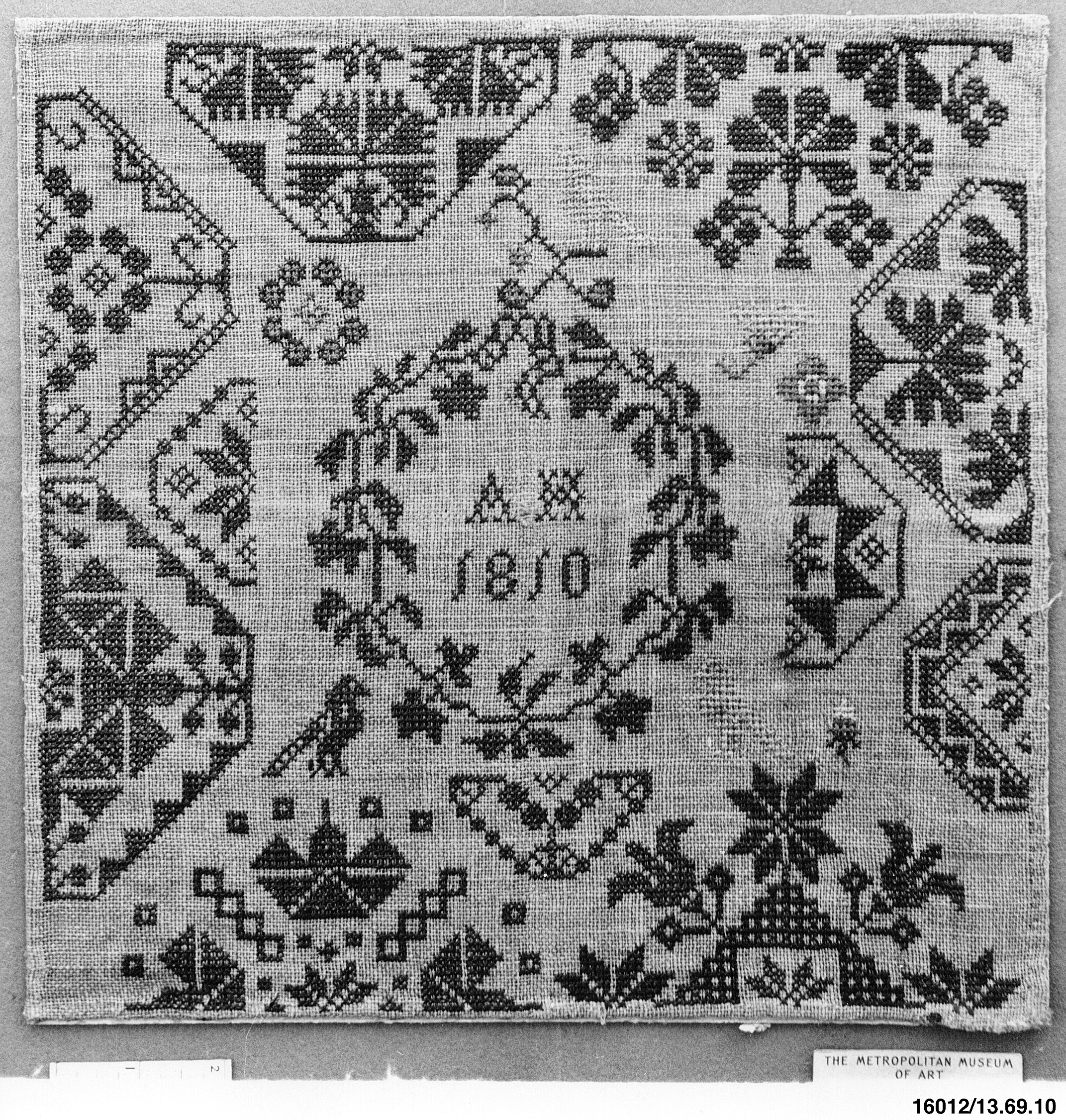
The Embroidered Sampler: A Cartography of Feminine Discipline and Artistic Agency
Within the hallowed archives of textile history, the embroidered sampler occupies a uniquely paradoxical position. It is at once a pedagogical tool of rigid domesticity and a deeply personal canvas of nascent artistic expression. The piece under current examination—a silk-on-linen sampler of American or English origin, created as a standalone study—transcends its utilitarian beginnings to emerge as a sophisticated artifact. For Katherine Fashion Lab, this object is not merely a relic of stitched letters and geometric motifs; it is a foundational text that decodes the visual language of a bygone era, revealing the intricate negotiation between societal expectation and individual creativity.
Materiality and the Grammar of Stitch
The physical composition of this sampler demands immediate scholarly attention. The ground is a finely woven linen, its natural ecru tone providing a luminous counterpoint to the lustrous silk threads that traverse its surface. The choice of silk is itself significant. In the 18th and early 19th centuries, silk thread was a premium commodity, reserved for garments of status and, notably, for the most accomplished needlework. Its use here signals that this sampler was not the crude exercise of a novice, but rather the work of a student of considerable means, or one attending a school that prioritized refined execution. The silk’s inherent sheen catches ambient light, creating a subtle three-dimensionality that a flax or wool thread could never achieve. This is a study in light manipulation, a precursor to the haute couture techniques of beading and sequin application that Katherine Fashion Lab champions today.
Technically, the stitches employed—cross-stitch, satin stitch, and stem stitch—are executed with a precision that borders on the mechanical. Yet, within this rigorous framework, the needleworker’s hand asserts its presence. The tension of the thread, the infinitesimal variations in stitch length, and the slight asymmetries in the alphabets are not flaws; they are evidence of a human pulse. They transform the sampler from a mere reproduction of a pattern into a unique, hand-wrought document. The discipline required to maintain such consistency across hundreds of individual stitches is a form of somatic training, a physical memorization of order that was believed to instill moral virtue in the young maker.
Decoding the Iconography: Order, Piety, and the Natural World
The iconographic program of this standalone study is a rich tapestry of cultural signifiers. The ubiquitous alphabet and numerals, rendered in a bold, unadorned cross-stitch, occupy the upper register. These are not merely letters; they are the foundational tools of literacy and numeracy, skills deemed essential for managing a household and engaging in commerce. Below these, a band of stylized floral motifs—perhaps a carnation or a rose—unfurls in a rhythmic repetition. This is where the sampler’s voice becomes more complex. The flowers are not botanically accurate; they are idealized, symmetrical fantasies of nature. This deliberate stylization speaks to a worldview in which nature is meant to be ordered, tamed, and re-presented through the lens of human craft.
In many samplers, a religious verse or a moral maxim anchors the composition. In this standalone study, the absence of overt religious text is notable. Instead, the focus is purely on the mastery of technique and the harmonious arrangement of form. This suggests a shift in educational priorities, moving from purely devotional instruction toward a more secular appreciation of aesthetic accomplishment. The standalone nature of the piece—not intended as part of a larger household linen set—reinforces this idea. It was created as an end in itself, a display of competence meant to be framed and shown, a testament to the maker’s refined upbringing and her family’s ability to provide such an education.
The Sampler as a Precursor to Couture Construction
From the perspective of a modern fashion laboratory, the sampler is a masterclass in compositional architecture. The careful division of the linen ground into distinct bands—the alphabet, the numerals, the floral border—mirrors the structural segmentation of a couture garment. Each section is a separate pattern piece, designed to fit within a larger, coherent whole. The maker’s ability to plan the spacing, to calculate the count of threads to ensure symmetry, is a form of proto-pattern making. This is the same mathematical and spatial intelligence that a contemporary première d’atelier employs when draping a bias-cut gown or aligning a complex plaid.
Furthermore, the sampler’s emphasis on negative space is a lesson in restraint. The unworked linen between the motifs is not empty; it is an active component of the design, providing breathing room and highlighting the density of the embroidery. This principle of luxe et calme is central to Katherine Fashion Lab’s design philosophy. We understand that true opulence is not about maximalist embellishment, but about the judicious placement of detail against a backdrop of impeccable fabric. The sampler teaches us that the eye must be guided, not overwhelmed.
Agency Within Constraint: The Maker’s Quiet Rebellion
While the sampler is undeniably a product of a patriarchal system that sought to confine women to the domestic sphere, it is reductive to view it solely as an instrument of oppression. Within the strict parameters of the exercise, there is a profound space for agency. The selection of colors, the subtle deviations from the pattern, the choice of which motifs to emphasize—these are all acts of personal expression. The maker, likely a young woman between the ages of eight and twelve, was using this sanctioned medium to develop a private visual vocabulary. The sampler was her first opportunity to exercise taste, to make decisions about proportion and palette that would later inform her role as the arbiter of her household’s aesthetic.
This act of creation within constraint is a resonant theme for the contemporary designer. The fashion industry is a landscape of limitations—commercial pressures, seasonal deadlines, the physical properties of fabric. Yet, it is within these very limitations that innovation is born. The embroidered sampler is a testament to the fact that artistic freedom is not the absence of rules, but the mastery of them. It is a quiet, stitched rebellion that celebrates the intellect and the imagination of a hand often overlooked by history.
Conclusion: A Living Text for Modern Design
In conclusion, the embroidered sampler is far more than a historical curiosity. For Katherine Fashion Lab, it is a foundational text on the relationship between discipline and artistry. It demonstrates that the highest form of craft is achieved through rigorous training, that materiality matters profoundly, and that true elegance lies in the confident handling of structure and space. The silk threads, now slightly faded, still whisper their lessons of patience, precision, and quiet defiance. As we study its composition, we are reminded that every couture garment we create is, in its own way, a sampler—a standalone study of our skills, our values, and our unique vision, stitched into the fabric of our time. The needleworker’s hand, though anonymous, reaches across centuries to guide our own.