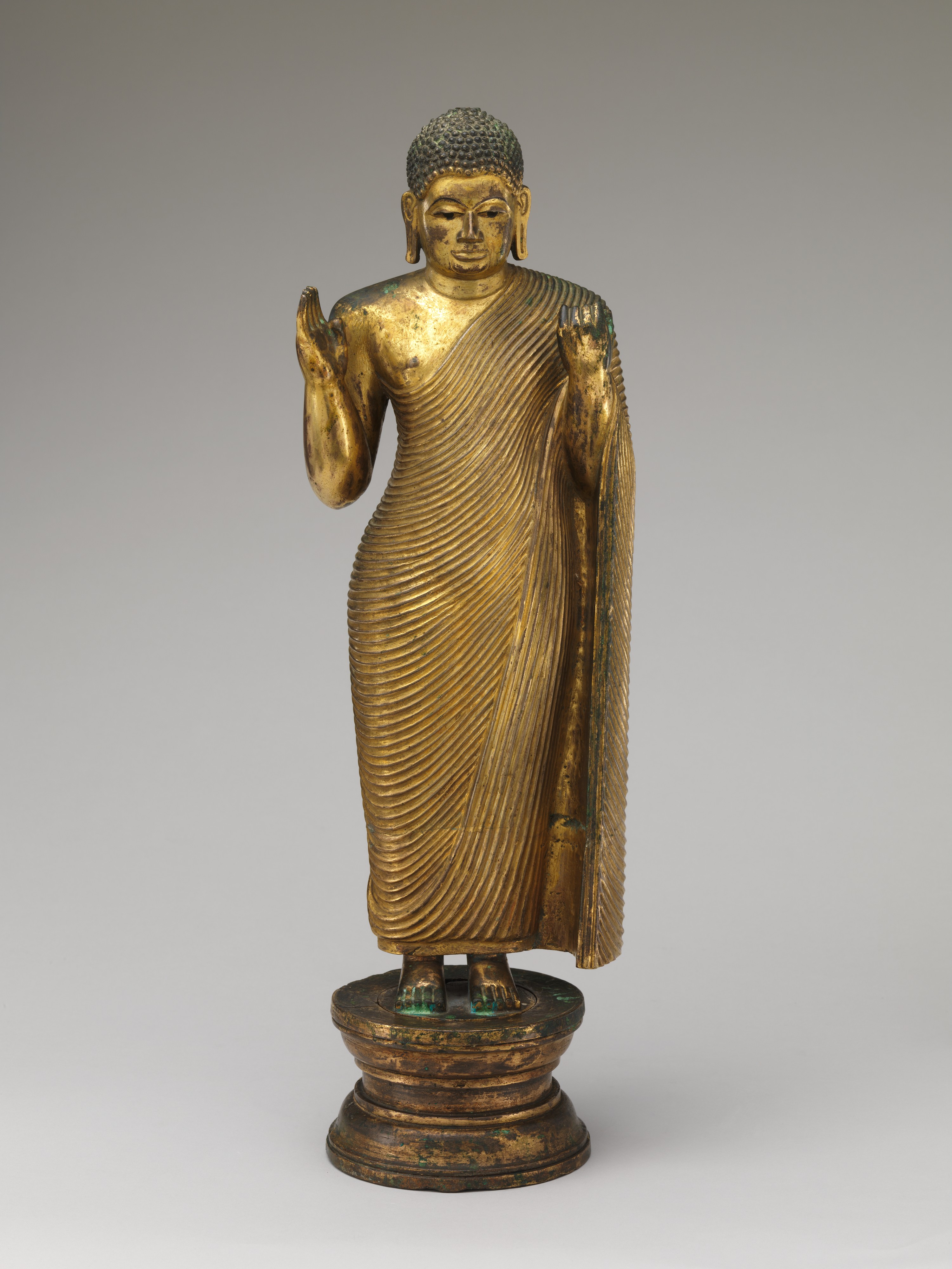
The Gilded Gesture: A Couture Analysis of the Buddha Offering Protection
Introduction: The Sartorial Silence of the Sacred
In the rarefied echelons of high fashion, where fabric drapes the human form to articulate identity, status, and aspiration, there exists a parallel universe of material culture that speaks a language far older and infinitely more profound. The Buddha Offering Protection, a copper alloy sculpture with gilding from the western regions of Sri Lanka, is not a garment in the conventional sense. Yet, to the discerning eye of the couture analyst, it is a masterclass in the principles that underpin all great design: proportion, texture, surface treatment, and the deliberate orchestration of light and shadow. This standalone study elevates the piece beyond its religious and historical significance, positioning it as a seminal artifact of aesthetic engineering—a silent, gilded couturier of the spirit.
The sculpture’s provenance—the western coastal and interior regions of Sri Lanka, circa the 18th to 19th centuries—places it within a vibrant period of artistic synthesis. This era witnessed a confluence of indigenous Sinhalese traditions, South Indian Dravidian influences, and the lingering visual lexicon of Portuguese, Dutch, and later British colonial presence. The result is a distinctive artistic vernacular, one that is at once deeply rooted in Theravada Buddhist orthodoxy and remarkably receptive to external stylistic currents. For the fashion scholar, this piece is not merely a devotional object; it is a material document of cultural negotiation, a testament to how a society’s aesthetic identity is forged through the delicate interplay of tradition and external inspiration.
Deconstructing the Silhouette: A Study in Proportion and Flow
The first and most arresting element of the Buddha Offering Protection is its silhouette. In couture, the silhouette is the foundational gesture—the initial stroke that defines the entire composition. Here, the figure is rendered in a state of serene, yet dynamic, equilibrium. The posture, known as Abhaya Mudra, features the right hand raised to shoulder height, palm facing outward, fingers gracefully extended. This gesture, signifying fearlessness and reassurance, creates a powerful diagonal line that cuts across the vertical axis of the body. It is a moment of pure visual tension, a frozen gesture that suggests both authority and benevolence.
Contrast this with the flowing, almost liquid, rendering of the monastic robes (sanghati). The fabric is not depicted as a series of stiff, separate folds but rather as a continuous, undulating mass that clings to the body with a wet-drapery effect. This is a hallmark of high sculptural achievement, echoing the classical Greco-Roman tradition that influenced Gandharan art, which in turn percolated through the Buddhist world. The robe’s lines are long, sweeping, and uninterrupted, creating a visual rhythm that draws the eye downward to the lotus base. This base, with its layered petals, functions as the ultimate grounding element, a structural anchor that balances the upward, aspirational energy of the raised hand.
From a couture perspective, the robe is a masterclass in negative space. It conceals the body’s anatomical details while simultaneously revealing its essential form. The absence of defined musculature is not a lack of skill but a deliberate choice—a shift from the corporeal to the spiritual. The body becomes a mere suggestion beneath the drapery, a ghost-like presence that prioritizes the ethereal over the earthly. This is the antithesis of the Western couture tradition, which often celebrates the human form through strategic tailoring and revealing cuts. Here, the fabric is not a vehicle for the body; the body is a vehicle for the fabric’s spiritual message.
Materiality and Surface: The Alchemy of Gilded Copper
The choice of materials is where the couture analogy becomes most potent. Copper alloy is a robust, workable metal, yet it is also inherently susceptible to oxidation and environmental degradation. The artist’s decision to gild the surface—to apply a thin layer of gold—transforms this base material into a luminous, imperishable icon. This is the ultimate act of haute couture embellishment. Just as a designer might overlay a simple silk base with intricate beadwork or metallic thread, the Sri Lankan artisan has elevated the humble copper core with a precious metal skin.
The gilding is not uniform; it has aged, worn, and pooled in the crevices of the drapery, creating a natural patina that is the sculptural equivalent of a beautifully distressed leather or a meticulously faded denim. In high fashion, this is known as the "lived-in" aesthetic, a quality that imbues a garment with history and character. The highlights on the raised hand, the chin, and the forehead have been burnished to a high sheen, catching the light to create focal points of intense brilliance. In contrast, the recessed folds of the robe retain a deeper, richer tone, creating a chiaroscuro effect that adds immense depth and three-dimensionality.
This interplay of light and dark is not accidental. It is a sophisticated manipulation of surface to control the viewer's gaze. The eye is drawn to the illuminated face and hand, the very sources of the Buddha’s spiritual power, while the darker, more subdued drapery recedes, providing a restful, contemplative backdrop. In the language of couture, this is the principle of emphasis—using texture and finish to dictate the hierarchy of visual information. The gilding does not merely decorate; it narrates, highlighting the divine attributes of protection and wisdom while subordinating the physical form.
Ornamentation as Identity: The Embellishment of the Divine
While the Buddha’s robes are austere, the figure is not devoid of ornament. The cranial protuberance (ushnisha) and the cranial curl (siraspata) are rendered with meticulous precision, their spiral forms a subtle yet powerful textural counterpoint to the smooth expanses of the face and robe. The elongated earlobes, a remnant of the Bodhisattva’s princely past when he wore heavy jewelry, are depicted as elegant, empty loops. This is a profound sartorial statement: the deliberate absence of adornment signifies the renunciation of material wealth. The empty earrings are a powerful symbol of detachment, a silent critique of the very opulence that the gilding represents.
This paradox is the heart of the piece’s couture relevance. It is a study in luxury and asceticism. The material is precious, the craftsmanship is impeccable, and the overall effect is one of regal splendor. Yet, the iconography is one of humility, renunciation, and inner peace. This tension is a recurring theme in the most compelling fashion. Think of a minimalist Issey Miyake garment that costs a fortune yet appears deceptively simple, or a Rick Owens silhouette that is both monastic and aggressively avant-garde. The Buddha Offering Protection achieves this same duality with a quiet, unassailable confidence. It demonstrates that true luxury is not about excess but about the perfect, purposeful execution of a singular vision.
Conclusion: A Timeless Lesson in Draped Authority
As a standalone study, the Buddha Offering Protection transcends its devotional context to offer a profound lesson in the principles of design. It is a testament to the power of drapery as a form of communication, capable of conveying complex ideas about power, spirituality, and human vulnerability. The sculpture’s silhouette teaches us about the balance between dynamic action and contemplative stillness. Its materiality demonstrates the transformative power of surface treatment, where a humble alloy becomes a vessel for the divine. And its ornamentation reveals the sophisticated use of absence as a statement of intent.
For the contemporary fashion designer, this piece is a timeless reference point. It challenges the notion that innovation is solely about novelty, reminding us that the most enduring forms of expression are often rooted in ancient, universal principles. The gilded Buddha is not a relic of the past but a living source of inspiration, a masterwork that speaks directly to the modern obsession with identity, materiality, and the art of the draped form. In its silent, golden gesture of protection, it offers not just spiritual solace, but a profound and enduring aesthetic truth.