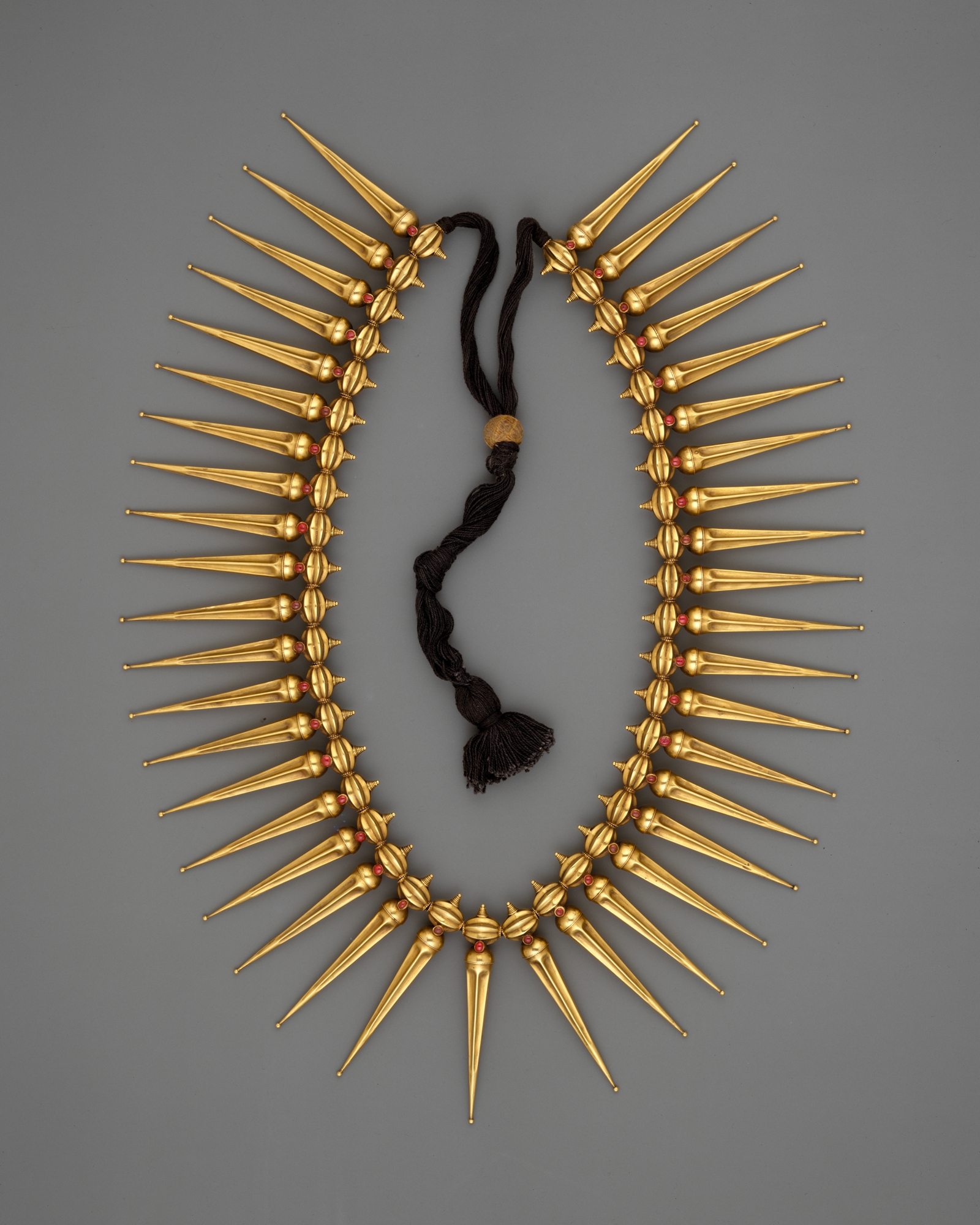
Executive Heritage Brief: The Jasmine Bud Necklace (Malligai Arumbu Malai)
Katherine Fashion Lab presents this strategic standalone research on the Malligai Arumbu Malai—the Jasmine Bud Necklace—as a masterclass in translating regional craft into global luxury vernacular. Originating from the temple towns and royal courts of Tamil Nadu and Kerala, this ornament is not merely a jewel; it is a coded artifact of femininity, devotion, and dynastic prestige. For the 2026 luxury landscape, where the consumer seeks narrative depth over ostentatious volume, this necklace offers a profound opportunity. This analysis deconstructs its symbolic power, historical adornment, spiritual resonance, and proposes a high-end strategy that positions the piece as an heirloom of the future.
Symbolic Power: The Bud as a Metaphor for Restrained Potential
The defining feature of the Malligai Arumbu Malai is its representation of the unopened jasmine bud, known locally as arumbu. Unlike the fully bloomed flower, which signifies completion and overt sensuality, the bud embodies anticipation, purity, and disciplined elegance. In classical Tamil poetics, particularly the Sangam literature, the jasmine bud is a recurring motif for a young woman's nascent beauty and inner strength—a power that is potent precisely because it is not yet fully revealed. This is a critical distinction for luxury positioning: the necklace does not shout; it whispers. It communicates a quiet confidence, a wealth of character that does not require external validation. The choice of gold and rubies further amplifies this symbolism. The gold represents the immutable, the divine and the eternal, while the ruby—the stone of passion and vitality—is nestled within the bud, suggesting that fierce energy is contained and controlled. This duality of contained fire and luminous calm is the necklace's primary symbolic asset, offering a sophisticated counter-narrative to the loud maximalism often seen in contemporary high jewelry.
Historical Adornment: From Temple Ritual to Royal Prerogative
Historically, the Malligai Arumbu Malai occupied a dual role: sacred and secular. In the temple traditions of Madurai and Thiruvananthapuram, jasmine was considered the favorite flower of the deities, and gold replicas were created as permanent, non-wilting offerings. Adorning the deity with a gold jasmine bud necklace was an act of bhakti (devotion), and the practice gradually extended to the royal women and the devadasis (temple dancers) who were considered the custodians of this sacred aesthetics. For the Nayak and Chera dynasties, wearing this necklace was a declaration of divine right and cultural patronage. The intricate craftsmanship—each bud meticulously formed with tiny gold granules and set with a single ruby—was a testament to the sthapathi (master sculptor) tradition of the region. The black thread, known as karu mani, is not an afterthought; it is a deliberate aesthetic and symbolic choice. Black is believed to absorb negative energy and ward off the evil eye, a protective element that grounds the opulence of gold. This combination of sacred geometry, protective talisman, and royal adornment gives the piece a layered provenance that is rare in global jewelry heritage.
Spiritual Meaning: The Chakra of Patience and Devotion
Beyond its physical beauty, the Malligai Arumbu Malai is a spiritual tool. In Ayurvedic and Yogic traditions, jasmine is associated with the Anahata (Heart) Chakra, governing love, compassion, and emotional balance. The bud form is particularly potent; it symbolizes the state of Samskara—the latent impressions that shape one's destiny—suggesting that the wearer is in a state of becoming, of spiritual evolution. The act of wearing the necklace close to the chest is thus an act of aligning one's energy with the heart's purest intentions. The ruby, associated with the Sun and the Manipura (Solar Plexus) Chakra, adds a layer of personal power and courage. Thus, the necklace becomes a wearable meditation, balancing the heart's compassion with the will's fortitude. For the modern luxury consumer, this spiritual dimension is increasingly valuable. They are not buying a product; they are acquiring a talisman for mindful leadership and emotional resilience. The narrative of the bud—patience before bloom—resonates deeply with a generation that values slow living, intentional growth, and the rejection of instant gratification.
2026 High-End Luxury Strategy: The 'Quiet Bloom' Collection
To leverage this heritage for 2026, Katherine Fashion Lab must position the Malligai Arumbu Malai not as a cultural relic, but as an avant-garde architectural statement. The strategy should pivot on three pillars: Artisanal Provenance, Scarcity via Ritual, and Modern Minimalist Styling.
Artisanal Provenance & The 'Atelier of Silence'
Launch a dedicated micro-collection, "The Arumbu Code," produced in a limited run of 50 pieces. Each necklace must be handcrafted by a single master artisan in a specific Chettinad atelier, with a certificate detailing the artisan's lineage and the hours spent (minimum 200 hours per piece). The marketing narrative must emphasize the slowness of creation—contrasting sharply with machine-made luxury. We will introduce a "Ritual of Gifting" box, which includes a hand-poured wax seal, a silk pouch dyed with natural madder root, and a QR code linking to a documentary film of the artisan's process. This transforms the purchase into a patronage act, not a transaction.
Scarcity via Customization: The 'Bud Initiation'
Offer a bespoke service where clients can commission a necklace with a specific number of buds (e.g., 27 for the lunar mansions, 108 for the sacred count in Hinduism). This "Bud Initiation" program allows the client to choose the ruby's origin (e.g., Burmese vs. Indian) and the exact gold karat, making each piece a unique expression of the wearer's spiritual and aesthetic identity. This moves the product from ready-to-wear to haute couture in the jewelry sphere, justifying a price point of $85,000–$150,000.
Modern Minimalist Styling: The 'Deconstructed Temple'
To attract the global high-end consumer, we must detach the necklace from heavy ethnic styling. The 2026 campaign should feature the Malligai Arumbu Malai worn against a stark white silk shirt, a black tailored blazer, or a simple cashmere turtleneck. The black thread allows this seamlessly, acting as a graphic line that draws the eye to the gold buds. We will partner with a contemporary fine-art photographer to capture the necklace in negative space, emphasizing its sculptural quality. The tagline, "Power in Patience," will anchor the collection, appealing to the executive woman who leads with quiet authority.
Conclusion: A Legacy Asset for the Conscious Collector
The Jasmine Bud Necklace is not a trend; it is a cultural equity asset. By honoring its Tamil and Keralite roots while recontextualizing it within a minimalist, spiritual luxury framework, Katherine Fashion Lab can offer a product that satisfies the 2026 consumer's deepest desires: authenticity, meaning, and enduring beauty. This is not merely jewelry; it is a wearable philosophy of restraint and inner radiance. The Malligai Arumbu Malai, in its gold and ruby form, is ready to bloom on the global stage—not as a flower of the past, but as a perennial icon of the future.