The Canine Motif in Silk: A Couture Analysis of a Japanese Textile Fragment
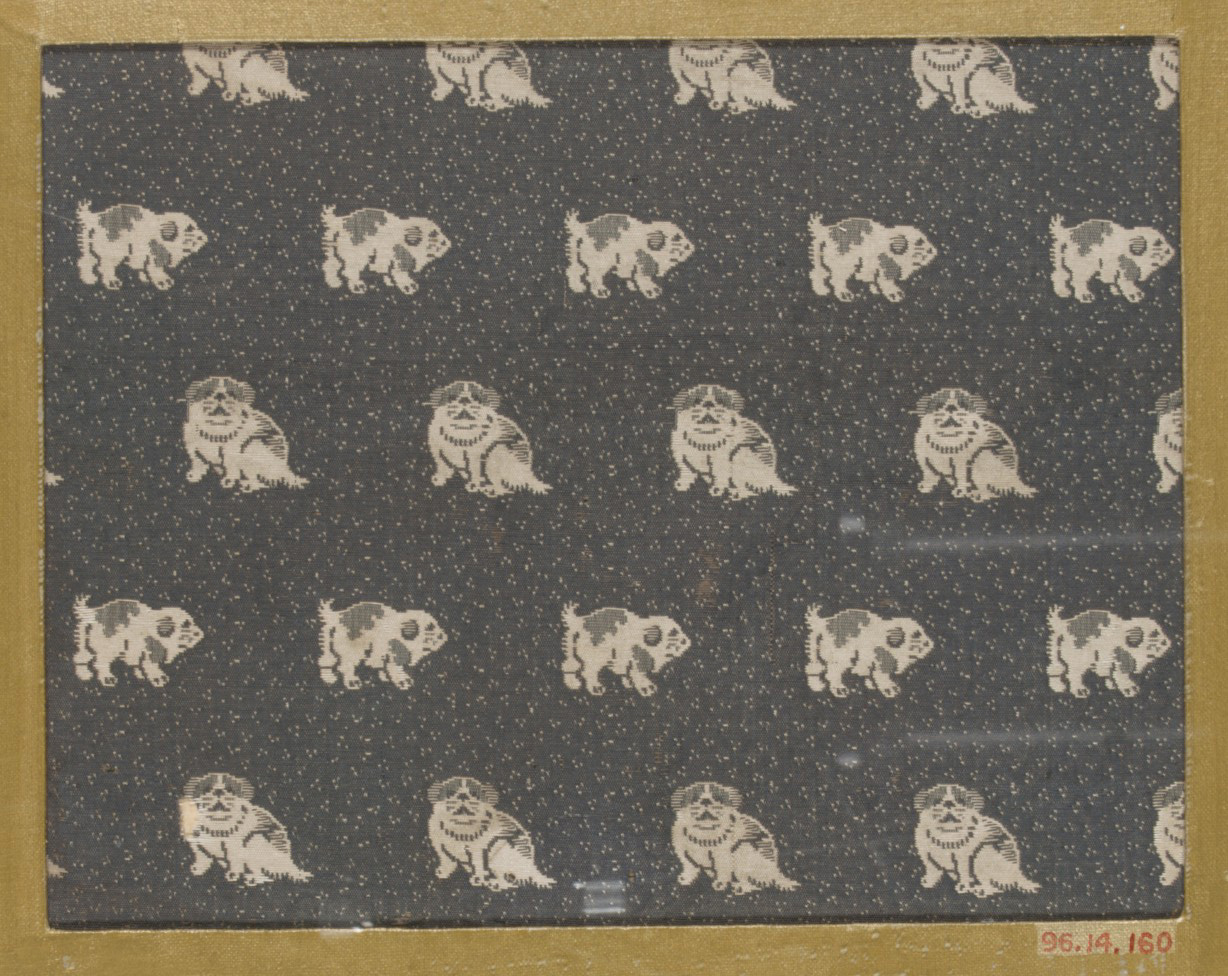
In the rarefied world of haute couture, where every thread is a narrative and every motif a cultural cipher, the study of historical textile fragments offers an unparalleled lens into the intersection of artistry, symbolism, and material mastery. Katherine Fashion Lab is privileged to present a standalone study of a singular Japanese silk fragment, distinguished by its repeating pattern of dogs rendered upon a meticulously dotted ground. This piece, while modest in its dimensions, is monumental in its semiotic and technical complexity. It is not merely a decorative swatch; it is a frozen moment of Edo-period sensibility, a testament to the sophisticated visual language that continues to inform contemporary luxury design. This analysis deconstructs the fragment’s iconography, its materiality, and its enduring relevance to the modern couture atelier.
Iconographic Decoding: The Dog as a Symbol of Fortune and Fidelity
The central motif—the dog—is a deceptively simple subject that belies a rich tapestry of meaning within Japanese visual culture. In the pre-modern Japanese lexicon, the dog (inu) was not merely a domestic animal but a potent talisman of protection, safe childbirth, and good fortune. The very word for "dog" in Japanese, inu, is phonetically linked to the verb inu (to drive away), suggesting a protective function against malevolent spirits. This fragment, therefore, is not a mere pastoral scene but an apotropaic charm woven into the very fabric of a garment, intended to safeguard its wearer from harm and attract prosperity. In the context of a kimono or an obi, such a pattern would have been a discreet yet powerful declaration of the wearer’s desires for a blessed life.
Beyond the talismanic, the dogs here are depicted in a state of dynamic repose—their postures are alert yet playful, suggesting a vitality that is both charming and controlled. This duality is a hallmark of Japanese aesthetic philosophy, where the natural world is rendered with a stylized precision that elevates it beyond mere representation. The repetition of the motif is not monotonous; rather, it creates a rhythmic cadence, a visual pulse that mirrors the cyclical nature of life and fortune. For the couture designer, this repetition offers a lesson in pattern engineering—how a single, well-executed motif can be scaled and manipulated to create a surface that is at once uniform and deeply engaging.
Technical Virtuosity: The Dotted Ground and the Art of Komon
The technical brilliance of this fragment lies not only in its primary subject but in its supporting ground. The "dotted ground" is a masterclass in k komon (small pattern) dyeing, a technique that reached its zenith during the Edo period (1603-1868). This method, often executed through a meticulous stencil-printing process using a fine mesh of silk or paper, allowed artisans to achieve an extraordinary level of detail. The dots are not random; they are uniformly spaced, creating a subtle texture that mimics the granularity of natural elements—perhaps the patter of rain, the grain of sand, or the speckled hide of the very animals depicted. This ground serves a dual purpose: it provides a visual foil that makes the larger dog motif pop with clarity, and it introduces a sophisticated level of tactile and visual depth that elevates the fabric from a simple print to a multi-dimensional surface.
From a couture perspective, this treatment of the ground is a profound lesson in restraint and contrast. In an era where maximalist embellishment often dominates, this fragment demonstrates that true luxury lies in the interplay between a bold motif and a meticulously considered negative space. The dotted ground is not an afterthought; it is a deliberate compositional choice that ensures the eye is drawn to the dogs without the overall pattern becoming chaotic. For the modern designer, this suggests an approach where the "background" is as important as the "foreground," a principle that can be translated into modern jacquards, embroidered tulle, or even digital prints for a contemporary clientele who values quiet opulence over loud display.
Materiality and the Language of Silk
The substrate of this fragment—silk—is intrinsic to its value and its message. Silk in Japan was not merely a fabric; it was a currency of status, a medium for artistic expression, and a symbol of national identity. The specific weight and weave of this fragment suggest a fabric intended for a high-ranking member of the samurai class or the wealthy merchant elite. The silk’s natural luster interacts with the indigo and other muted dyes used in the pattern, creating a play of light that shifts with the viewer’s angle. In a candlelit interior or under the dappled light of a garden, the dogs would appear to move, the dots to shimmer—a kinetic quality that no digital reproduction can fully capture.
The choice of silk also speaks to the durability of the message. Unlike cotton or hemp, silk was reserved for the most significant garments—those worn for ceremonies, festivals, and rites of passage. A pattern of protective dogs on such a material would have been deemed appropriate for a bride’s trousseau or a warrior’s formal attire, ensuring that the wearer was enveloped in both physical luxury and spiritual protection. For Katherine Fashion Lab, this reinforces the principle that material selection is a form of storytelling. A modern couture piece that seeks to evoke this fragment’s essence must consider not just the print, but the weight, drape, and hand of the fabric. A silk organza or a duchesse satin would each tell a different version of the same story, and the designer must choose wisely to honor the original’s intent.
From Fragment to Future: Implications for Contemporary Couture
The relevance of this fragment to the contemporary fashion landscape is profound. In an industry increasingly driven by fast-paced trend cycles, this piece offers a counter-narrative of permanence and intentionality. Its repeating pattern is a precursor to the modern concept of the "signature print," a brand’s visual shorthand that is instantly recognizable. The dog motif, with its blend of charm and symbolism, can be reimagined for a modern audience—perhaps scaled up for a dramatic evening coat, or deconstructed into a subtle embroidery on a tailored blazer. The dotted ground, too, offers a rich source of inspiration for textural effects, from micro-pleating to beaded surfaces that mimic the original’s granular depth.
Moreover, this fragment challenges the modern designer to think beyond the surface. It asks us to consider the provenance of our materials, the cultural significance of our motifs, and the ethical implications of our choices. To appropriate the dog motif without understanding its talismanic roots would be a disservice; to use it as a starting point for a dialogue about protection, loyalty, and the beauty of the natural world is to engage in the highest form of couture—one that respects the past while innovating for the future. The fragment is not a relic to be copied but a mentor to be studied. Its lessons in pattern rhythm, material integrity, and symbolic depth are timeless, and they remain as instructive today as they were two centuries ago.
In conclusion, this Japanese silk fragment is a masterpiece of micro-design, a compact universe where technical skill, cultural belief, and aesthetic beauty converge. For Katherine Fashion Lab, it serves as a benchmark for what couture can achieve when it is grounded in history and driven by a deep understanding of material and meaning. The dogs on the dotted ground are not just a pattern; they are a promise of protection, a whisper of fortune, and a testament to the enduring power of a well-crafted textile. As we continue to push the boundaries of modern fashion, we do so with this fragment as a guiding star—a reminder that true luxury is never loud, but always profound.