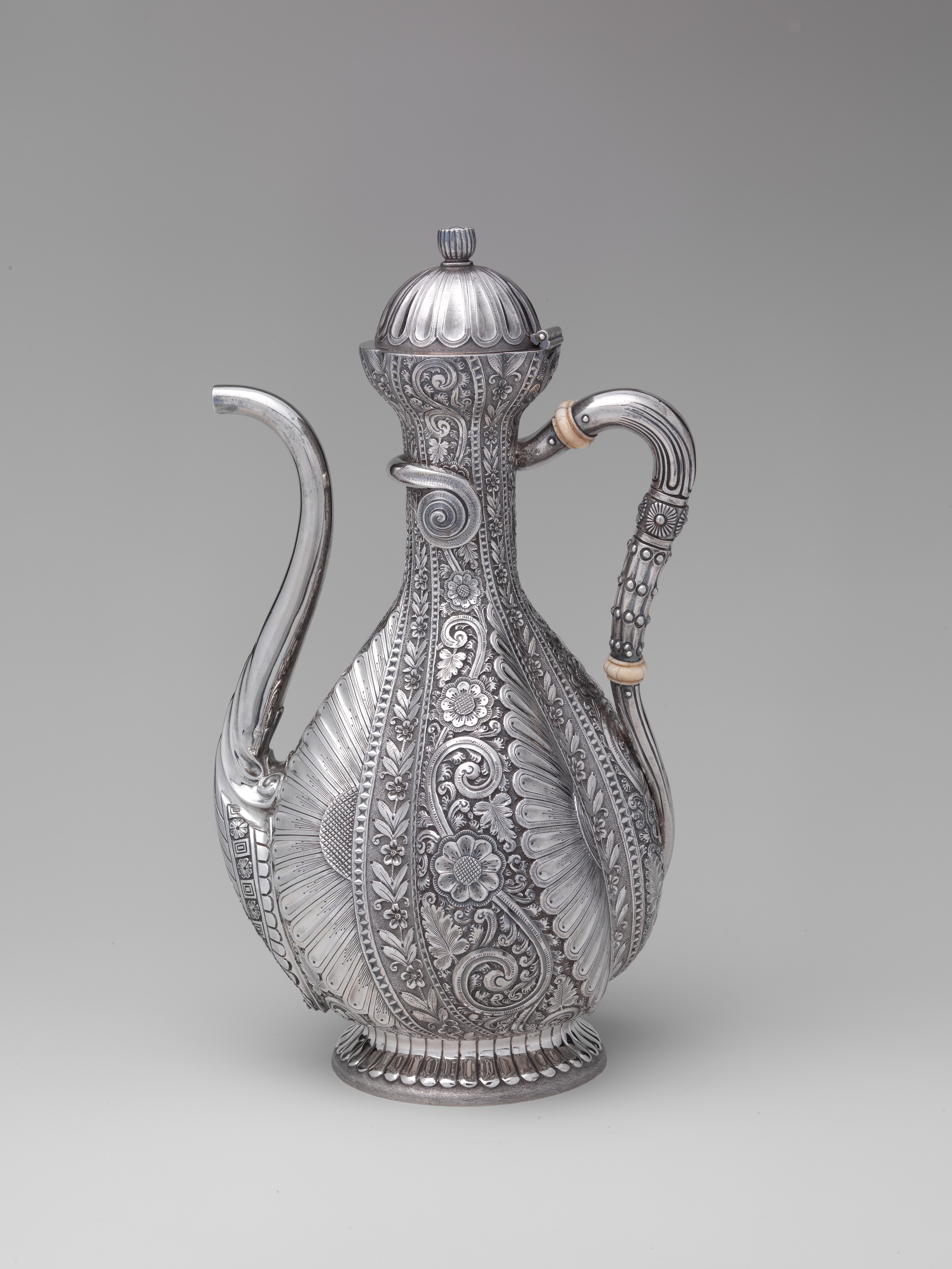
Heritage Analysis: The American Silver Coffeepot as a Symbol of Domestic Sovereignty and Luxury Lineage
In the canon of American decorative arts, the silver coffeepot occupies a singular position—neither purely utilitarian nor wholly ornamental, but a hybrid artifact that encodes the nation’s evolving relationship with hospitality, commerce, and self-fashioning. For Katherine Fashion Lab, this object offers a compelling strategic lens through which to examine how domestic rituals become repositories of symbolic power. This analysis examines the coffeepot’s historical adornment, spiritual undertones, and its translation into a 2026 high-end luxury strategy, drawing parallels between the object’s material language and the contemporary codes of prestige consumption.
Symbolic Power: The Coffeepot as a Throne of the Domestic Realm
The American silver coffeepot, particularly those crafted between 1750 and 1850, was not merely a vessel for caffeine. It was a declaration of economic agency and social standing. In a nation lacking hereditary aristocracy, silver objects functioned as portable proof of civic virtue and mercantile success. The coffeepot, specifically, became the centerpiece of the morning ritual—a moment when the household, not the state, asserted its authority. Its raised form, often standing over a foot tall, commanded the table, transforming a simple meal into a ceremony of order and abundance.
Symbolically, the coffeepot’s handle—frequently crafted from insulating ivory—represents a deliberate negotiation between heat and control. The silver body conducts heat aggressively, while the ivory grip offers a cool, tactile reprieve. This duality mirrors the American ethos: the capacity to harness raw energy (commerce, ambition, industry) while maintaining the poise of refinement. For Katherine Fashion Lab, this translates into a luxury narrative where power is not overtly displayed but is instead embedded in the tension between material intensity and controlled restraint. A 2026 collection can draw on this by emphasizing pieces that juxtapose high-conductivity textures (sleek metallic finishes) with warm, organic accents (bone, wood, or ivory alternatives), signaling mastery over extremes.
Historical Adornment: The Grammar of Ornament and Lineage
Examining the coffeepot’s decorative vocabulary reveals a distinct American interpretation of European baroque and rococo forms. Unlike the heavily gilded French écuelle or the ornate English tea urn, American silver coffeepots often favored cleaner lines, subtle fluting, and restrained engraving—monograms, crests, or simple geometric bands. This aesthetic choice was not a lack of sophistication but a deliberate assertion of republican simplicity. The adornment was communicative, not decorative. A monogram was a signature of lineage, but an American lineage rooted in achievement rather than birthright.
The ivory finial atop the lid, often carved into a simple ball or acorn shape, served as a tactile and visual anchor. In historical context, ivory signified exotic reach—access to global trade networks—yet its use was understated, never ostentatious. This paradox is instructive for luxury branding. In 2026, the high-end consumer is increasingly fatigued by logo-heavy ostentation. The coffeepot’s grammar suggests a shift toward semantic adornment: pieces that carry meaning through material provenance and subtle, almost hidden, detailing. Katherine Fashion Lab can adopt this by offering limited-edition accessories with concealed interior engravings, or by using ethically sourced, fossilized ivory alternatives (tagua nut, bone) as a nod to heritage without ethical compromise. The adornment becomes a conversation starter, not a shout.
Spiritual Meaning: The Ritual of Communion and the Hearth’s Sacred Flame
Beyond its social function, the coffeepot holds a quasi-spiritual dimension. In early American households, the act of brewing and serving coffee was often framed as a secular communion—a shared moment of warmth and clarity that forged familial bonds. The silver vessel, kept polished and gleaming, was not unlike a liturgical object. Its reflective surface was believed to ward off negative energy, a folk belief carried from European silversmithing traditions. The pouring spout, angled precisely, was seen as a channel for life-giving liquid, akin to a libation.
This spiritual resonance is not incidental. It speaks to a human need for ritualized consumption, a need that luxury markets have long exploited but rarely articulated with depth. For Katherine Fashion Lab’s 2026 strategy, the coffeepot suggests a pivot toward ritual-centric product lines. Instead of standalone garments or accessories, the brand could curate “ceremonial sets”—a tailored morning coat paired with a silver-and-ivory-inspired brooch, or a silk scarf whose pattern replicates the coffeepot’s fluting. The marketing narrative would not sell a product but a moment of intentionality. The brand becomes a modern-day silversmith, crafting tools for personal ceremony in an age of distraction. This aligns with the growing “slow luxury” movement, where consumers seek objects that anchor them to time-honored practices.
2026 High-End Luxury Strategy: From Artifact to Archetype
Translating the coffeepot’s heritage into a 2026 luxury strategy requires a tripartite approach: material storytelling, experiential retail, and scarcity through provenance.
Material Storytelling: The New Silver Age
Contemporary luxury consumers are not buying products; they are investing in narratives of endurance. The coffeepot’s silver—a metal that tarnishes yet can be restored to brilliance—offers a powerful metaphor for resilience. Katherine Fashion Lab can introduce a “Patina Collection,” where each piece (whether a handbag clasp, a shoe buckle, or a jewelry line) is crafted from recycled sterling silver and finished with a matte, slightly oxidized surface that deepens with wear. The ivory accents are replaced with responsibly sourced bone or resin composites, maintaining the tactile warmth. The story is not of perfection but of transformation—an heirloom in the making.
Experiential Retail: The Coffeehouse as Showroom
To embody the coffeepot’s ritualistic spirit, the brand should launch pop-up “Heritage Coffeehouses” in flagship cities—New York, London, Tokyo—where the retail space doubles as a working café. Patrons are invited to handle replicas of historical coffeepots while viewing the collection. Baristas, trained as “ritual guides,” narrate the history of the vessel and its connection to the garments on display. This experiential approach transforms a purchase into a pilgrimage, aligning with the luxury sector’s shift from transactional to transformational commerce.
Scarcity Through Provenance: The Limited Pour
Finally, the coffeepot’s historical value was often predicated on its uniqueness—each piece was individually crafted and marked by the silversmith. Katherine Fashion Lab can adopt a “batch-and-number” system, where each collection is limited to a specific number of units, each with a certificate of authenticity that traces its design lineage back to a specific historical coffeepot (e.g., “Inspired by the 1820 Boston Revere-style pot”). This creates a secondary market narrative, positioning the brand’s pieces as collectible assets rather than disposable fashion.
Conclusion: The Pour as a Promise
The American silver coffeepot is far more than a relic of domestic history. It is a masterclass in symbolic economy—how an object can hold power, beauty, and spirit within a single, functional form. For Katherine Fashion Lab, this heritage analysis offers a clear directive: luxury in 2026 must not merely adorn the body but elevate the ritual of daily life. By channeling the coffeepot’s duality of silver and ivory, its balance of heat and control, and its sacred role in communal gathering, the brand can craft a strategy that is both historically literate and commercially forward. The pour is the promise—a promise of warmth, of lineage, and of an enduring, polished presence in an increasingly disposable world.