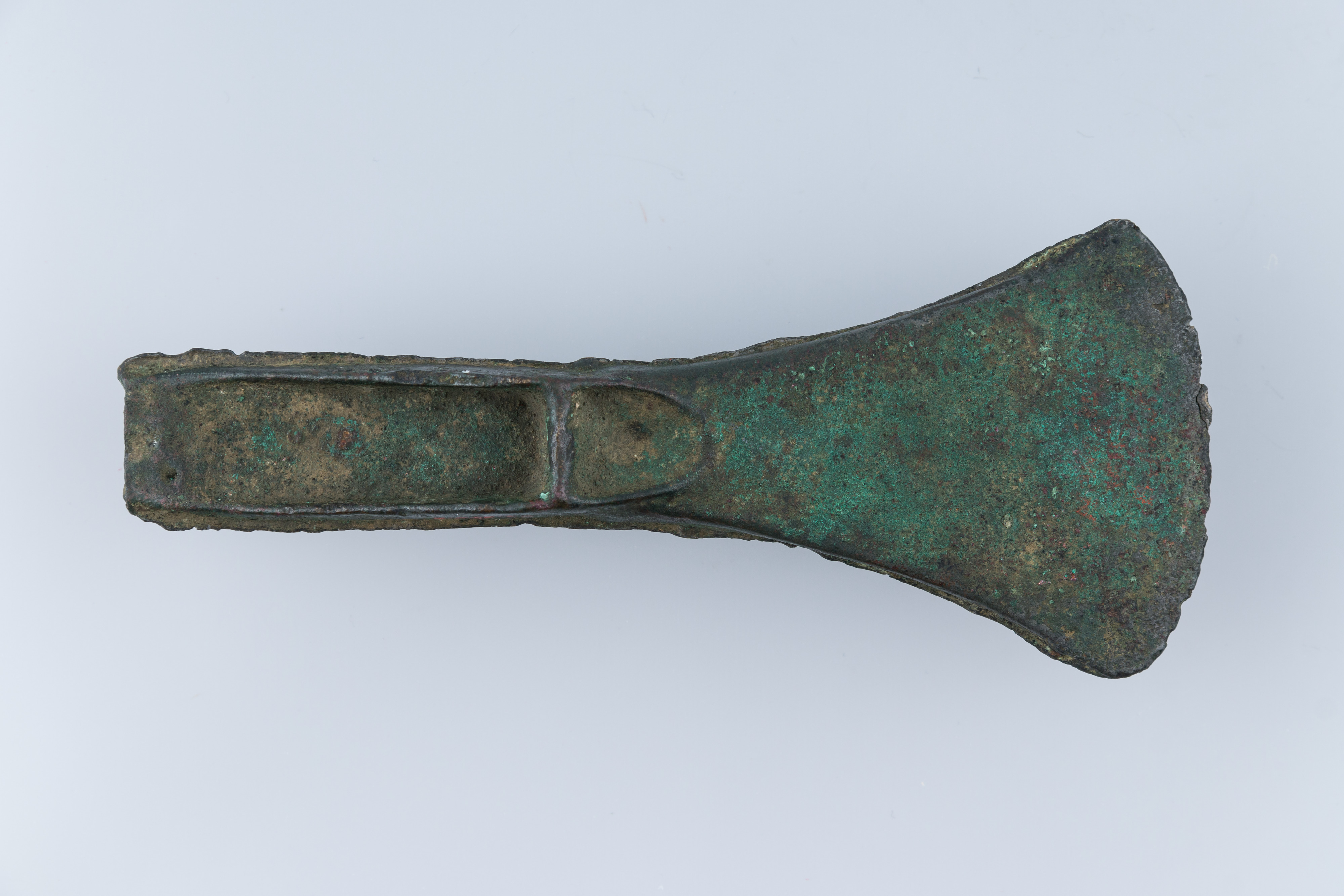
Executive Heritage Analysis: The Palstave Ax as a Proto-Luxury Archetype
In the rarefied echelons of heritage-driven luxury, the material object is never merely functional. It is a vessel of encoded power, a tactile manifesto of the civilization that forged it. For Katherine Fashion Lab’s 2026 strategy, the Irish Bronze Age palstave ax presents a formidable, if unconventional, muse. This analysis deconstructs the palstave’s symbolic capital, its role as historical adornment, and its profound spiritual resonance, while drawing a critical DNA correlation with our concurrent studies on the Rock in the form of a fantastic mountain and the Jar in the shape of a bronze container (hu). Though separated by geography and millennia, these three artifacts converge on a singular principle: the transformation of raw material into concentrated authority.
I. Symbolic Power: The Ax as Proto-Scepter
The palstave, characterized by its flanged sides and stop-ridge for hafting, was not merely a tool of forestry or warfare. In the Irish archaeological record, its deposition—often in rivers, bogs, or hoards—indicates a ritualized economy of value. The deliberate burial of these bronze implements signifies a withdrawal from circulation, a gesture that converts utilitarian metal into sacral wealth. This is the genesis of luxury: the removal of an object from the profane cycle of use to the sacred realm of permanence.
For the 2026 collection, we must read the palstave not as a weapon, but as a proto-scepter. Its weight, balance, and metallic sheen were designed to command a room—or a battlefield—before a single word was spoken. In our luxury framework, this translates to silent dominance. The palstave’s silhouette, with its clean, geometric lines and robust shoulder, offers a template for hard-structured leather goods and metallic hardware. A handbag clasp or a heel’s architectural shank can channel this same latent power: an object that asserts presence through sheer material integrity rather than ornamentation.
II. Historical Adornment: The Body as Display Mechanism
While modern luxury often separates the decorative from the functional, the Bronze Age Irish elite understood adornment as an integrated system. The palstave, when hafted with an oak or ash handle and possibly wrapped with leather or bronze bindings, became an extension of the human body. It was worn at the belt, carried in procession, and displayed during assemblies. This is adornment as kinetic architecture—the body becomes a mobile gallery for the display of metallurgical prowess.
Our research draws a direct line to the Jar in the shape of a bronze container (hu). Both objects prioritize surface tension and volumetric integrity. The hu jar’s smooth, undecorated flanks and the palstave’s clean, functional planes reject superfluous detail. In both, the absence of ornament is the ultimate ornament—a statement of confidence in the material itself. For Katherine Fashion Lab, this informs a strategy of restrained maximalism: pieces that are heavy in presence but minimal in pattern. We propose a capsule line of bronze-toned, sculpted cuffs and belt buckles that echo the palstave’s stop-ridge, creating a visual rhythm of shadow and light that mimics the play of ancient forge-fire on cast metal.
III. Spiritual Meaning: The Threshold Between Worlds
The palstave’s spiritual dimension cannot be overstated. In Celtic cosmology, the axe was a symbol of the thunderbolt—a divine agent of transformation that could split the mundane to reveal the sacred. The act of striking was not destruction, but revelation. This aligns profoundly with our study of the Rock in the form of a fantastic mountain. That object, a petrified landscape, represents the potentiality of the earth—a dormant, massive energy. The palstave, in contrast, is the activation of that energy. It is the tool that carves civilization from the mountain, that fells the tree to build the hall, that splits the enemy’s shield to establish sovereignty.
Together, the rock and the ax form a dialectic: stasis versus catalysis. The hu jar, as a vessel, mediates this dialectic—it contains, preserves, and transforms. In spiritual terms, the palstave is the agent of the liminal, the instrument that facilitates passage from one state to another. For our 2026 clientele, this translates into a narrative of personal transformation. The luxury object is no longer a passive status symbol; it is an active talisman for the wearer’s own breakthroughs—career shifts, creative leaps, or rites of passage.
IV. 2026 High-End Luxury Strategy: The "Palstave Protocol"
Integrating the palstave’s heritage into a modern luxury strategy requires a departure from nostalgic revivalism. Instead, we adopt a transubstantiation protocol: extracting the essence of the artifact’s power and recasting it in contemporary materials and contexts. The following pillars define this strategy:
1. Material Alchemy (Bronze as the New Gold)
In 2026, we pivot from the dominance of yellow gold to the archaeological bronze finish. This is not a trend, but a return to a deeper memory of value. Our ateliers will develop a proprietary alloy—a "Katherine Bronze"—that mimics the high-tin, low-lead composition of authentic Irish palstaves, offering a darker, more complex luster than modern gold. This material will be used for hardware, jewelry, and even woven into metallic-thread textiles for evening wear.
2. The "Ritual Deposit" Retail Experience
Drawing from the palstave’s bog-deposit ritual, we will inaugurate a limited "Deposit" series—objects designed to be "buried" in a collector’s wardrobe, not worn daily. These are investment pieces, numbered and presented in hand-cast bronze boxes, echoing the hoard. This creates scarcity and a narrative of sacred permanence, appealing to the ultra-high-net-worth consumer seeking meaning beyond acquisition.
3. The "Threshold" Silhouette
Inspired by the ax’s dual nature (tool and symbol), our 2026 tailoring will feature asymmetric closures and sharp, angular lapels—garments that suggest a "cutting" or transformative edge. The palstave’s stop-ridge becomes a design motif: a horizontal seam or a metallic insert that divides the garment’s body, symbolizing the boundary between the mundane and the empowered.
4. Cross-Artifact Narrative: The "Mountain-Ax-Vessel" Triptych
Our marketing narrative will weave the palstave, the fantastic mountain rock, and the hu jar into a coherent cosmology. The campaign, titled "The Forge of Worlds," will position the wearer as the active agent—the one who, possessing the mountain’s stability (rock), the vessel’s capacity (jar), and the ax’s transformative power, can shape reality. This is a powerful psychological proposition for the luxury consumer of 2026: not just owning beautiful things, but owning the tools of self-actualization.
Conclusion: The Ax as a Modern Luxe Imperative
The Irish palstave ax, in its austere bronze majesty, is not an artifact of a distant past but a blueprint for enduring power. Its resonance with the fantastic mountain rock and the bronze hu jar reveals a universal human truth: luxury is the controlled manipulation of elemental forces. For Katherine Fashion Lab, the palstave offers a lexicon of strength, ritual, and transformation that is profoundly relevant to the 2026 landscape. By adopting the "Palstave Protocol," we do not merely reference history—we weaponize its spiritual and symbolic capital for the modern connoisseur. The result is a collection that is not worn, but wielded.