Executive Heritage Assessment: The Amulet of Antithetical Falcons and the Crouching Lion
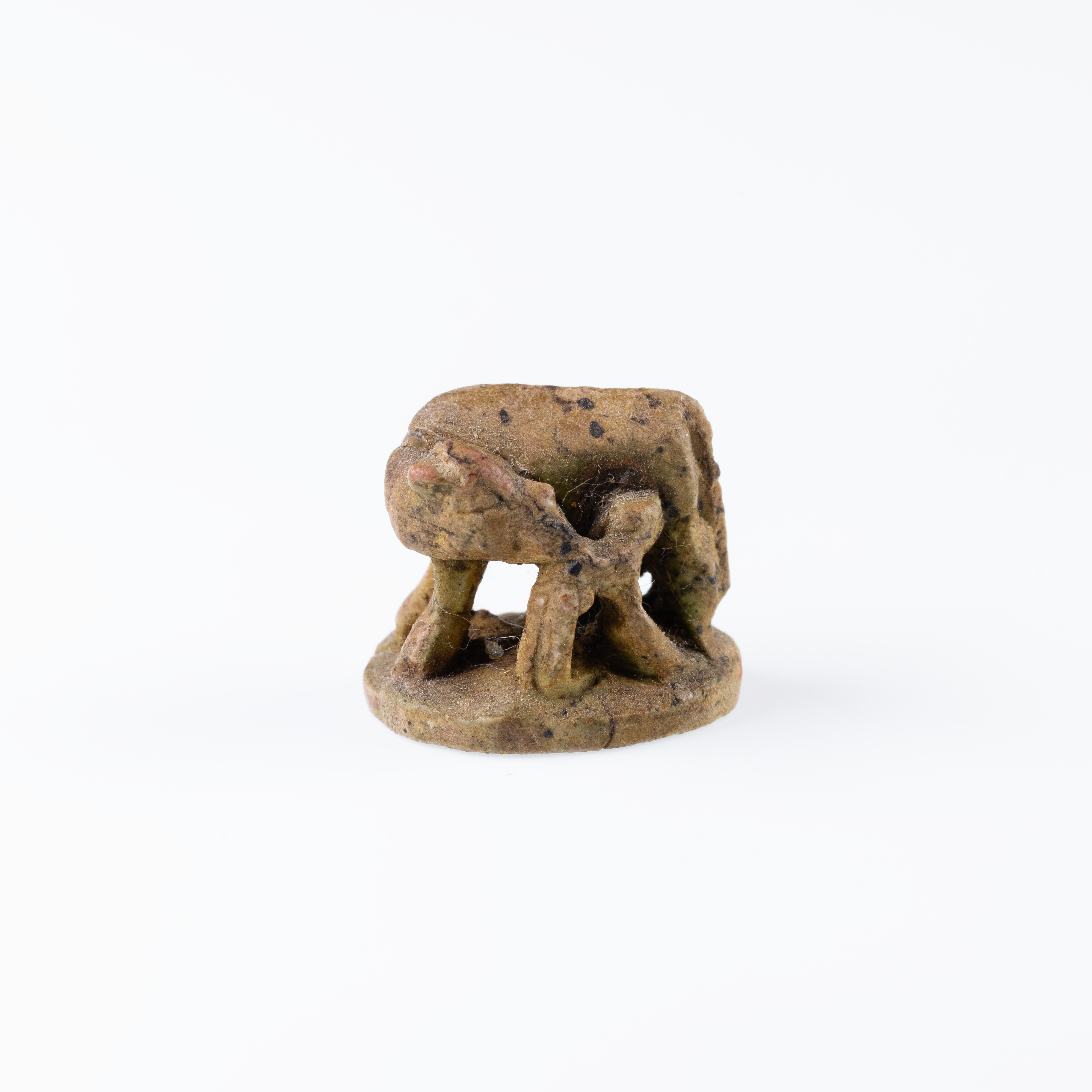
This strategic heritage analysis, commissioned by Katherine Fashion Lab, examines a singular artifact of profound symbolic density: a steatite amulet depicting antithetical falcons flanking an ankh sign, positioned over a crouching lion. Originating from the Nile Valley’s mature dynastic periods—most plausibly the New Kingdom (circa 1550–1069 BCE)—this object is not merely decorative but a condensed theological and political manifesto. For a luxury house operating in the 2026 market, this amulet offers a blueprint for crafting narratives that fuse divine authority, protective power, and terrestrial dominance. The following paper deconstructs its iconographic layers, historical function, and spiritual resonance, then translates these into a high-end strategic framework for Katherine Fashion Lab’s upcoming collections.
Iconographic Deconstruction: The Grammar of Power
Antithetical Falcons: The Horizon of Duality
The composition’s upper register features two falcons in perfect bilateral symmetry, flanking a central ankh. In ancient Egyptian visual language, the falcon is the terrestrial embodiment of Horus, the sky god and divine patron of kingship. The antithetical pose—mirrored yet facing inward—creates a dynamic tension that signifies cosmic equilibrium. This is not static balance but the active reconciliation of opposing forces: Upper and Lower Egypt, life and death, the solar and the lunar. The falcons’ talons rest upon the ankh, the hieroglyph for “life,” implying that divine will is the very mechanism that sustains existence. For a modern luxury audience, this motif translates into a brand ethos of harmonized opposition—the fusion of heritage and innovation, of sculptural weight and ethereal drape.
The Ankh: The Key of Vitality
Centrally positioned, the ankh transcends its phonetic value to become a symbolic conduit. It is the crux ansata, the key that unlocks the gates of the underworld and the breath of eternal life. In this amulet, the ankh is not merely held but flanked and activated by the falcons’ gaze. This triangulation elevates the sign from a passive glyph to an active nexus of divine energy. The material itself—steatite, a soft soapstone often glazed to mimic turquoise or lapis—amplifies this meaning. Steatite was chosen for its workability, but its final glazed surface, typically a vivid blue-green, evoked the primordial waters of Nun, the source of all creation. Thus, the amulet’s physical medium is inseparable from its spiritual message: life emerges from the aqueous void, guarded by the celestial.
The Crouching Lion: Subjugated Terrestrial Force
Beneath this celestial drama, a lion crouches in a posture of submission and vigilance. The lion in ancient Egyptian iconography is Aker, the guardian of the eastern and western horizons, but also Sekhmet, the fierce solar eye. Here, however, the lion is not rampant but recumbent, its head lowered. This is a deliberate iconographic choice: the lion’s raw, untamed power is contained beneath the divine order of the falcons and the ankh. The crouching posture signals that brute force is subordinate to cosmic law. For the wearer, this amulet proclaimed: I command the wild; I am protected by the divine; I possess the key to eternal life. It is a three-tiered hierarchy of power—celestial, vital, and terrestrial—compressed into a 3-centimeter object.
Historical Adornment and Spiritual Function
The Amulet as Wearable Contract
In antiquity, such amulets were not accessories but functional spiritual technology. They were placed on the mummy’s chest or throat to ensure the deceased’s safe passage through the Duat (underworld). The steatite’s cool, smooth texture against the skin was believed to draw out inflammation and poison. The living also wore them as pectorals, suspended on gold or linen cords, to secure divine favor in legal disputes, military campaigns, and childbirth. The amulet was a private covenant with the gods, invisible to the public eye yet supremely potent to the wearer. This contrasts sharply with modern luxury’s emphasis on external display. The historical amulet’s power was internal, talismanic, and deeply personal.
Steatite as a Medium of Prestige
While gold and carnelian were reserved for royal tombs, steatite was a democratic luxury—accessible to priests, scribes, and high officials. Its glazing process, known as Egyptian faience, produced a luminous sheen that mimicked precious stones at a fraction of the cost. This material choice signals a sophisticated understanding of perceived value versus intrinsic value. The amulet’s worth lay not in its raw material but in its carved narrative and consecrated purpose. For Katherine Fashion Lab, this is a potent lesson: narrative and craft can elevate humble materials to iconic status.
Spiritual Meaning: The Triadic Protection Model
Spiritually, the amulet operates on three simultaneous planes. First, apotropaic protection: the falcons’ sharp gaze repels malevolent forces. Second, vital regeneration: the ankh ensures the continuity of breath and blood. Third, terrestrial authority: the crouching lion signals dominion over the physical realm. The wearer, by possessing this amulet, internalized all three. This is not passive belief but active psychological armor. In a 2026 context of global volatility, this triadic model offers a compelling narrative for clients seeking not just beauty but resilience, purpose, and grounded power.
Strategic Translation for 2026 High-End Luxury
Collection Architecture: “The Horizon Key”
Katherine Fashion Lab should develop a capsule collection titled “The Horizon Key,” directly referencing the amulet’s composition. The collection would feature three product tiers, mirroring the amulet’s hierarchy:
- The Falcon Tier (Celestial): Haute couture gowns with mirrored, symmetrical embroidery on the shoulders and collarbone, evoking antithetical falcon wings. Use metallic thread on dark silk to create a “glazed” effect reminiscent of steatite’s faience finish.
- The Ankh Tier (Vital): A signature jewelry line in oxidized silver and green chalcedony, featuring a central ankh pendant flanked by two falcon heads. This piece is designed to be worn close to the sternum—the historical amulet position—not merely as decoration but as a personal talisman.
- The Lion Tier (Terrestrial): Structured leather goods and outerwear with a low, crouching silhouette. A tailored blazer with exaggerated, lowered shoulders and a cinched waist mimics the lion’s posture—power held in reserve, not aggressively displayed.
Material Strategy: The New Steatite
Just as steatite was a “humble” stone elevated by craft, Katherine Fashion Lab should champion upcycled and bio-based materials with high artisanal input. For example, a bonded leather made from agricultural waste, carved with laser-etched falcon motifs, replicates the amulet’s texture and narrative depth. The 2026 luxury consumer is not seeking ostentatious logos but hidden codes and material intelligence. The brand should publish a “heritage dossier” for each piece, detailing the amulet’s iconography and the craftsman’s hours, turning the product into a collectible artifact.
Marketing Narrative: “Wear the Triad”
The campaign should move away from seasonal trends and toward permanent symbolic value. Messaging will center on three pillars: Protection (the falcons), Vitality (the ankh), and Mastery (the lion). This triad aligns with the psycho-emotional drivers of high-net-worth individuals in 2026: security, longevity, and control. The amulet’s historical function as a private covenant offers a unique positioning: “Not for the crowd. For the carrier.” This exclusivity is not about price but about initiatic knowledge—the wearer understands the amulet’s ancient grammar, making them part of a select lineage.
Retail Experience: The Consecration Ritual
In flagship stores, the purchase of a “Horizon Key” piece should be accompanied by a private consecration ritual—a modern, secular adaptation of the ancient amulet’s activation. A trained “heritage guide” explains the falcons’ symmetry, the ankh’s curvature, and the lion’s posture, then presents the piece in a steatite-textured box with a subtle ankh embossment. This transforms a transaction into a rite of passage, creating deep emotional anchoring and repeat patronage.
Conclusion: From Ancient Amulet to Modern Heirloom
The amulet of antithetical falcons, ankh, and crouching lion is not a relic but a strategic archetype. Its genius lies in its compression of cosmic, vital, and terrestrial power into a single wearable object. For Katherine Fashion Lab, this artifact provides a complete blueprint for 2026: a collection structured on triadic symbolism, materials that elevate the humble, and a retail experience that privileges meaning over spectacle. By adopting this ancient grammar of power, the brand does not merely reference history—it re-activates its protective and aspirational energy for a contemporary elite. In an era of digital noise, this amulet’s silent, symmetrical authority offers the ultimate luxury: quiet, absolute significance.