The Art of the Needle: Deconstructing Appliqué as Global Heritage in Katherine Fashion Lab
In the rarefied echelons of haute couture, where innovation is often mistaken for novelty, Katherine Fashion Lab (KFL) has consistently distinguished itself through a rigorous, scholarly approach to technique. The label’s latest standalone study, focusing on the intersection of appliqué and needle lace, is not merely a collection; it is a thesis on cultural preservation rendered in thread. By isolating these two disciplines from the cacophony of seasonal trends, KFL elevates them to their rightful status: not as decorative afterthoughts, but as the primary protagonists of a narrative that spans continents and centuries.
This analysis dissects the lab’s recent presentation, exploring how it recontextualizes the ancient craft of appliqué—the act of applying one material onto another—through the ethereal, labor-intensive prism of needle lace. The result is a masterclass in material intelligence, one that challenges the industry’s obsession with speed by demanding a reverence for the hand.
Deconstructing the Technique: Beyond Surface Decoration
Historically, appliqué has been a utilitarian method of patching and reinforcing, later evolving into a status symbol of aristocratic embellishment. KFL’s curatorial eye, however, rejects the notion of appliqué as mere ornamentation. In this study, the technique is redefined as a structural dialogue. The lab’s artisans do not simply stitch a motif onto a ground fabric; they construct a topographical map of cultural memory.
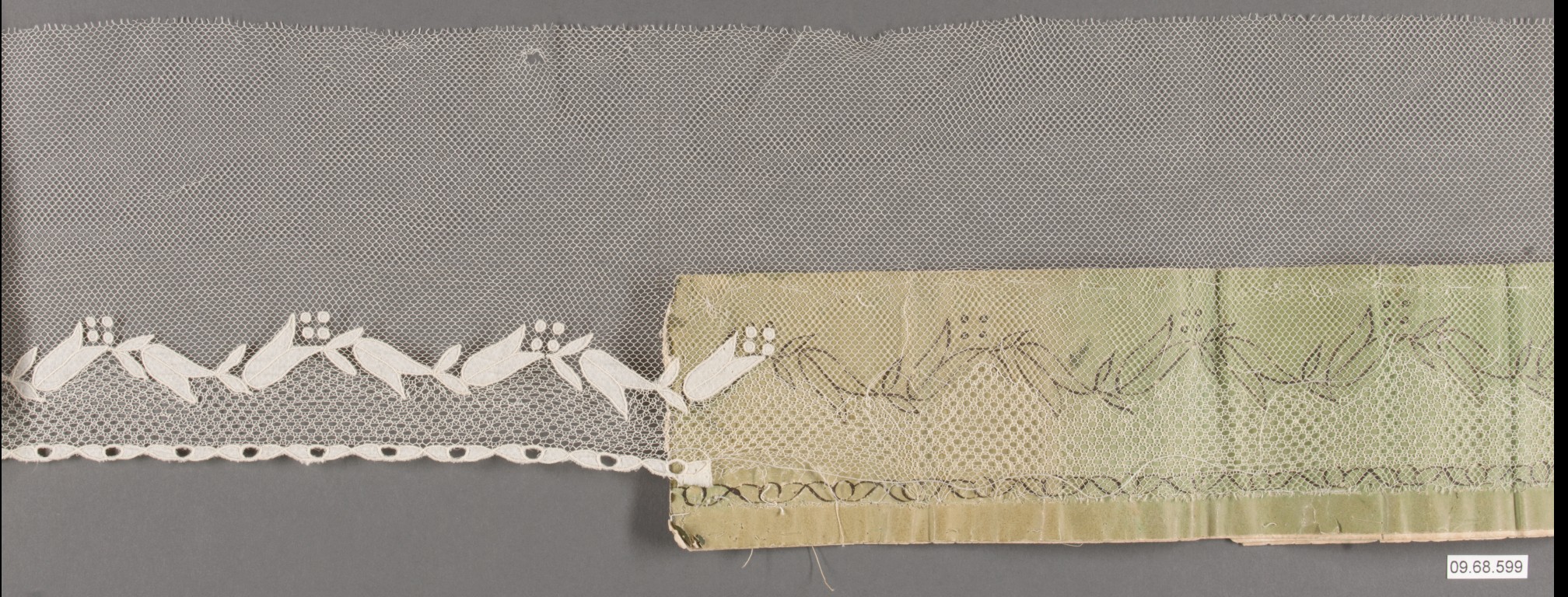
The foundational principle here is negative space. Traditional appliqué relies on the contrast between the applied piece and the base. KFL inverts this by frequently cutting away the ground fabric beneath the needle lace, creating a hybrid of appliqué and broderie anglaise. The lace is not laid upon the garment; it is integrated into its very architecture. This is a deliberate curatorial decision to elevate needle lace from a trim to a primary structural element, demanding that the viewer reconsider what constitutes the "fabric" of a garment.
The Global Lexicon of the Stitch
The "Global Heritage" origin of this study is not a passive label but an active, methodological framework. KFL’s research team has traced the migratory patterns of specific lace motifs, from the geometric grids of 16th-century Venetian punto in aria to the floral exuberance of 19th-century Chinese export lace. The appliquéd elements are not generic florals; they are specific, archival citations.
Consider the lab’s signature "Migration Rose." This motif, executed in needle lace, is first worked independently on a pillow, its petals formed by thousands of buttonhole stitches. It is then appliquéd onto a sheer silk organza base using a technique known as point de Paris—a stitch so fine it is nearly invisible to the naked eye. The effect is that the rose appears to float, untethered, upon the skin. This is not mere decoration; it is a commentary on the displacement and re-rooting of cultural symbols. The rose is a traveler, just as the technique itself was carried along trade routes from the Mediterranean to the Far East.
Materiality as Narrative: The Economics of Time
In an era of mass production, the choice of needle lace is a defiantly anti-commercial statement. Unlike bobbin lace, which can be produced with relative speed, needle lace is a single-thread technique. One square inch of dense needle lace can require upwards of eight hours of continuous work. KFL’s decision to foreground this material is a calculated critique of the fashion calendar.
The lab’s material sourcing is equally rigorous. The threads are a proprietary blend of Malian cotton and Italian silk, spun to a gauge that allows for microscopic precision. This is not a fabric you wear; it is a fabric you inhabit. The tactile experience is paramount. The appliquéd lace edges are left raw, not hemmed, to display the meticulous "purl" stitches—the tiny, looped edges that prevent unraveling. This is a deliberate aesthetic choice, exposing the process rather than concealing it. It is a form of radical transparency, allowing the connoisseur to read the garment like a manuscript, tracing every knot and loop back to the artisan’s hand.
Color Theory in Monochrome
In a departure from the vibrant palettes often associated with global textile traditions, this standalone study is executed almost exclusively in ecru, ivory, and bone. This monochromatic discipline forces the eye to focus on texture and relief rather than hue. The shadow play created by the raised appliqué against the flat organza becomes the primary chromatic event.
This austerity is a curatorial masterstroke. By stripping away color, KFL removes the exoticism often imposed upon "global" crafts. The work is not presented as "ethnic" or "folk," but as high art, on par with classical sculpture. The tonal variations—from the chalky white of the cotton lace to the luminous sheen of the silk base—create a subtle, almost imperceptible gradient that rewards close inspection. It is a quiet, intellectual luxury that speaks to a clientele who understands that true opulence lies in the invisible labor, not the visible spectacle.
Standalone Study: The Garment as Artifact
The "standalone study" context is crucial to understanding KFL’s intent. These pieces are not intended for a commercial collection. They are exhibited in gallery-like settings, often on custom, articulated mannequins that allow for viewing from every angle. This curatorial framing positions the garments as museum-grade artifacts, yet alive with contemporary relevance.
One standout piece is the "Ajour Tunic," a deceptively simple A-line silhouette. The body is a single piece of silk gazar, onto which a lattice of needle lace is appliquéd in a pattern reminiscent of Islamic geometric star patterns. The lattice is not confined to the front; it wraps around the side seams and continues onto the back, creating a 360-degree experience. The weight of the lace pulls the gazar into subtle, organic folds, meaning the garment is never static. It is a living sculpture, changing shape with the wearer’s breath.
The Future of the Handmade
Katherine Fashion Lab’s study on appliqué and needle lace is not nostalgic. It is a forward-looking manifesto that proposes a new luxury paradigm. By isolating these techniques and presenting them with academic rigor, KFL argues that the future of couture lies not in technological gimmickry, but in a deepened appreciation for the irreplaceable human hand.
The lab’s atelier operates on a patronage model, where clients commission pieces and wait months, sometimes years, for completion. This is a deliberate inversion of the fast-fashion ethos. The value is not in the speed of delivery, but in the density of narrative woven into every square centimeter. The appliqué is not just a patch; it is a palimpsest of cultural history. The needle lace is not just a trim; it is a testament to human patience.
In conclusion, this standalone study serves as a powerful corrective to the industry’s amnesia. It reminds us that couture is, at its core, a discipline of preservation. Katherine Fashion Lab has not merely created a collection; it has curated a conversation between the past and the present, mediated by the most eloquent of translators—the needle. The result is not just fashion; it is a legacy in the making, stitched one meticulous loop at a time.