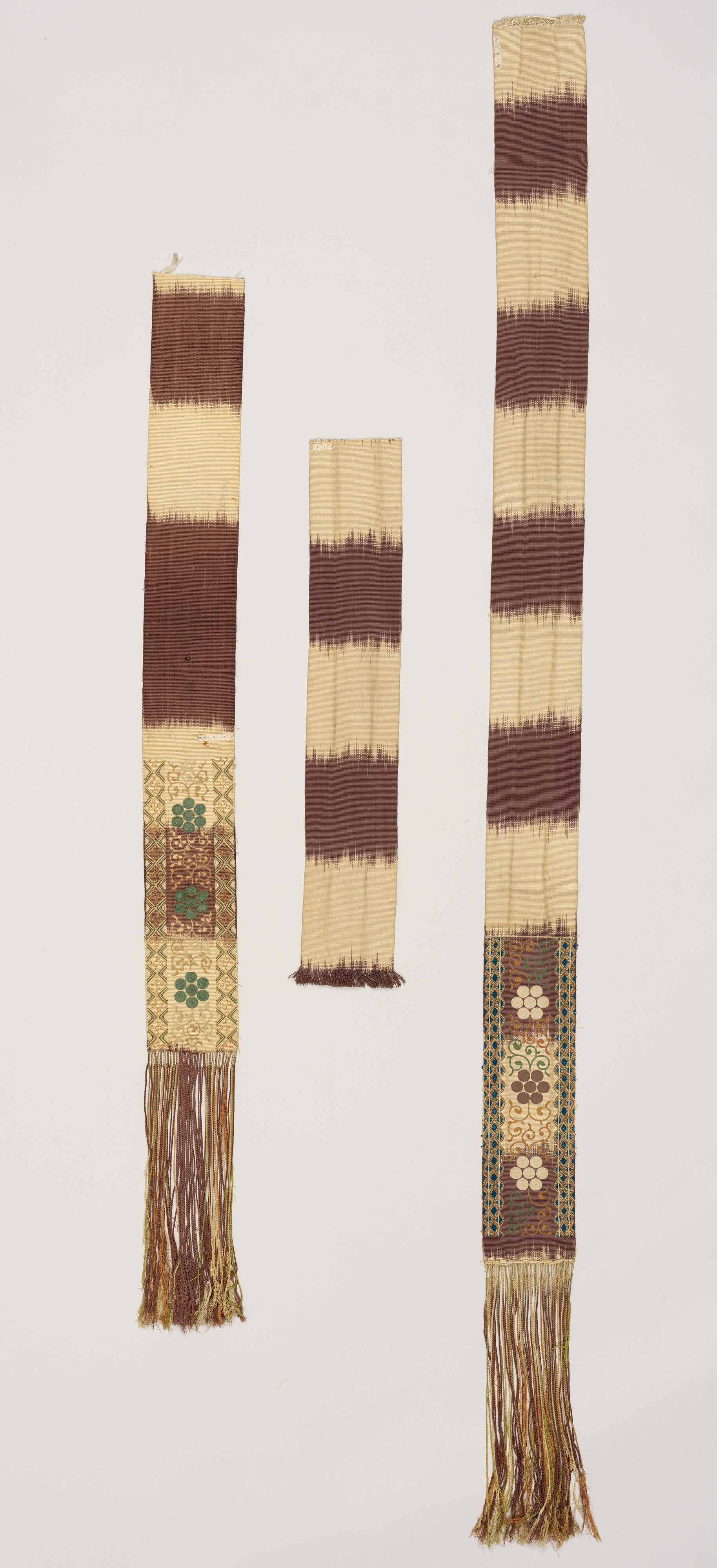
Deconstructing the Obijime: A Tripartite Study of the Hirao Sash
Within the rigorous, analytical environment of the Katherine Fashion Lab, we often turn our gaze to objects that embody profound cultural synthesis and technical mastery. The Japanese obijime, specifically the Hirao style sash presented here in three distinct sections, offers a compelling subject for a standalone couture analysis. More than a mere accessory to the kimono's obi, the obijime is a nexus of structural necessity, symbolic communication, and breathtaking artistry. This tripartite study—examining a formal, a semi-formal, and an innovative contemporary section—allows us to isolate and appreciate the variables of material, motif, and technique that define this singular art form. Originating from Japan's Edo period, the obijime evolved from a practical cord securing the obi's knot into a critical element of the ensemble's final statement, its color and pattern speaking to the wearer's age, status, and the occasion's formality.
Section I: The Formal Canon – Silk and the Language of Status
The first section of our study represents the formal canon. Woven from the finest, tightly twisted silk, its material immediately communicates luxury and tradition. The hand is substantial yet supple, designed to hold a complex knot without buckling and to gleam softly under light. In this formal context, the embroidery is not merely decorative but heraldic. We observe traditional motifs such as karakusa (intertwining vines) or precise, geometric mon (family crests) executed in metallic threads—gold and silver—often complemented by subtle shadings of silk floss. The Lab's analysis notes the embroidery technique: likely a combination of nuihaku (couching with metallic thread) and satin stitch, creating a raised, textured surface that catches the light differentially.
The strategic restraint in the color palette—deep indigo, burgundy, or black grounds with metallic accent—is a calculated exercise in sophisticated signaling. It conveys maturity, social standing, and respect for ceremony. The craftsmanship is flawless, with reverse-side finishes so impeccable they could nearly be worn either way, a hallmark of true couture-level textile work. This section operates within a strictly codified language, where innovation is expressed through minute variations in thread density and motif arrangement rather than radical departure.
Section II: The Semi-Formal Dialogue – Playful Motifs and Textural Innovation
Transitioning to the second, semi-formal section, the Lab identifies a palpable shift in creative dialect. While the foundational material remains high-quality silk, we may encounter a broader array of weaves—perhaps a slightly looser braid or a incorporation of matte and glossy silk threads to create inherent visual texture. The embroidery here engages in a more playful, narrative dialogue with nature and the seasons. Motifs like fluttering chō (butterflies), delicate ume (plum blossoms), or stylized waves (seigaiha) emerge.
The color palette expands to include softer pastels, vibrant greens, and contrasting harmonies, indicating use for less rigidly formal occasions like tea ceremonies or seasonal festivals. The technical analysis reveals a more experimental approach: knotting techniques integrated into the sash's body, small, punctuating beads, or the use of shibori-dyed silk strips incorporated into the embroidery to add a haptic, dimensional quality. This section demonstrates the artisan's skill in balancing tradition with personal expression, using the established "grammar" of the obijime to compose a more personal, seasonal "sentence." It serves as a vital bridge between the unyielding formality of the first piece and the avant-garde nature of the third.
Section III: The Contemporary Fragment – Deconstruction and Conceptual Rebirth
The third section presented for study demands a recalibration of our analytical framework. This is the obijime deconstructed, a conceptual fragment that challenges its own traditional ontology. The silk may be intentionally raw-edged, juxtaposed with unexpected materials like fine leather, transparent synthetic mesh, or even paper yarn. Embroidery transforms from illustrative motif to abstract textural mapping. One might encounter dense, three-dimensional embroidered pods, irregular cascades of thread, or photorealistic floral elements rendered in stark monochrome silk against a techno-fabric ground.
This piece asks fundamental questions: What is the core function of an obijime when divorced from the kimono? Is it a belt, a sculptural neckpiece, an art object? The Lab's analysis focuses on its conceptual posture. It references the traditional form through its general proportion and the persistence of hand-embroidery, but it liberates the object from its sartorial duty. The "three sections" thus become a chronological and conceptual timeline: from adherence, to adaptation, to abstraction. This final fragment is not meant to secure an obi; it is meant to secure a place for the tradition in the contemporary discourse of wearable art, proving the obijime's vocabulary is rich enough for profound reinterpretation.
Conclusion: The Sash as Microcosm
This standalone study of three sections of a Hirao sash reveals the object as a microcosm of broader couture principles. We witness the interdependence of material, technique, and context. The luxurious silk of the formal piece justifies and demands its meticulous embroidery, just as the experimental materials of the contemporary fragment necessitate a break from traditional technique. Each section also demonstrates a masterful understanding of scale and proportion; the motifs are designed to be legible when the sash is both laid flat and cinched in a knot, a 3D consideration paramount to its design.
Ultimately, the Katherine Fashion Lab's analysis posits that the power of the obijime, from the most formal to the most deconstructed, lies in its paradoxical nature. It is a functional artwork, a structured expression of fluidity, and a deeply traditional canvas for radical innovation. By studying these three sections in isolation, we gain not only an appreciation for Japanese textile artistry but also a framework for analyzing any accessory that operates at the intersection of culture, craft, and contemporary relevance. The sash, in its tripartite form, teaches us that even the most defined sartorial languages are capable of infinite, eloquent new sentences.