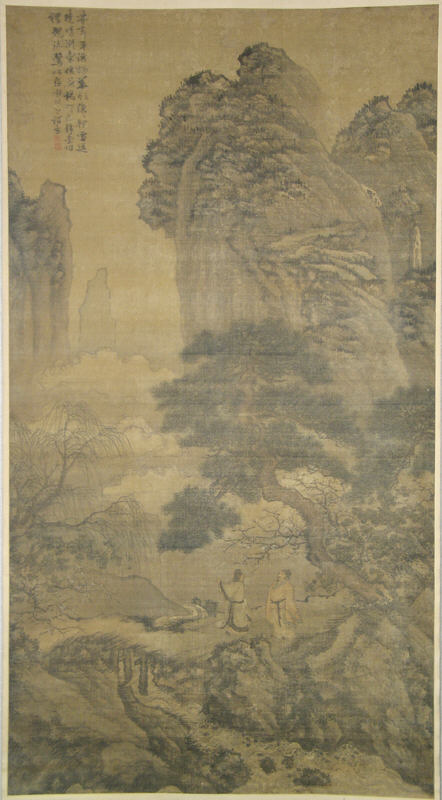
Spring Morning in the Mountains: A Study in Temporal Luxury
At Katherine Fashion Lab, we do not merely observe art; we dissect its material consciousness, its dialogue with time, and its translation into wearable narrative. Our latest couture analysis focuses on “Spring Morning in the Mountains,” a standalone hanging scroll executed in ink and color on silk, originating from the refined aesthetic traditions of China. This is not a garment, yet its construction—layered, tensioned, and deliberately ephemeral—offers a masterclass in the very principles that underpin high fashion’s most compelling expressions.
The piece presents itself as a vertical meditation, a format that immediately disrupts the horizontal logic of Western landscape painting. In doing so, it forces the viewer—and by extension, the designer—to reconsider the body’s relationship to space. A hanging scroll is not a static image; it is an unfurling, a controlled revelation. This sequential exposure is the first couture lesson: garment as narrative, not mere covering.
Materiality as a Signature of Intent
The substrate is silk, a fiber that has historically been the province of imperial courts and the most rarefied ateliers. Its tensile strength, its ability to absorb pigment with a luminous depth, and its inherent drape are not incidental. In this scroll, the silk is not a passive canvas; it is an active participant. The ink—lampblack, mineral pigments, possibly ground azurite and malachite for the mountain greens—does not sit atop the weave but rather bonds with it, creating a surface that shifts with ambient light. This is analogous to the way a couture fabric must respond to the wearer’s micro-movements.
Consider the technical discipline required. The artist worked on a horizontal plane, applying wet-on-wet washes that bled into the silk’s warp and weft. Any hesitation, any overworking, would result in irreparable staining. This is a process of committed spontaneity, a concept we champion in our own design philosophy. The material dictates the gesture; the gesture, in turn, honors the material. For the modern couturier, this is a reminder that fabric is not a blank slate but a collaborator with its own memory and resistance.
Compositional Architecture: The Invisible Corset
Visually, the scroll is structured on a diagonal axis—a rocky promontory emerging from the lower left, dissolving into mist, then re-emerging as a distant peak in the upper right. This is not mere scenery; it is a skeletal framework, akin to the boning in a tailored jacket. The negative space—the un-painted silk that reads as morning fog—is the true couture element. It is the seam allowance, the vent, the breathing room that allows the composition to move.
The color palette is restrained: mineral greens, a whisper of ochre, and the stark contrast of black ink defining crevices. There is no gold leaf, no embroidery. The luxury here is not additive but subtractive. This is a critical distinction for high-end fashion. In an era of over-embellishment, “Spring Morning” argues for the power of negative space as the ultimate statement. The unpainted silk becomes a metaphor for the skin between the seams, the pause between the stanzas of a garment’s silhouette.
Notice the brushwork on the tree branches—each stroke is a calligraphic event, not a descriptive one. They are not “real” branches but emotional indices of spring’s fragility. In couture, this translates to the hand-stitched detail: a single, deliberate stitch that holds more meaning than a thousand machine-made ones. The irregularity is the signature; perfection is found in the controlled imperfection.
Temporal Luxury: The Scroll as a Wearable Philosophy
The context of this piece as a standalone study is significant. It is not part of a narrative series; it exists in a state of self-contained completeness. This is the essence of a couture piece—a garment that does not need a collection around it to justify its existence. It is a monologue, not a conversation. The scroll’s verticality further suggests a body in motion—a figure standing, contemplating, ascending. The eye travels upward, from the rocky base (the foundation garment) through the mist (the sheer overlay) to the summit (the shoulder line or the crown of a hat).
The “morning” in the title is not incidental. It denotes a transient light, a moment of becoming. This is the antithesis of fast fashion’s static permanence. Couture, like this scroll, must capture a fleeting atmospheric condition—the chill of dawn, the dew on a leaf, the silence before birdsong. The artist has frozen this instant, but the silk’s sheen and the ink’s fluidity suggest that the moment is still unfolding. A couture garment must do the same: it must feel alive, as if it were still being draped on the stand.
Translating the Scroll into Garment Construction
How does this analysis inform our atelier? We extract three core directives. First, proportional tension: the scroll’s diagonal axis suggests a bias cut, a skirt that wraps asymmetrically to mimic the mountain’s incline. The hem would not be straight but would echo the mist line—soft, irregular, and hand-rolled to mimic the feathered edge of the ink wash.
Second, material hierarchy: the primary fabric would be a raw silk dupioni for the “rock” elements, with a translucent organza for the “fog” passages. The colors would be dyed in a gradient, not printed, to achieve the same depth as the mineral pigments. The “black ink” details would be rendered in hand-couched silk thread, following the exact calligraphic strokes of the original.
Third, the closure system: there would be no visible zipper or button. Instead, the garment would be secured by a series of hidden silk ribbons, tied internally—a reference to the scroll’s own hanging cord. This is a quiet luxury, a secret known only to the wearer. The act of dressing becomes an act of unfurling, of revealing the painting on one’s own body.
Finally, the scroll’s standalone nature demands a garment of singular presence. It would not be a “look” but a statement object, perhaps a coat with an interior painted by hand, visible only when the wearer moves. The exterior might be stark, almost monastic; the interior, a burst of spring mountainscape. This inversion—private opulence, public restraint—is the highest form of couture intelligence.
In conclusion, “Spring Morning in the Mountains” is not a painting to be copied but a system of thought to be internalized. It teaches us that true luxury is not in accumulation but in elimination, not in speed but in patience, not in surface but in the depth of the material’s soul. For Katherine Fashion Lab, this scroll is not an artifact; it is a living brief for our next collection—a testament to the fact that the most avant-garde ideas are often those whispered by an ancient brush on silk.