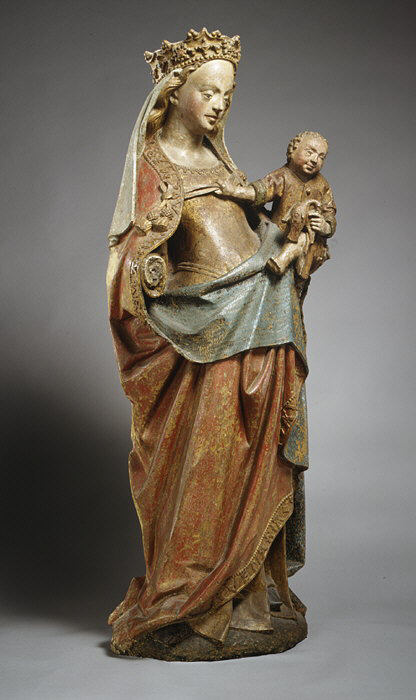
The Sacred Silhouette: Deconstructing the Gothic Line in the Virgin and Child with Bird
At Katherine Fashion Lab, we do not merely observe historical artifacts; we dissect their structural grammar, their drape, and their implicit commentary on the human form. The Virgin and Child with Bird, a French limestone sculpture dating from the High Gothic period, offers a masterclass in the architecture of clothing. While its primary function is devotional, its secondary language is profoundly sartorial. The piece, a standalone study, presents a narrative not just of motherhood and divinity, but of the disciplined, almost architectural, manipulation of fabric that defined an era of European aesthetics. For the modern couturier, this sculpture is a blueprint for understanding volume, negative space, and the politics of concealment.
Materiality as a Metaphor for Couture Construction
The choice of limestone with polychromy is not incidental; it is the foundation of the garment’s perceived weight. In contemporary fashion, we speak of "hand" – the tactile quality of a textile. Here, the limestone’s dense, porous nature mimics a heavy wool or a stiffened silk brocade. The surviving polychromy, though faded, suggests a deliberate palette that would have once emulated the rich blues, crimsons, and gilded accents of royal vestments. This is not a casual drape; it is a deliberate, engineered construction. The sculptor’s chisel acts as the couturier’s shears, carving out deep undercuts that create the illusion of layered fabric folding over itself. The standing posture is crucial; unlike the later, more fluid S-curve of the International Gothic style, this figure maintains a vertical, columnar rigidity. This is the silhouette of a haute couture tailleur – structured, unyielding, and imposing. The fabric is not following the body; the body is following the fabric.
The Mantle as an Architectural System
Let us examine the mantle enveloping the Virgin. It is not a simple cloak. It is a system of tension and release. The folds are deeply carved, creating a series of vertical channels that elongate the figure, a visual trick that pre-dates the modern vertical seam by centuries. The garment’s weight appears to be anchored at the hip, where the Virgin’s hand, presumably once holding the Child, creates a point of stress. This is the couture principle of structural anchoring – the idea that a garment must have a load-bearing element to achieve a specific drape. The heavy, tubular folds falling to the plinth are reminiscent of a modern bias-cut gown, but one that is weighted and disciplined, not fluid. There is no accidental flutter here. Every fold is a deliberate decision, a testament to the sculptor’s understanding of how a heavy textile behaves under the influence of gravity and a stationary pose.
The polychromy, where it remains, would have further defined these planes of fabric. Imagine the original effect: a deep ultramarine for the mantle, with vermilion edges, and gilded trim that would catch the candlelight of a chapel. This is not subtlety; it is a statement of opulence. The color blocking would have visually separated the undergarment from the outer mantle, creating a two-piece look that is both modest and extravagant. This juxtaposition of a simple, undecorated under-layer with an ornate outer shell is a recurring theme in high fashion – think of a minimalist slip dress under a heavily embroidered coat.
The Child as an Accessory: The Economics of the Gaze
The Child with Bird is not merely a figure; he is the ultimate accessory, a living brooch pinned to the Virgin’s chest. In fashion terms, this is the statement piece that completes the ensemble. The bird, a symbol of the soul, serves as a tactile, interactive element. The Child’s hand reaching for the bird introduces a point of micro-movement into an otherwise static composition. This is akin to the strategic placement of a jewel or a feathered trim at the neckline – it draws the eye upward, creating a secondary focal point that breaks the vertical monotony of the drapery. The sculptor’s decision to have the Child grasp the bird creates a tension that is both narrative and visual. It is the same tension a designer creates when placing a sharp shoulder pad or a cinched waist: a moment of dynamic contrast within a larger, harmonious form.
From a couture perspective, the Child’s positioning is problematic yet brilliant. He sits off-center, destabilizing the symmetry of the Virgin’s robe. This asymmetry is a hallmark of advanced design. It prevents the piece from becoming a mere ceremonial effigy and instead gives it a lived-in, intimate quality. The Virgin’s gaze, directed not at the viewer but at the Child, closes the loop. The garment serves as a frame for this interaction, its severe lines emphasizing the tenderness of the central gesture. It is a lesson in negative space: the empty area between the Virgin’s chin and the Child’s head is as important as the carved fabric itself.
Silhouette and the Politics of Modesty
The overall silhouette is a study in the denial of the female form, a pre-cursor to the corseted but equally concealing garments of later centuries. The Virgin’s body is entirely subsumed by the fabric. There is no suggestion of a waist, hip, or bust. This is a deliberate erasure of anatomy in favor of a monumental, iconic presence. In modern terms, this is the power of the cocoon coat or the oversized silhouette – a garment that does not describe the body but rather creates its own environment. The Virgin is not a woman; she is a throne, a vessel, an architectural column. The couturier can learn from this: true power in dress often comes not from revealing, but from the disciplined concealment that forces the viewer to focus on line and material.
The folds themselves act as a visual metronome, counting out a slow, solemn rhythm. They are not naturalistic; they are exaggerated for effect. This is the essence of stylized couture – taking a fabric’s natural behavior and amplifying it to the point of abstraction. The deep channels of the stone are the equivalent of a modern accordion pleat, but they are static, permanent, and unyielding. They speak of permanence, of a garment that is not meant to be removed but to be inhabited for eternity.
Conclusion: A Timeless Lesson in Rigor
The Virgin and Child with Bird is more than a religious relic; it is a treatise on the power of structured design. It demonstrates that the most profound statements in fashion are often made through what is left to the imagination. The heavy limestone drapery, the anchored folds, the strategic placement of the Child as a living ornament – all of these elements coalesce into a piece that is both austere and luxurious. For the modern designer, this sculpture is a reminder that innovation does not always lie in new fabrics or radical cuts, but in the disciplined manipulation of volume and the deliberate, sculptural treatment of material. It is a call to rigor, to the belief that a garment can be a monument, and that even in stillness, there is a profound, powerful form of couture expression. The bird, forever frozen in the Child’s grasp, is the final detail – a whisper of life and movement against the eternal, immaculate structure of the gown.