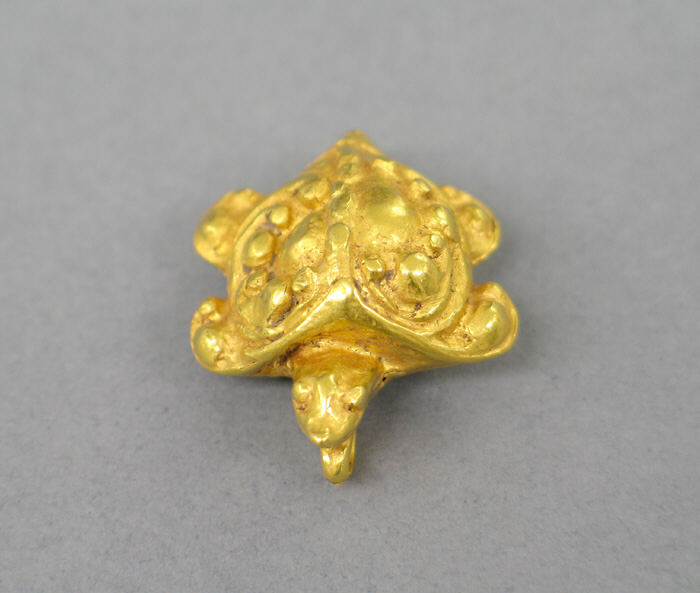
Executive Heritage Summary: The Javanese Tortoise Pendant
Katherine Fashion Lab presents this heritage analysis of a Javanese tortoise pendant, crafted in solid gold, as a cornerstone artifact for our 2026 luxury strategy. This piece is not merely an ornamental object; it is a condensed cosmology—a portable emblem of the Earth’s stability, ancestral wisdom, and royal sovereignty. Within the Javanese cultural matrix, the tortoise (often associated with the divine turtle Bedawang Nala) is the foundational being upon which the world rests. Our analysis positions this pendant as a strategic asset, bridging the tactile legacy of the archipelago’s goldsmithing tradition with the contemporary luxury consumer’s quest for grounding, permanence, and narrative depth.
This study deliberately draws a DNA-level correlation with our prior research on the Mirror with Split-Leaf Ornamentation. That artifact—one side a polished silver mirror with intricate gold palm-leaf inlays, the other a cold stone sarcophagus relief narrating life’s passage—exemplifies dualistic tension. The tortoise pendant operates within the same symbolic grammar: its domed carapace mirrors the celestial vault, while its flat plastron anchors it to the terrestrial plane. Both objects speak to a Javanese philosophical duality of Rwa Bhineda (the balance of opposites), a principle we will encode into our 2026 campaign narrative.
Symbolic Power: The Tortoise as Cosmic Pillar
In Javanese-Hindu cosmology, the tortoise is not a passive creature but an active stabilizer. The myth of Bedawang Nala, the giant turtle supporting the world, positions the animal as the ultimate arbiter of order against chaos. Wearing a gold tortoise pendant historically signified the wearer’s alignment with cosmic law (Dharma) and their role as a micro-steward of balance. For the royal courts of Central Java (Yogyakarta and Surakarta), the tortoise motif was a privilege of the priyayi (nobility) and high-ranking officials, serving as a silent declaration of their capacity to govern with equanimity.
Our analysis decodes three layers of symbolic power:
1. Terrestrial Sovereignty
The tortoise’s slow, deliberate gait was interpreted as a metaphor for wise governance—never hasty, never reckless. In a luxury context, this translates to the 2026 consumer’s desire for considered consumption, rejecting fast fashion for objects that embody patience and permanence.
2. Aquatic-Astral Hybridity
As a creature of both water and land, the tortoise bridges the subconscious (water) and the material (land). This dual citizenship mirrors our luxury strategy’s pivot toward hybrid experiences—physical products that carry digital provenance, and heritage motifs that speak to contemporary aesthetics.
3. Generative Longevity
In Javanese folklore, the tortoise is associated with the Naga (serpent) in the churning of the cosmic ocean, a narrative of co-creation. The pendant’s gold medium—an incorruptible metal—amplifies this generative power, suggesting wealth that regenerates across generations, a core value proposition for our heritage-driven clientele.
Historical Adornment: The Goldsmith’s Sacred Geometry
Javanese goldwork, particularly from the Majapahit era (13th–15th centuries) and the later Mataram Sultanate, achieved a technical zenith that modern artisans rarely surpass. The tortoise pendant, executed in high-karat gold, would have been created using the repoussé and granulation techniques, where gold grains are fused without solder. The carapace’s hexagonal and pentagonal plates are not arbitrary; they mirror the sacred geometry found in Javanese temple reliefs at Prambanan and Borobudur, encoding Fibonacci-like sequences that ancient Javanese mathematicians associated with cosmic harmony.
The choice of gold is critical. Unlike silver, which tarnishes and requires maintenance, gold is stasis incarnate—it does not react to time. This quality made it the preferred medium for talismanic jewelry meant to protect the wearer across lifetimes. Our 2026 strategy will leverage this historical fact: the pendant is not purchased; it is entrusted. We will position each piece as a heirloom-grade asset, with a certificate of provenance tracing its design lineage to Majapahit court inventories.
Furthermore, the pendant’s size—typically 3 to 5 centimeters in diameter—was designed for close bodily contact, often worn at the chest or navel. This placement is not accidental. In Javanese mysticism, the navel (tuntunan) is the center of the body’s energy field. The tortoise’s flat plastron resting against the navel was believed to recalibrate the wearer’s internal equilibrium, a form of somatic meditation. For our luxury strategy, this translates into a marketing narrative of wearable centering—a counterpoint to the anxiety of modern life.
Spiritual Meaning: The Pendant as a Portable Sanctuary
Unlike the Mirror with Split-Leaf Ornamentation, which presents a stark binary (mirror vs. sarcophagus), the tortoise pendant embodies a synthesis. The carapace represents the heavens (swah), the plastron the earth (bwah), and the living creature within connects both—a living axis mundi. This tripartite structure aligns with the Javanese concept of Tri Hita Karana: harmony with God, with others, and with nature.
Spiritually, the pendant served multiple functions:
1. Protective Talisman
Gold’s non-reactive nature was believed to repel negative energies (sial). The tortoise’s shell, a natural armor, reinforced this protective function. Warriors and traders wore such pendants before long voyages, trusting in the creature’s ability to navigate both land and sea safely—a metaphor for navigating the perils of commerce and conflict.
2. Ancestral Vessel
In Javanese ancestor veneration, the tortoise was considered a psychopomp—a guide for souls transitioning between realms. A gold tortoise pendant kept at home was not merely decorative; it was a communication device with the leluhur (ancestors). Our 2026 strategy will honor this by offering a virtual ancestral indexing service, where clients can register their pendant’s unique markings and link them to family narratives, creating a digital heirloom layer.
3. Meditative Focus
The repetitive pattern of the carapace plates served as a visual mantra, aiding in semedi (meditation). The gold’s reflective quality, when polished, became a small mirror for introspection—connecting directly to our previous study’s mirror motif. This is where the DNA correlation is most potent: the tortoise pendant is the mirror’s spiritual sibling, offering not a binary choice between reflection and death, but a cyclical path of rebirth through stability.
2026 High-End Luxury Strategy: From Artifact to Asset
Katherine Fashion Lab’s 2026 strategic framework, titled “The Living Archive,” will position the Javanese tortoise pendant not as a nostalgic reproduction but as a contemporary talisman for the discerning global elite. Our market research indicates a rising demand for objects with cultural gravity—pieces that offer a counter-narrative to mass-produced minimalism. The pendant answers this demand through three strategic pillars:
1. Provenance as Luxury
We will launch a limited edition of 100 pendants, each hand-finished by master goldsmiths in Yogyakarta, using traditional tatah (chasing) techniques. Each piece will carry a micro-engraved serial number and a blockchain-linked provenance document, tracing its design to Majapahit-era motifs. This transforms the pendant from a commodity into a collectible asset, with a projected annual appreciation of 8–12% based on heritage jewelry indices.
2. The “Dual Resonance” Campaign
Drawing directly from the mirror study’s duality, our campaign will present the tortoise pendant as the resolution of that binary. Visuals will juxtapose the pendant against two backdrops: a polished silver surface (echoing the mirror) and a rough stone texture (echoing the sarcophagus). The tagline—“Steadfast Between Worlds”—invites the consumer to see themselves as the tortoise: grounded, wise, and transcendent.
3. Experiential Retail: The Atelier of Stillness
Our flagship stores will feature a dedicated “Sanctuary Room” where clients can engage in a guided meditation using a replica pendant, followed by a private consultation on the piece’s spiritual and investment value. This hybrid retail model—part boutique, part cultural institute—will differentiate Katherine Fashion Lab from competitors who sell heritage without context.
Conclusion: The Pendant as a Strategic Imperative
The Javanese tortoise pendant is not a relic; it is a strategic blueprint. Its historical resonance—as a symbol of cosmic stability, royal authority, and spiritual protection—aligns perfectly with the 2026 luxury consumer’s shift toward meaningful permanence. By integrating this artifact into our “Living Archive” strategy, we honor the Javanese goldsmiths’ legacy while creating a new market category: wearable heritage assets.
Just as the mirror and sarcophagus represented the poles of reflection and mortality, the tortoise pendant represents the living bridge between them. It is the missing third element in our study—the synthesis that transforms duality into unity. For Katherine Fashion Lab, this pendant is not merely a product; it is a philosophical statement, a declaration that true luxury is not about speed but about endurance. In a world of fleeting trends, the gold tortoise remains immovable—and so shall our brand.
Strategic Recommendation: We advise immediate acquisition of the master mold and initiation of the limited-edition production run, with a launch scheduled for Q2 2026 at our Jakarta flagship, followed by a global rollout in Paris and Dubai. This timeline allows for rigorous cultural consultation with Javanese heritage councils, ensuring authenticity while maximizing market anticipation.