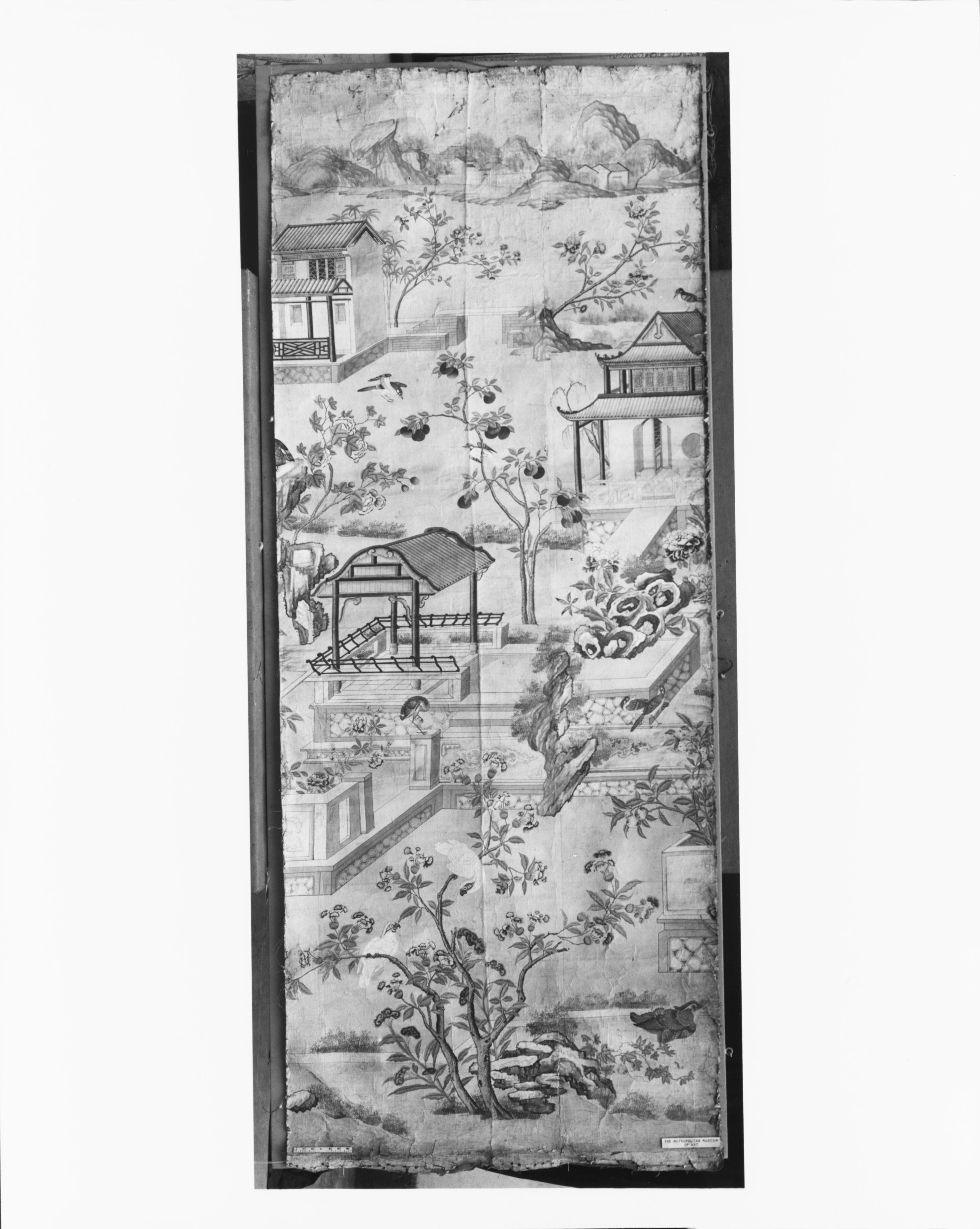
The Wallpaper Panel: A Study in Material Poetry
In the rarefied atmosphere of contemporary couture, where the ephemeral is often mistaken for the essential, Katherine Fashion Lab presents a meditation that defies the conventional boundaries of fabric and form. The Wallpaper Panel, a standalone study drawn from a global heritage of decorative arts, is not merely an object of aesthetic interest; it is a profound thesis on the relationship between surface, structure, and the silent language of domestic space. By elevating a humble material—paper, hand-painted and mounted on linen—the Lab invites us to reconsider the very architecture of dress, shifting our gaze from the body's silhouette to the narrative inscribed upon its covering.
Deconstructing the Domestic: From Wall to Wardrobe
The conceptual pivot of this piece lies in its audacious provenance. The wallpaper panel is traditionally an instrument of interiority, a backdrop to human life, a silent witness to the intimate dramas of the home. By isolating a single panel and recontextualizing it as a standalone study, Katherine Fashion Lab performs a radical act of semantic displacement. The wall is no longer a passive boundary; it becomes an active protagonist. The panel, once part of a continuous, repetitive pattern, is now a singular, autonomous composition. This act of isolation forces a new kind of attention: we are no longer reading a pattern across a room, but confronting a single, complete image, a frozen moment of artistic expression.
This recontextualization speaks to a broader contemporary discourse on the porosity of boundaries—between public and private, between the decorative and the functional, between the two-dimensional and the sculptural. In the hands of the Lab, the wallpaper panel ceases to be a backdrop and becomes a foreground, a primary text demanding exegesis. It challenges the modernist dictum that form must follow function, instead proposing that narrative can be a function in itself. The garment, or in this case, the study, is not designed to clothe a body but to clothe a concept, to provide a physical and intellectual shelter for a specific idea of beauty.
Material Alchemy: The Dialogue of Paper and Linen
The materiality of the piece is its most compelling argument. Paper, in the hierarchy of textiles, is often dismissed as fragile, impermanent, and ill-suited for the rigors of wear. Yet, in this study, paper is treated with the reverence reserved for the most precious silks. The hand-painted nature of the surface is paramount. Each brushstroke, each subtle variation in pigment saturation, bears the trace of the artist's hand, rendering the piece an irreproducible original in an age of mechanical and digital reproduction. This is not a print; it is a painting, a unique artifact of human labor and intention.
The choice of linen as a support is equally significant. Linen, derived from the flax plant, is a material of immense historical weight, associated with durability, purity, and a certain austere elegance. By mounting the fragile paper onto this robust foundation, the Lab engineers a dialogue between strength and delicacy. The linen acts as a structural subtext, a hidden skeleton that provides tensile strength and a sense of permanence. It prevents the paper from being merely a decorative surface, grounding it in a tactile reality. The interplay of textures—the smooth, painted surface of the paper against the subtle, slubbed weave of the linen—creates a rich sensory experience that rewards close inspection. This is a piece that demands to be felt, not just seen.
A Global Heritage: The Cartography of Pattern
The origin of the panel, described as Global Heritage, is a deliberate obfuscation that functions as a conceptual tool. It refuses to be pinned down to a single geographic or historical origin, instead suggesting a syncretic lineage. The pattern itself is likely a palimpsest of influences—a floral motif that recalls French toile de Jouy, a geometric border that hints at Islamic geometric art, a color palette that evokes the muted tones of Japanese washi prints. This deliberate ambiguity challenges the notion of cultural purity, positing that heritage is not a static inheritance but a dynamic, cross-pollinated construct.
In this light, the Wallpaper Panel becomes a cartographic artifact, mapping the trade routes, colonial exchanges, and artistic migrations that have shaped our collective visual vocabulary. It is a silent testament to the fact that no culture is an island; that the most profound expressions of beauty are often born from the friction and fusion of disparate traditions. The Lab’s decision to present this as a standalone study further amplifies this notion. It is not part of a collection, not a prototype for a series, but a singular investigation into a specific set of aesthetic and material questions. It is a research document, a hypothesis made manifest in pigment and fiber.
The Standalone Study: An Object of Contemplation
By framing this as a study, Katherine Fashion Lab positions it within the tradition of the artist's sketch or the scientist's specimen. It is not a finished product intended for mass consumption but a focused inquiry. This framing elevates the object from the realm of commodity to the realm of epistemology. The panel is a tool for thinking, a visual essay on the potential of material and pattern. It invites the viewer to engage in a similar process of analysis, to deconstruct the elements of the composition and consider their individual and collective significance.
The absence of a functional garment form is a deliberate provocation. The Wallpaper Panel is not a dress, not a coat, not a jacket. It is a proposition. It asks us to consider what couture might be if it were untethered from the demands of wearability. What if the primary function of a textile was not to cover but to communicate? What if the body's form was secondary to the idea's form? This intellectual exercise is the very essence of the Lab's philosophy. The panel is a pure distillation of the couture impulse—the desire to create beauty through material manipulation—stripped of all utilitarian pretense.
Conclusion: The Quiet Revolution of Surface
The Wallpaper Panel is a quiet radical. It does not shout; it whispers. It does not conform; it proposes. In its fusion of paper and linen, of global motifs and singular vision, it offers a new paradigm for understanding couture. It is a reminder that fashion is not merely an industry of cloth but a discipline of meaning. Katherine Fashion Lab has, with this standalone study, repositioned the wallpaper panel as a nexus of artistic and intellectual inquiry. It stands as a testament to the power of material poetry, a profound and beautiful argument that the walls we build around ourselves can, in the right hands, become the most eloquent garments of all. The study is not an end, but a beginning—a seed of an idea that will undoubtedly germinate into future explorations, challenging and expanding the lexicon of what we dare to call fashion.