An Ode to Effortless Grace: Deconstructing the Nu Féminin
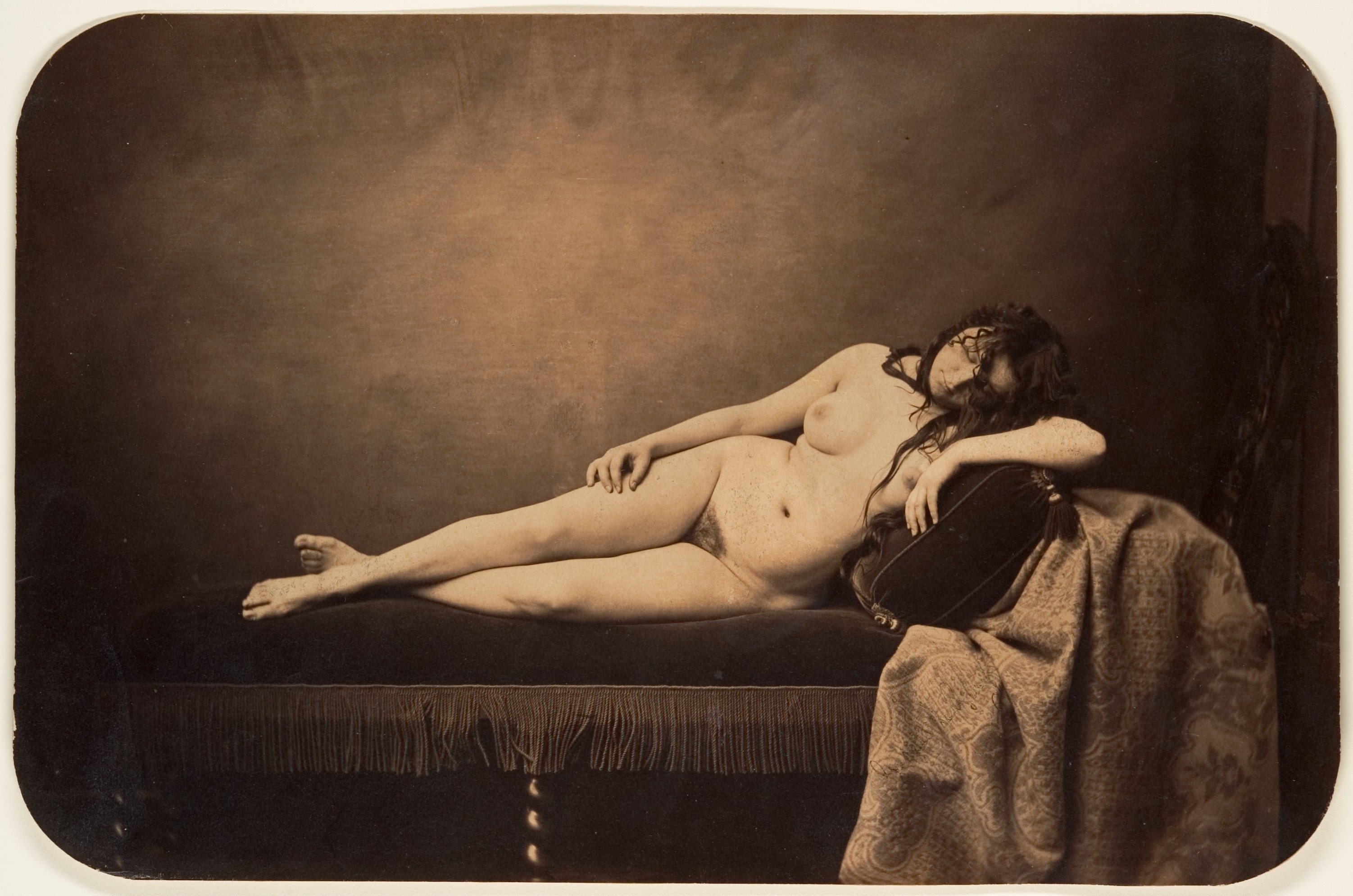
In the hallowed halls of fashion history, where fabric meets flesh and light sculpts silhouette, there exist rare artifacts that transcend mere documentation. Katherine Fashion Lab’s current curatorial focus on the Nu féminin allongé sur un canapé Récamier presents precisely such a transcendent piece. This is not a photograph of a garment; it is a masterclass in the architecture of repose, a dialogue between the human form and the furniture of desire. As a standalone study, this albumen silver print—a relic of the 19th century’s nascent photographic artistry—offers a profound meditation on how the body, unclothed yet fully adorned by posture and shadow, becomes the ultimate couture statement.
The Récamier as Structural Muse
The choice of the Récamier sofa is no mere backdrop; it is the structural counterpoint to the subject’s fluidity. Named for the famed Parisian salonnière Juliette Récamier, this piece of furniture—with its high, scrolled backrest and elongated, chaise-like seat—was designed for a specific kind of performance: the art of being seen while appearing utterly unselfconscious. In this print, the sofa’s rigid, carved wood and taut upholstery provide a stark, geometric foil to the model’s organic curves. The visual tension is palpable. The hard lines of the frame anchor the composition, while the soft, yielding flesh of the nu suggests a surrender to gravity, a deliberate abandonment of the day’s rigid corsetry.
From a fashion perspective, this is the first principle of draping—the interplay between the structure of the garment (or in this case, the furniture) and the body’s natural drape. The Récamier acts as a living bustier, shaping the space around the model, forcing her into a diagonal (the ligne of the composition) that echoes the bias cut of a Fortuny gown. The photographer, whose identity is lost to history but whose eye was impeccable, understood that the most provocative "fabric" is skin, and the most essential "seam" is the line where the body meets the object.
Albumen Silver and the Texture of Memory
The medium itself—albumen silver print from a glass negative—is integral to the piece’s sartorial resonance. This process, popular from the 1850s to the 1890s, produces a print with a distinctive, lustrous sheen, a surface that seems to glow from within. The egg-white binder creates a tonal range that is at once velvety and sharp, rendering the model’s skin with a luminosity that modern digital photography rarely achieves. This is not the sterile perfection of a studio retouching; it is the tactile reality of light reacting to a chemical emulsion.
For the fashion analyst, this texture is akin to a heavy silk faille—it has body, it has depth, and it holds the light in a way that is both reflective and absorptive. The shadows in the print are not merely the absence of light; they are active participants, carving out the model’s hip, the hollow of her throat, the gentle curve of her calf. These shadows function as the couture seams of the image, defining the garment of the body without a single stitch. The grain of the albumen adds a tactile quality, a sense of historical weight, suggesting that this image is not a fleeting moment but a woven tapestry of memory and desire.
Global Heritage, Universal Language
The label "Global Heritage" is crucial here. While the subject and the furniture are unmistakably European—rooted in the neoclassical revival and the French Second Empire—the photographic technique and the aesthetic of the female form draw from a broader, more universal lexicon. The pose, the reclining nude, is a motif that spans cultures and centuries: from the odalisques of Ingres to the yin-yang of Eastern depictions of leisure. This print is not a provincial artifact; it is a synthesis of global visual culture, a testament to how the language of the body transcends borders.
In the context of Katherine Fashion Lab’s mission, this piece serves as a foundational text. It reminds us that heritage is not static. The "global" aspect lies in the universality of the pose—the female form as a symbol of beauty, vulnerability, and power. The Récamier, while French, is a descendant of the Roman lectus and the Egyptian daybed. The photographic process, while refined in Europe, was a global revolution in image-making. This print, therefore, is a node in a vast network of cultural exchange, a silent conversation between different eras and geographies, all converging on the timeless act of reclining.
Standalone Study: The Power of Singularity
Its designation as a standalone study elevates its status. It is not part of a series meant to tell a linear story; it is a singular exclamation point. In the fashion world, we often speak of the "capsule collection"—a small, focused group of pieces that each carry immense weight. This image is the ultimate capsule piece. It requires no companions, no context, no explanation. The composition is complete within its own frame. The model’s gaze, whether directed at the viewer or lost in introspection, holds the entire narrative in a single glance.
This singularity allows for a more profound contemplation of form. Without the distraction of a sequence, the eye is free to trace the line of the spine, the delicate arch of the foot, the way the hair falls against the pillow. It becomes a study in the physics of elegance. The absence of clothing does not signify a lack of fashion; rather, it strips fashion to its essential core: the relationship between the body and its environment. The model is, in effect, wearing the sofa. She is wearing the light. She is wearing the shadow. This is the ultimate lesson in styling—that true elegance is not about the garment, but about the attitude with which one inhabits space.
Implications for the Contemporary Atelier
What does a 19th-century nude on a sofa teach a 21st-century fashion house? Everything. It teaches the importance of negative space—the empty areas around the body that give the form its power. It teaches the value of contrast—the hard versus the soft, the structured versus the flowing. It teaches the art of restraint—what is left unseen is often more provocative than what is revealed.
For Katherine Fashion Lab, this print is a touchstone for a new collection that might explore "deconstructed tailoring" or "fluid structure." Imagine a gown that mimics the line of the Récamier’s backrest, a jacket that drapes like the shadows on the model’s hip. The albumen’s sepia tones could inspire a palette of warm, earthy neutrals—champagne, bronze, and deep umber. The print is a call to return to the fundamentals: to understand the body as the primary canvas and to use all other elements—fabric, furniture, light—as mere accessories to its inherent majesty.
In conclusion, the Nu féminin allongé sur un canapé Récamier is far more than a historical curiosity. It is a profound, silent treatise on the intersection of art, design, and the human form. It is a testament to the enduring power of the female silhouette and the objects that frame it. As a standalone study, it demands not just a glance, but a sustained, reverent gaze—a reminder that in the world of true couture, the most exquisite garment is the one we are born with, styled by the light and shadow of the world around us.