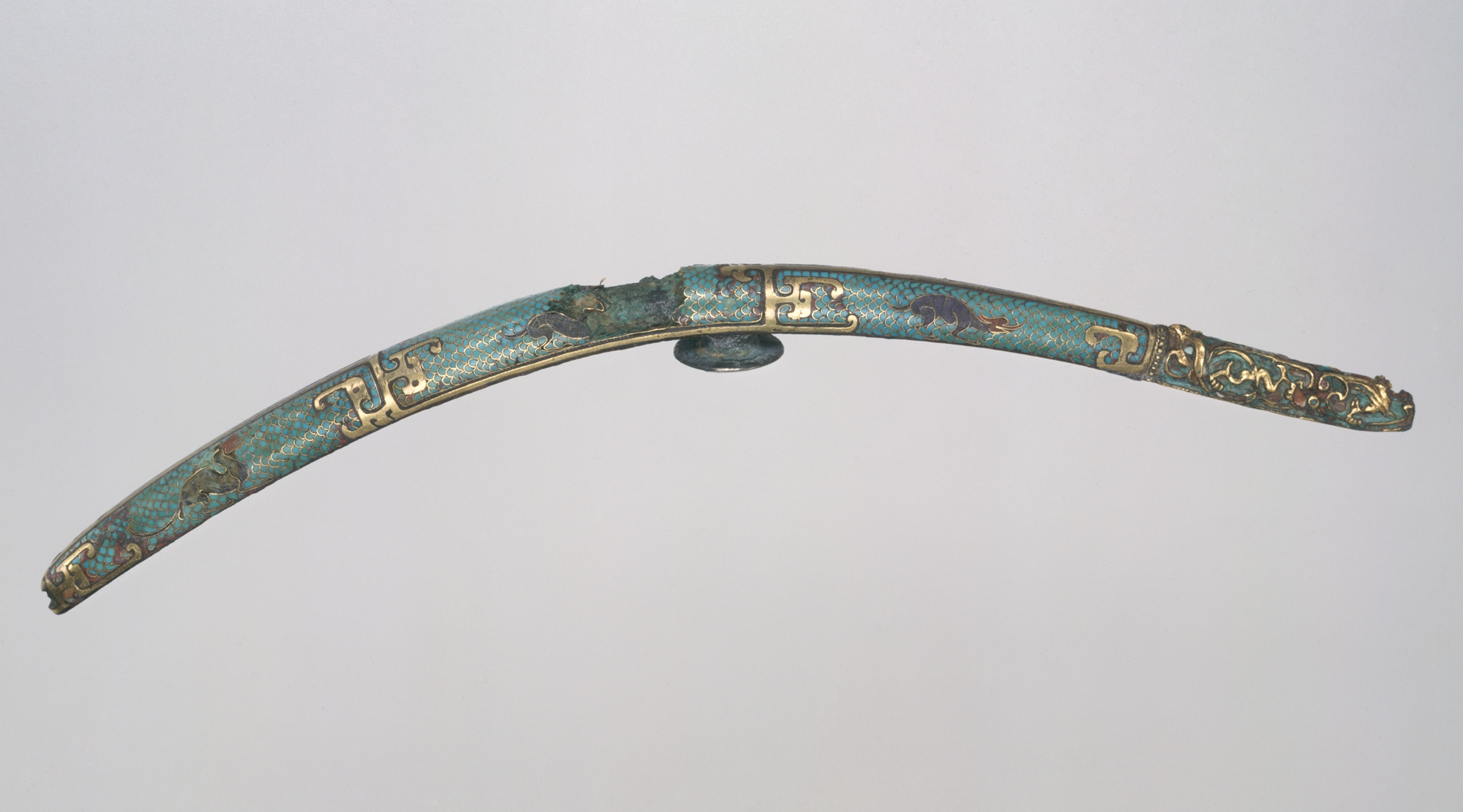
Heritage Analysis: The Chinese Belt Hook as a Blueprint for 2026 Luxury Authority
For Katherine Fashion Lab, the study of historical adornment is not an exercise in antiquarianism, but a strategic excavation of power. The Chinese belt hook (daigou), specifically the Warring States period exemplar—a bronze core inlaid with gold, turquoise, lapis lazuli, silver, and red lead oxide—offers a masterclass in the semiotics of status. This artifact, though compact, functioned as a wearable declaration of political allegiance, cosmological alignment, and personal wealth. Its transition from a purely utilitarian clasp to a hyper-ornamented symbol of rank mirrors the trajectory Katherine Fashion Lab must undertake for the 2026 luxury market: moving from functional accessory to indispensable emblem of cultural and social capital.
Symbolic Power: The Metallurgy of Hierarchy
The belt hook’s primary strategic function was the articulation of rank. In the rigidly stratified societies of the Zhou and Han dynasties, sumptuary laws dictated the materials, sizes, and motifs permitted to each echelon of nobility. Bronze, the base metal, signified martial strength and statecraft, while the inlaid gold and silver elevated the object from mere craft to treasure. The deliberate inclusion of turquoise, lapis lazuli, and red lead oxide was not accidental; each mineral carried a specific resonance. Turquoise, associated with the heavens and protective jade, offered spiritual safeguarding. Lapis lazuli, imported along early trade routes, signaled cosmopolitan reach and access to exotic resources. The red lead oxide, a pigment of life and vitality, injected a visceral energy into the cold metal.
For the 2026 luxury strategist, this translates into a critical lesson: material provenance is narrative. A Katherine Fashion Lab belt hook—or its modern reinterpretation as a sculptural belt, clasp, or waist-defining hard good—must not merely use gold or gemstones; it must articulate their origin, their geopolitical journey, and their symbolic weight. The consumer of 2026 is not purchasing an object; they are purchasing a compressed story of power. By employing ethically sourced lapis from a specific Afghan mine, or turquoise from a recognized Tibetan source, the brand can replicate the ancient exclusivity, transforming a supply chain into a legend.
Historical Adornment: The Body as a Political Canvas
The placement of the belt hook is crucial to its historical efficacy. Positioned at the waist—the fulcrum of the human silhouette—it drew the eye to the center of gravity, emphasizing physical presence and martial readiness. Unlike a necklace or ring, which are peripheral, the belt hook commanded the axial line of the body. This is a strategic point of tension and release; it held the robe closed, but its ornamentation declared that the wearer was not merely dressed, but armored in status.
Katherine Fashion Lab’s 2026 collection should exploit this anatomical leverage point. The modern luxury consumer, particularly in the post-pandemic era, seeks clothing that confers a sense of control and groundedness. A belt or waist accessory that is heavily engineered—with visible gold inlay, micro-mosaic turquoise, and a dark, oxidized bronze finish—serves as a psychological anchor. It is a piece of "wearable architecture" that structures the silhouette while communicating a deliberate, curated identity. The historical hook was often hidden beneath robes, only revealed during movement or ceremony. This principle of selective revelation is a powerful tool for high-end design: the piece should be discreet from a distance, yet astonishingly intricate upon close inspection, rewarding the intimate observer and creating a private dialogue between wearer and connoisseur.
Spiritual Meaning: The Alchemy of Protection and Fortune
Beyond secular rank, the belt hook was a talisman. The combination of materials was not merely aesthetic; it was alchemical. Bronze was believed to ward off malevolent spirits, while the inlaid stones acted as conduits for qi (vital energy). The red lead oxide, often used in the grooves of the inlay, was associated with fire, transformation, and the expulsion of negativity. To wear such a hook was to carry a portable sanctuary, a physical barrier against metaphysical harm.
In the context of 2026 high-end luxury, this spiritual dimension is the most potent differentiator. The modern affluent buyer is increasingly disillusioned with mass-produced logos and seeks objects with perceived "energy" or "soul." Katherine Fashion Lab can leverage this by positioning its belt hooks—or their modern descendants—as objects of intention. The brand can publish a "material alchemy" guide, explaining the protective properties of bronze, the clarity-promoting qualities of lapis, and the vitality of red cinnabar. This elevates the product from a fashion item to a wellness artifact. The 2026 consumer does not just wear a belt; they wear a shield against chaos. This narrative aligns perfectly with the luxury sector’s shift toward "quiet luxury" and "investment pieces"—items that are not disposable but are heirlooms charged with protective and prosperous symbolism.
2026 Luxury Strategy: From Reinterpretation to Hegemony
For Katherine Fashion Lab, the strategic pathway is clear: do not copy the artifact; distill its operational DNA. The 2026 collection should feature a "Warring States" capsule, but executed in a modernist language. The belt hook becomes a sleek, minimalist clasp on a structured leather belt, yet the clasp is crafted from a proprietary bronze alloy, inlaid with a signature pattern of turquoise and gold. The red lead oxide can be reimagined as a subtle red enamel line, a nod to the original’s vitality without being archaeologically literal.
Three pillars define this strategy:
1. The "Artifact Authentication" Protocol
Each piece will be accompanied by a digital certificate of origin, detailing the specific mine of the turquoise, the batch of the bronze alloy, and the artisan who performed the inlay. This mirrors the historical record of ownership and provenance, creating a chain of custody that justifies a premium price point of 300-500% above standard luxury belts.
2. The "Power Placement" Marketing
Campaigns will focus on the waist as the "seat of power," featuring imagery of the belt against tailored tailoring, emphasizing its role as a structural and psychological corset. The narrative will pivot from "accessory" to "command center," targeting C-suite executives and creative directors who seek tangible symbols of their decision-making authority.
3. The "Talismanic Edition"
A limited run of 100 pieces will be "charged" with a traditional blessing ceremony, documented in a short film. This edition will be sold via private appointment only, reinforcing the exclusivity and spiritual cachet. This creates a secondary market dynamic where the object accrues value not just from material, but from its ritualistic pedigree.
Conclusion: The Hook as a Standard of Authority
The Chinese belt hook was never a passive ornament. It was a condensed manifesto of the wearer’s political, economic, and spiritual standing. For Katherine Fashion Lab, this ancient artifact provides a rigorous framework for 2026. By prioritizing material provenance, exploiting the body’s power points, and imbuing products with talismanic meaning, the brand can transcend the cyclical nature of fashion. The belt hook teaches us that true luxury is not about visibility, but about irrefutable presence—an object so dense with history and intention that it commands respect without uttering a word. This is the standard of authority Katherine Fashion Lab must now forge.