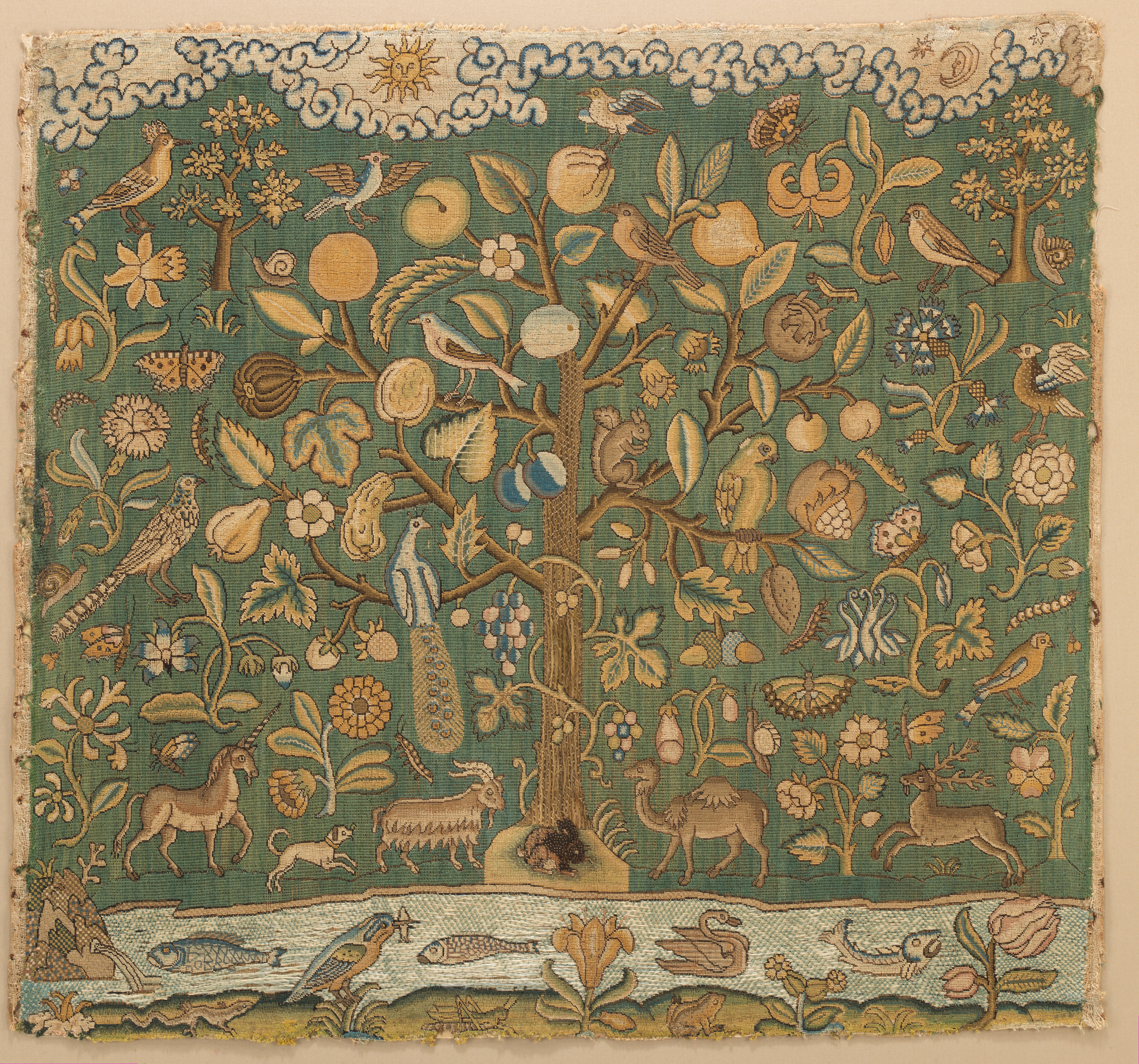
The Tree of Life: An Heirloom in Thread
In the rarefied atmosphere of haute couture, where innovation often masquerades as disruption, Katherine Fashion Lab’s “The Tree of Life” offers a profound counter-narrative. This standalone study, rendered in canvas and silk thread, is not a garment but a thesis—a meditation on permanence, heritage, and the tactile intelligence of the hand. It eschews the ephemeral buzz of the seasonal calendar for a slower, more deliberate form of luxury, one that speaks to the enduring power of global storytelling.
At first glance, the piece presents a deceptively simple iconography: the arborial form, a motif as old as human expression itself. Yet, within this universal symbol, the Lab has encoded a complex dialogue between cultures. The Tree of Life is not a single narrative but a confluence—appearing in the Celtic ogham as a symbol of cosmic balance, in the Persian cypress as a marker of immortality, in the Buddhist bodhi tree as enlightenment, and in the Abrahamic traditions as the axis of moral choice. By refusing to anchor the design in a single geographic tradition, Katherine Fashion Lab elevates the motif from folklore to a universal grammar of existence. This is Global Heritage not as appropriation, but as curation—a respectful acknowledgment that the roots of our collective consciousness are deeply intertwined.
Materiality as Memory: The Canvas and Silk Dialogue
The choice of materials is a masterclass in conceptual rigor. The canvas base is not a mere utilitarian ground; it is a deliberate counterweight to the opulence of the silk. Its coarse, unbleached texture evokes the earth, the bark, and the raw, unvarnished reality of nature. It is the terra firma upon which the entire narrative is built. This is a radical departure from the silk taffetas and organzas that dominate couture ateliers. Here, the canvas is not a hidden structural layer but a visible, honest partner in the creative process. It grounds the piece in a philosophy of authenticity, suggesting that true luxury is not the absence of imperfection, but the mastery of it.
Against this rugged foundation, the silk thread performs a breathtaking ballet. Silk, with its natural proteinaceous luster, possesses an unrivaled ability to refract light. The Lab has exploited this property with surgical precision. The trunk of the tree is not a solid block of color but a shimmering, dimensional column, its surface alive with the play of light and shadow. This is where the materiality transcends mere decoration and becomes metaphor: the canvas represents the immutable, the structural; the silk, the ephemeral, the luminous spirit. Together, they form a synthesis—a reminder that life itself is a fragile, brilliant thread woven through a robust, unyielding reality.
Technical Virtuosity: A Lexicon of Stitches
The technical execution is where Katherine Fashion Lab separates itself from the merely competent. The piece is a veritable encyclopedia of embroidery, deploying tent, Gobelin, and couching stitches with an intellectual rigor that borders on the academic. This is not decorative embroidery; it is structural embroidery, where each stitch is a deliberate mark of intent.
- Tent Stitch: The foundational half-cross stitch, worked diagonally, provides the dense, tapestry-like background. This is the soil of the piece—a quiet, rhythmic murmur of thread that establishes the tonal depth and sets the stage for the central figure. Its uniformity is a testament to the artisan’s discipline.
- Gobelin Stitch: A longer, upright stitch, the Gobelin is used to model the trunk and primary branches. Its elongated structure allows for subtle gradations of hue, creating the illusion of bark, muscle, and sinew. The Lab has used this stitch to articulate the tree’s chi—its life force—giving the trunk a palpable sense of growth and tension.
- Couching: The most dramatic of the techniques, couching involves laying a thicker silk thread along the surface and securing it with fine, invisible stitches. Here, it is used for the foliage and the intricate root system. The couched threads are laid in swirling, concentric patterns, creating a dense, sculptural canopy that appears to burst from the canvas. This is not flat work; it is relief work, with the threads rising and falling to mimic the organic chaos of leaves and the gnarled grip of roots.
The mastery lies not in the mere execution of these stitches but in their orchestration. The transition from the dense, dark Gobelin of the trunk to the lighter, airy couching of the canopy is seamless, a visual crescendo that mirrors the tree’s own journey from earthbound anchor to skyward aspiration.
Contextual Analysis: The Standalone Study as a Luxury Object
The designation of this piece as a standalone study is critical to its interpretation. It is not a prototype for a garment, nor a swatch for a collection. It is a complete object of contemplation, designed to be framed, displayed, and revered. This positioning challenges the traditional hierarchy of fashion, where the garment is the ultimate endpoint. Here, the embroidery is the art, and the canvas is the gallery.
In a commercial landscape obsessed with wearability and immediacy, the standalone study is a radical act of defiance. It insists on the value of process over product, of durée over défilé. It is a luxury object in the truest sense: it cannot be mass-produced, its value is intrinsic to its hand-crafted singularity, and its consumption is purely intellectual and sensory. It is an invitation to pause, to inspect the millimeter-perfect tension of a couched thread, and to appreciate the years of practice compressed into a single, perfect stitch.
Furthermore, the piece functions as a rebuttal to digital saturation. In an era of AI-generated patterns and rapid prototyping, the hand-stitched canvas is a testament to the irreplaceable human element. The slight, intentional irregularities—the subtle variation in tension, the infinitesimal shifts in hue—are not flaws but signatures. They are the fingerprints of the artisan, the physical evidence of a human being’s focused attention over hundreds of hours. This is the new frontier of luxury: not the exclusivity of a brand name, but the exclusivity of human time and skill.
Conclusion: The Root of All Luxury
Katherine Fashion Lab’s “Tree of Life” is more than an embroidery; it is a philosophical position. It asserts that the future of couture lies not in technological novelty, but in a return to the primacy of the hand and the depth of cultural memory. By fusing the humble canvas with the regal silk, and by deploying a global lexicon of stitches, the Lab has created an object that is at once ancient and avant-garde. It is a quiet, powerful reminder that the most profound expressions of luxury are not those that shout, but those that whisper the stories of our shared heritage, one stitch at a time. In this study, the tree is not just alive; it is an eternal, shimmering testament to the art of patience.