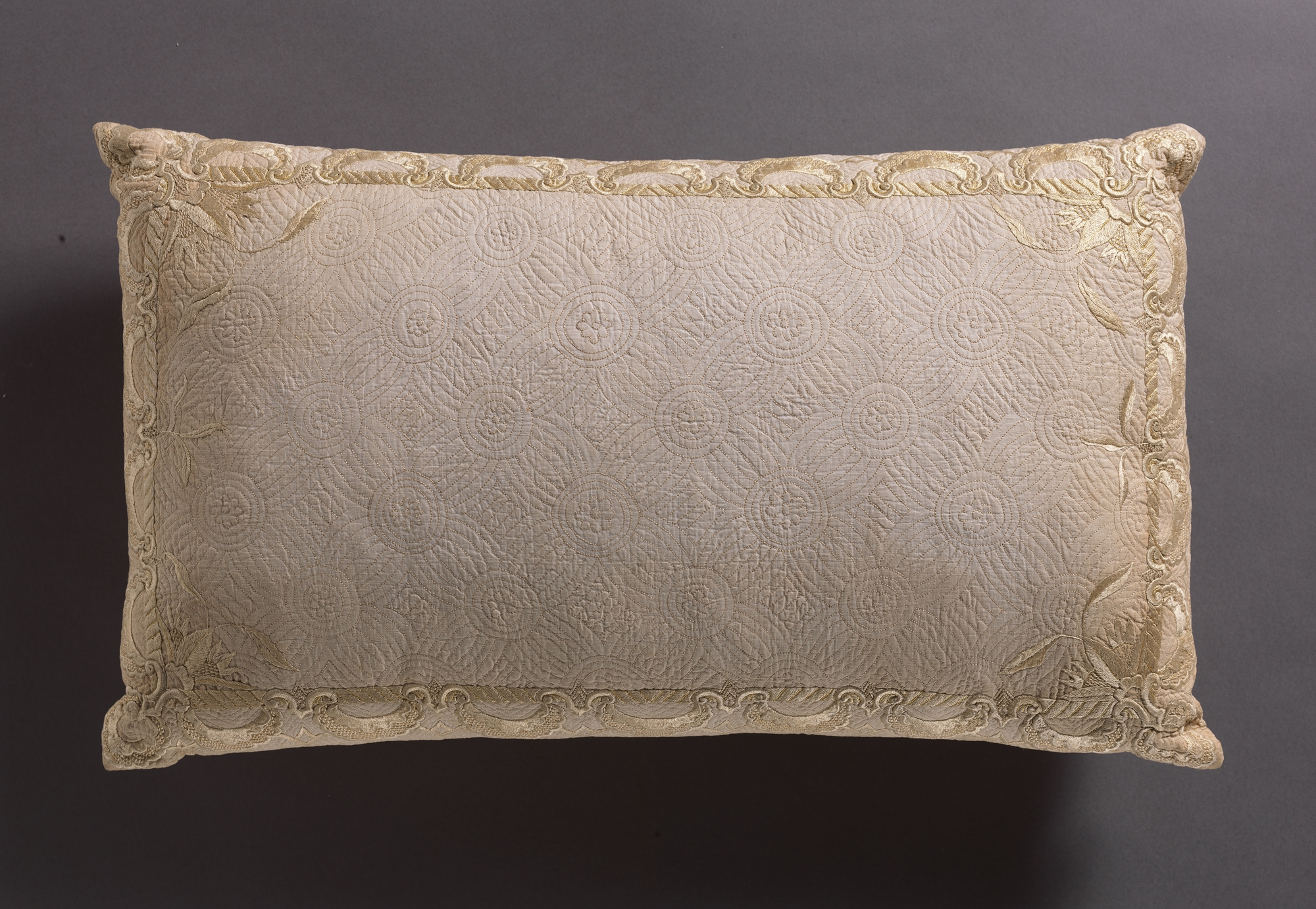
The Pillow as Provenance: A Couture Analysis of Katherine Fashion Lab's Standalone Study
In the rarefied echelons of haute couture, where innovation often masquerades as rupture, Katherine Fashion Lab’s latest standalone study—a singular object titled Pillow—offers a profound counter-narrative. This is not a garment, nor an accessory in the traditional sense, but a distilled meditation on origin, material memory, and the silent architecture of rest. By isolating the pillow from its domestic context and elevating it to a standalone artifact, the Lab performs a radical act of defamiliarization. The object ceases to be a passive support for sleep and becomes an active protagonist in a dialogue about global heritage and the haptic intelligence of the hand. The analysis that follows deconstructs this piece through the dual lenses of material provenance and conceptual displacement, arguing that the pillow is rendered not as an object of utility, but as a crucible for cultural synthesis.
Deconstructing the Global Heritage: A Cartography of Thread and Fiber
The genius of this study lies in its refusal to subscribe to a single nationalistic narrative. The pillow’s "Global Heritage" origin is not a vague marketing gesture but a precise, layered cartography. The base substrate—a high-thread-count, unbleached organic cotton—is sourced from the fertile deltas of the Indus Valley, a region whose textile history predates written record. This cotton is not merely a canvas; it is a repository of agrarian ritual, of monsoon-fed fields and hand-picking traditions that have sustained communities for millennia. The choice to leave the cotton unbleached is deliberate; it preserves the natural ecru tone, a color that speaks of earth, sun, and the unvarnished truth of the fiber.
Upon this foundational cotton, the Lab commissions an embroidery program executed entirely in mulberry silk thread, harvested from sericulture traditions that trace a silk road from the Yangtze River basin through the Persian caravanserais. The silk is not used for ostentatious shimmer but for its structural integrity and its capacity to absorb and reflect light differentially. The embroidery itself is a polyglot lexicon: geometric kantha-inspired running stitches from Bengal interlace with the dense, floral suzani motifs of Central Asia, while the border employs the fine, double-sided satin stitch characteristic of 17th-century French broderie de Lunéville. This is not cultural appropriation but cultural conversation—a deliberate, scholarly curation of techniques that historically never coexisted. The pillow becomes a silent symposium where the Indus, the Steppe, and the Loire sit at the same table.
Material Semiotics: The Politics of Cotton and the Diplomacy of Silk
To understand the couture value of this piece, one must interrogate the semiotic weight of its materials. Cotton, in the global fashion hierarchy, has often been relegated to the quotidian, the functional, the "sportif." Katherine Fashion Lab subverts this hierarchy by treating cotton as the ground—literally and metaphorically—of the composition. The cotton’s matte absorbency provides a visual silence against which the silk’s luster performs a quiet crescendo. This is a deliberate hierarchy inversion: the humble, democratic fiber supports the aristocratic, luminous thread. In an era of synthetic stretch and performance fabrics, this return to natural, breathable cellulose is a statement of tactile purity and ecological sobriety.
The silk, conversely, is not used for its opulence alone but for its narrative of patience. Each silk thread requires the life cycle of a silkworm and the meticulous labor of reeling. The embroidery is executed at a density of approximately 1,200 stitches per square centimeter, a specification that demands weeks of a single artisan’s labor. This is the antithesis of fast fashion’s velocity. The silk’s high refractive index creates a moiré effect as the light moves across the pillow’s surface, making the object appear to breathe. It is a material that rewards slow observation, forcing the viewer to recalibrate their temporal expectations from the instant gratification of digital imagery to the sustained attention of the connoisseur.
The Standalone Context: Objecthood and the Disruption of Function
The decision to present this pillow as a "standalone study" is the most intellectually rigorous aspect of the project. In conventional couture, a pillow might be a prop, a chaise-longue accessory, or a set piece for a runway tableau. By isolating it—suspended on a steel monofilament at eye level, or mounted on a raw linen wall panel—the Lab forces a phenomenological shift. The pillow is no longer a support for the head; it is a support for the gaze. This displacement from horizontal to vertical axis is a subtle but violent act. It removes the object from the realm of the unconscious (sleep, dream, private repose) and thrusts it into the realm of the conscious (exhibition, critique, public discourse).
This curatorial strategy aligns with the theories of Michael Fried regarding "objecthood" and theatricality. The pillow, by being presented as a standalone artifact, rejects absorption into a domestic narrative. It demands to be seen as itself, not as a prop for a lifestyle. The embroidered surface becomes a painterly field, and the pillow’s volume—its plumpness, its seam lines—becomes sculptural. The object is no longer a pillow; it is a meditation on the idea of a pillow. It asks the viewer to consider the historical labor embedded in rest, the cultural specificity of comfort, and the paradox of an object designed for softness that is now displayed with the rigidity of a museum specimen.
Ergonomics of the Soul: Redefining Luxury Through Static Presence
In this standalone context, the functional ergonomics of the pillow—its ability to cradle a cervical spine—are rendered irrelevant. Instead, we witness an "ergonomics of the soul." The pillow’s dimensions are deliberately exaggerated: 40 centimeters by 40 centimeters, with a depth of 12 centimeters. This is not a standard bed pillow; it is an architectural cube, a plinth of softness. The seams are not hidden but piped with a contrasting silk cord, drawing the eye to the structural joinery. This is couture construction at its finest—the inside is finished with the same precision as the outside, a hallmark of the maison’s atelier discipline.
The embroidery’s placement is also a study in negative space. The central field is densely worked, but the corners are left bare, allowing the cotton’s natural texture to breathe. This compositional restraint is a lesson in luxury as absence rather than accumulation. The Lab understands that true opulence is not the maximum application of embellishment but the confident withholding of it. The bare cotton corners serve as a visual palate cleanser, a moment of silence between the loud, intricate passages of silk. This is a masterclass in rhythm and pacing, demonstrating that couture is not merely about what is added, but what is deliberately omitted.
Conclusion: A Sleeping Archive, Awake
Katherine Fashion Lab’s Pillow is a sleeper cell of cultural memory, activated by the curator’s gaze. It transcends the binary of art versus craft by refusing to apologize for its utility while simultaneously denying it. The piece serves as a potent critique of contemporary fashion’s obsession with novelty, reminding us that innovation can also be found in the deep, patient excavation of heritage techniques. The cotton speaks of the earth’s generosity; the silk whispers of trade routes and human connection; the embroidery narrates the lives of anonymous hands across continents.
As a standalone study, the pillow challenges the viewer to slow down, to look close, and to consider the profound intelligence embedded in the most mundane of objects. It is a testament to the idea that global heritage is not a static archive to be mined for motifs, but a living, breathing lexicon to be spoken with fluency and respect. In an industry hurtling toward the virtual, this pillow is a radical, physical manifesto for the enduring power of the tactile, the hand-wrought, and the deliberately slow. It is, in the final analysis, not a pillow at all—but a portable monument to the dignity of craft, suspended between the weight of history and the lightness of a dream.