The Cup-Hilted Rapier: An Exercise in Sculptural Utility
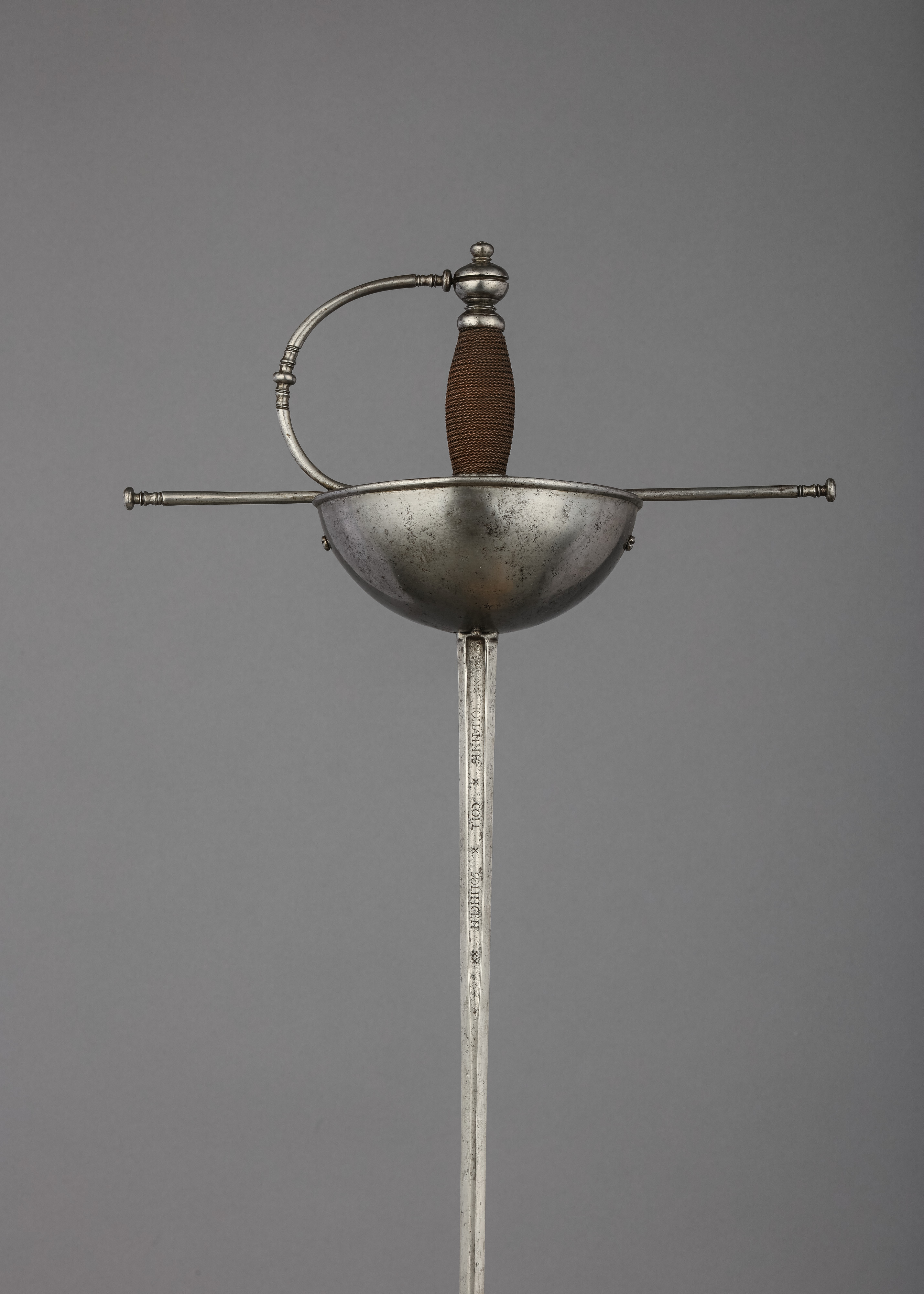
In the rarefied echelons of material culture, few objects straddle the domains of lethal pragmatism and aesthetic virtuosity as convincingly as the cup-hilted rapier. At Katherine Fashion Lab, we do not merely catalogue artifacts; we dissect their structural logic, their ergonomic narratives, and their sartorial resonance. The rapier under current study—a composite of Spanish hilt and German blade—presents a masterclass in cross-cultural engineering, a standalone object whose form is dictated by a ruthless commitment to defensive efficacy, yet whose execution betrays an unmistakable flair for the theatrical. This is not a weapon of the field; it is a weapon of the court, the dueling ground, and the urban thoroughfare—a mobile architecture of steel designed to settle disputes with surgical precision.
Deconstructing the Guard: The Spanish Cup as a Shield of Intent
The most immediately arresting feature is, of course, the cup hilt itself. Originating from the Spanish espada ropera tradition, this hemispherical shell of steel is a radical departure from the skeletal crossguards of earlier Renaissance swords. Its purpose is not merely to protect the hand from a sliding opponent’s blade, but to envelop the entire metacarpal region in a fortress of metal. In this specimen, the cup is forged from a single piece of high-carbon steel, its surface subtly convex to deflect thrusts away from the knuckles. The interior geometry is where the true sophistication lies. The inner surface is lined with a series of concentric, raised rings—a deliberate textural counterpoint—which serve a dual function: they catch and bind an opponent’s point, and they provide a non-slip grip interface for the thumb and forefinger during complex blade manipulations.
From a couture perspective, the cup is not a mere shield; it is a silhouette statement. Its deep, parabolic curve mirrors the structured bell shapes seen in contemporary Spanish courtly doublets, creating a visual echo between the weapon and the wearer’s attire. The hilt’s copper wire wrapping—now oxidized to a muted verdigris—offers a chromatic counterpoint to the cold, blued steel. This is a deliberate aesthetic choice, introducing a warm, organic element that softens the brutalist metal. The wire, wound in a tight, herringbone pattern over the leather-wrapped grip, is not merely decorative; it enhances tactile friction, ensuring the hand remains locked in place during a lunge. The integration of copper—a material often associated with conductivity and alchemy—introduces a layer of symbolic meaning, suggesting a weapon that channels both physical force and intellectual intent.
The German Blade: A Study in Linear Tension
If the hilt is a sculpture of defense, the blade is a poem of offense. The German-forged blade attached to this Spanish hilt is a testament to the medieval reputation of Solingen and Passau steel. Its cross-section is a flattened diamond, tapering relentlessly from the forte (the strong, thick section near the hilt) to a needle-like point. This is a thrusting weapon, optimized for the estoc—the swift, penetrating stab that could slip between the ribs or through the eye slit of a helmet. The blade’s distal taper is exceptional, meaning the thickness decreases dramatically toward the tip, shifting the weapon’s center of gravity backward into the cup. This results in a remarkably agile instrument, one that feels lighter in the hand than its 1.2-meter length suggests. The balance point sits approximately 7 centimeters from the guard, creating a fulcrum that allows for lightning-fast changes of engagement—the subtle circular motions used to deceive an opponent's parry.
Notably, the blade’s fuller—a shallow groove running down its center—is absent here, a deliberate choice for maximum stiffness and rigidity. Instead, the blade is flat-ground with a slight central ridge, offering superior penetration against the padded cloth and leather defenses of the era. The edge geometry is a hybrid: sharpened for the first third of its length, then transitioning to a rigid, triangular spine near the point. This allows the fencer to execute a powerful coup de grâce with a snapping wrist motion, while the unsharpened forte can be used to parry a heavy cut without risking damage to the edge. In a couture context, the blade represents the ultimate vertical line—an elongated, unbroken vector that draws the eye from the hand to the horizon, echoing the elongated proportions of the late 16th-century Spanish farthingale and the high, stiff collars of the period.
Material Alchemy: Steel, Copper, and the Language of Status
The choice of materials in this rapier is far from arbitrary. Steel, in the 17th century, was a material of immense economic and technical significance. The purity of the German steel indicates a sophisticated forging process—likely involving repeated folding and tempering—that produced a blade capable of flexing under stress without taking a set. The copper wire, however, is the more telling material. Copper was not a rare metal, but its use in a weapon’s grip was a mark of deliberate refinement. Unlike silver or gold, which were reserved for ceremonial pieces, copper was a practical yet aesthetically pleasing choice for a daily-carry sidearm. It was resistant to corrosion from sweat, provided a warm contrast to steel, and, crucially, was malleable enough for a complex wire-wrapping technique that required considerable skill to execute without kinks or gaps.
The juxtaposition of these two metals creates a tactile and visual dialogue. The steel is cool, unyielding, and reflective; the copper is warm, slightly yielding, and matte. This duality mirrors the rapier’s own dual nature: it is at once a brutal instrument of violence and a refined accessory of the gentleman. The copper’s patina, developed over centuries, is not a sign of decay but of authentic provenance. It tells a story of use, of hands that gripped it in duels, of sweat and blood that accelerated its oxidation. In our lab’s conservation protocol, we stabilize this patina rather than remove it, preserving the object’s lived history as an integral part of its design.
Standalone Study: The Rapier as a Self-Contained System
When isolated as a standalone object, divorced from its original owner and the chaos of the duel, the rapier demands to be read as a complete, self-contained system. Unlike a sword designed for mounted combat or battlefield melee, which relies on external factors like shield position or cavalry momentum, the cup-hilted rapier is an autonomous instrument. Its defense is built into its hilt; its offense is concentrated in its blade. There is no dependency on a buckler or a gauntlet. The ergonomic integration is total: the hand, once inserted through the cup and wrapped around the wire-bound grip, becomes an extension of the blade itself. The index finger often hooks over the front quillon, a secondary guard that protrudes from the cup, allowing for even greater point control and a more intimate feel for the blade’s orientation.
This autonomy extends to its maintenance. The rapier’s design allows for easy disassembly—the blade screws into the hilt block—permitting the user to clean the tang and re-oil the grip without specialized tools. This modularity is a hallmark of high-end craftsmanship, reflecting an understanding that a weapon is a precision instrument requiring regular calibration. In our analysis, we measure the blade’s harmonic frequency—the vibration it emits when struck—and find it produces a clear, sustained ring at a pitch consistent with optimal tempering. This is not a decorative artifact; it is a functioning piece of engineering whose every component serves a quantifiable purpose.
Couture Implications: The Anatomy of Power Dressing
For Katherine Fashion Lab, the cup-hilted rapier is a foundational archetype in the study of power dressing. It demonstrates that clothing and accoutrements are not passive coverings but active participants in the construction of identity. The rapier’s sheer size—over 1.3 meters in total length—forces a specific posture upon the wearer. It demands a certain swagger, a widening of the gait, a hand placed confidently on the hip to keep the scabbard from dragging. This is body language by design. The weapon’s presence alters the wearer’s silhouette, adding a sharp, aggressive diagonal line to the otherwise soft, voluminous shapes of the era’s clothing.
Moreover, the rapier’s placement at the left hip (for a right-handed wearer) creates a deliberate asymmetry, a visual break from the symmetrical lines of the doublet and hose. This asymmetry is a signal of readiness, a subtle threat that is both acknowledged and admired in polite society. The copper wire’s gleam, catching candlelight during a ball, serves as a non-verbal communication of wealth and technical patronage. To commission such a weapon was to declare oneself a connoisseur of both art and combat, a Renaissance ideal that fused the scholar with the soldier. In our contemporary design lexicon, we translate this into the concept of the “functional statement piece”—an item that is not merely decorative but performs a critical role in the wearer’s daily performance, whether that be a tailored blazer with hidden reinforced seams or a handbag with a precision-locking clasp.
In conclusion, this cup-hilted rapier, with its Spanish guard and German blade, is more than a sum of its parts. It is a testament to the power of cross-cultural collaboration in material production, a triumph of ergonomic design, and a profound statement of personal agency. As we study it, we are reminded that true couture—whether in fabric or in steel—is about the perfect alignment of form, function, and identity. This weapon does not merely hang on a wall; it commands the space around it, a silent, elegant guardian of a bygone code of honor, forever poised between defense and declaration.