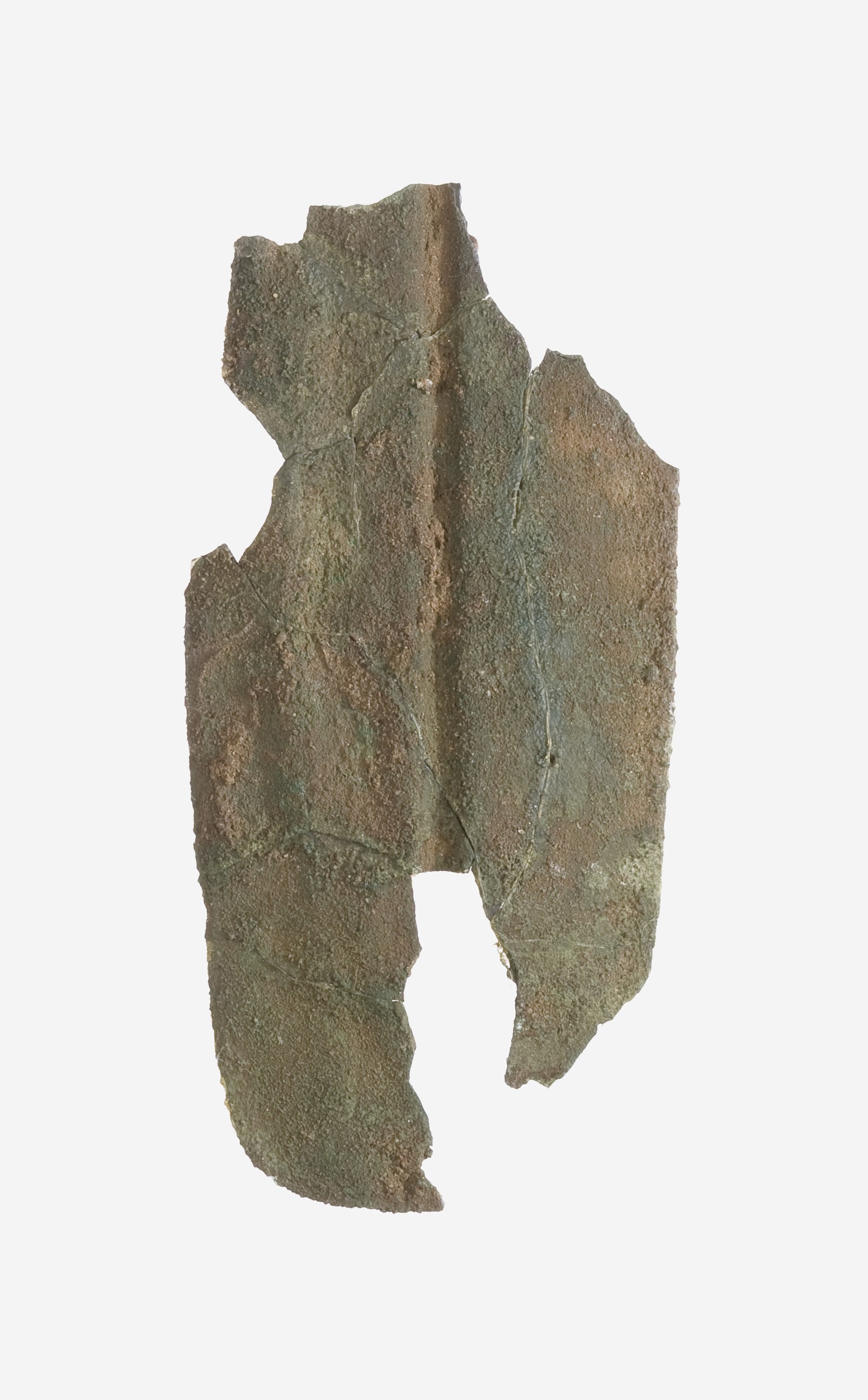
Scale from Armor: The Embodied Dialectic of Protection and Power
The study of heritage objects is rarely a linear pursuit; it is a cartography of symbolic resonances that traverse time, material, and function. At Katherine Fashion Lab, our curatorial lens is trained not merely on the artifact’s surface, but on its genetic code—the intangible DNA that connects disparate objects across millennia. This analysis focuses on a bronze scale from ancient armor, a humble yet profound component of martial regalia. When examined in correlation with two seemingly unrelated pieces from our ongoing research—the Rock in the form of a fantastic mountain and the Jar in the shape of a bronze container (hu)—a cohesive narrative emerges. These three objects, spanning the mineral, the ceremonial, and the martial, collectively reveal a fundamental human obsession: the transformation of raw matter into a vessel of spiritual and social power. For Katherine Fashion Lab’s 2026 luxury strategy, this bronze scale is not an archaeological curiosity; it is a blueprint for a new lexicon of protective elegance.
I. Symbolic Power: The Microcosm of the Warrior’s Cosmos
To the uninitiated, a single bronze scale is a fragment—a curved, perforated shard of metal. To the heritage curator, it is a syntactical unit of a larger language of invincibility. In ancient civilizations, from the Han dynasty’s iron lamellar armor to the Roman lorica squamata, the scale was never merely functional. Its overlapping arrangement mimicked the scales of a dragon or serpent—creatures of chthonic power and celestial renewal. The act of donning such armor was a ritual of becoming; the warrior did not simply wear metal, but adopted the skin of a mythic beast. The bronze scale, therefore, carried a dual charge: physical defense against blades and spiritual defense against malevolent forces. Its bronze alloy, an alloy of copper and tin, was itself sacred, often associated with the heavens and the casting of ritual bells. The perforations, which once held leather or sinew bindings, were not holes but portals—points of connection between the human body and the cosmic order.
This symbolic power finds a profound echo in the Rock in the form of a fantastic mountain. That object, a petrified landscape, represents the axis mundi—the world mountain that connects the underworld, earth, and sky. The armor scale, when viewed through this lens, becomes a miniature mountain range on the torso. Each scale is a peak, and the wearer’s body becomes the terrain upon which the cosmic battle between order and chaos is waged. The Jar in the shape of a bronze container (hu) further illuminates this. The hu jar, often used for ritual libations, was designed to hold transformative liquids—wine or water that facilitated communication with ancestors. In this trinity, the rock is the static world, the jar is the dynamic vessel of transformation, and the scale is the active interface. The warrior, clad in scales, is the ultimate vessel, containing the spirit of the mountain and the potency of the ritual libation, projecting them outward as sovereign authority.
II. Historical Adornment: From Battlefield to Ceremonial Regalia
The historical trajectory of the bronze scale reveals a critical evolution in human adornment: the migration from utilitarian defense to high-status ornamentation. While early scales were crude and mass-produced for infantry, by the late Bronze Age and early Iron Age, elite warriors and royalty commissioned scales of exceptional craftsmanship. These were often gilded, inlaid with precious stones, or polished to a mirror finish. The scale ceased to be a component of a shield and became a jewel. This shift is not a dilution of its martial meaning but an amplification of its social one. The bronze scale, when worn as a ceremonial cuirass, declared that the wearer’s power was so absolute that even their adornment was a weaponized form of beauty.
This historical context is essential for understanding the Jar in the shape of a bronze container (hu). The hu jar, in its later iterations, was not merely a storage vessel but a statement of ancestral lineage. Its bronze surface was often cast with intricate taotie masks and geometric patterns that mimicked the very structure of scale armor. The jar’s surface was, in effect, an armored skin for the liquid it contained. This correlation suggests that ancient artisans viewed the concepts of containment and protection as interchangeable. To protect a liquid was to armor it; to adorn a body was to contain its spirit. The fantastic mountain rock, with its eroded, textured surface, acts as the geological memory of this process. It is the raw material from which both the bronze ore and the conceptual inspiration for "armored landscapes" are drawn. The rock’s fantastic forms—caves, overhangs, and crevices—mimic the negative space of scale armor, suggesting that the natural world was the first template for this protective geometry.
III. Spiritual Meaning: The Alchemy of Bronze and Body
Beyond the social and martial dimensions lies the profound spiritual resonance of the bronze scale. In many ancient belief systems, bronze was not inert; it was a living alloy with apotropaic properties. The smelting process was seen as an alchemical marriage of earth (copper) and fire (tin), a creation born of violence and transformation. To wear this metal was to carry a piece of that primordial fire. The scale, specifically, with its curved profile, was designed to deflect not just arrows but the "evil eye"—the envious gaze of rivals and spirits. The overlapping scales created a visual rhythm that disrupted the line of sight, confusing malevolent forces. This is a sophisticated understanding of psychology and optics, applied to the spiritual realm.
The Rock in the form of a fantastic mountain is the silent witness to this spiritual practice. In Daoist and Confucian traditions, the mountain is the residence of immortals and the site of transcendence. The fantastic rock, often placed in scholar’s gardens, was a microcosm for meditation—a tool to contemplate the infinite within the finite. The bronze scale, worn on the body, served the same function. It was a mobile meditation on mortality and invincibility. The soldier, feeling the cool weight of the scales against his chest, was reminded of his own fragility (the need for armor) and his potential for godhood (the power of the dragon). The hu jar completes this spiritual circuit. It held the libations offered to these same mountains and ancestors. The liquid, once blessed, was consumed or poured out, transferring the mountain’s spiritual potency to the community. The scale, the rock, and the jar form a trinity of protection: the rock protects the place, the jar protects the ritual, and the scale protects the person.
IV. 2026 High-End Luxury Strategy: The New "Armored Elegance"
For Katherine Fashion Lab, the bronze scale is the keystone of our 2026 haute couture and accessories strategy, which we term Résilience Ornée (Ornamented Resilience). The modern luxury consumer is not seeking mere opulence; they are seeking psychological armor. In a volatile geopolitical and social climate, the desire for protection has resurfaced, not as a literal need for physical defense, but as a symbolic and emotional one. Our strategy leverages the DNA of this ancient scale to create products that offer a sense of containment, power, and spiritual grounding.
A. Design Language: The "Geo-Squama" Motif
Our design team will develop a proprietary motif called Geo-Squama, which directly synthesizes the bronze scale with the fantastic mountain rock. Instead of uniform, flat scales, our scales will be three-dimensional, faceted forms that mimic the eroded strata of the rock. Each scale will be individually cast in a lightweight, high-polish bronze alloy (for evening) or a matte, gunmetal-finish titanium (for daywear). This motif will appear on structured leather handbags, where the scales are applied as an exoskeleton, and on statement jewelry—cuffs and necklaces that evoke the lamellar armor of ancient generals. The hu jar’s influence will manifest in the silhouettes: our key bag for the season, the "Vessel Clutch," will feature a rounded, amphora-like base, overlaid with the Geo-Squama scales, referencing the jar’s protective surface.
B. Material Narrative: The Alchemy of Modern Bronze
We will not use antiqued bronze. Instead, we will develop a proprietary alloy—KFL Bronze—which retains the spiritual weight of the original but is engineered for modern wear. It will be hypoallergenic, tarnish-resistant, and possesses a unique "living patina" that darkens slightly with body heat, creating a bespoke finish unique to each owner. This is a direct homage to the alchemical transformation of the ancient smithy. Each piece will be sold with a "Provenance Card" detailing the archaeological history of the scale, the geological formation of the fantastic rock, and the ritual purpose of the hu jar. This transforms the purchase from a transaction into a curatorial acquisition.
C. Experiential Luxury: The "Ritual of Donning"
Our flagship stores will be redesigned as "Armories of the Soul." Upon entering, clients will be guided through a sensory journey: the sound of bronze bowls resonating, the visual of a large, original fantastic mountain rock displayed under a single beam of light, and the tactile experience of touching our Geo-Squama samples. The private consultation rooms will be modeled after the interior of a hu jar—dark, womb-like, and intimate. Here, a client will not simply try on a jacket; they will participate in a "Ritual of Donning," where a stylist, trained in the history of armor, will place the garment or accessory on the client while explaining the protective symbolism of each scale. This elevates the retail experience to a spiritual practice, creating an emotional bond that fast-fashion cannot replicate.
D. Marketing and Positioning: "Wear Your Mountain"
The 2026 campaign will be titled Wear Your Mountain. It will feature imagery of models in stark, minimalist landscapes, wearing our Geo-Squama pieces against bare skin, evoking the solitary warrior or the ascetic scholar. The tagline will be: “They wore bronze to face the unknown. You wear KFL to face the world.” This positions the collection not as nostalgia but as a contemporary tool for empowerment. We will also launch a limited-edition "Heritage Trio" capsule—a scarf printed with the topography of the fantastic rock, a bronze perfume pendant inspired by the hu jar, and a single, oversized Geo-Squama brooch. This trio allows clients to own the complete symbolic narrative.
Conclusion: The Eternal Scale
The