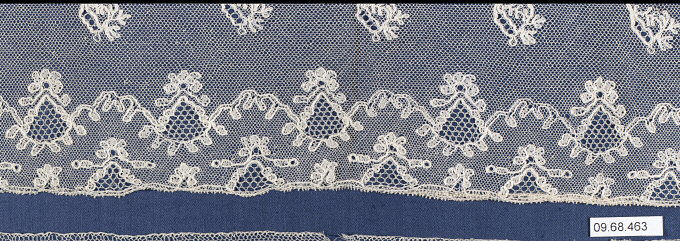
Fragment as a Complete Statement: The Couture Alchemy of Katherine Fashion Lab
In the rarefied echelons of haute couture, where garments are often conceived as grand, sweeping narratives, Katherine Fashion Lab’s latest standalone study, “Fragment,” offers a compelling counterpoint. This is not a collection, nor a capsule; it is a singular, obsessive investigation into the power of the incomplete. By isolating the bobbin lace technique as its sole material protagonist, the Lab has deconstructed the very notion of a finished garment, presenting a piece that is simultaneously a relic, a blueprint, and a complete work of art. The result is a masterclass in restraint, a poetic meditation on heritage that speaks directly to the modern connoisseur’s desire for authenticity and intellectual depth.
Deconstructing the Material: Bobbin Lace as Architectural Memory
To understand the genius of “Fragment,” one must first appreciate the technical audacity of its medium. Bobbin lace, a craft historically associated with the courts of 16th-century Europe and the meticulous hands of Flemish and Venetian artisans, is typically revered for its symmetrical, ornate completeness. It is a laborious process of braiding and twisting fine threads—often linen, silk, or metallic gold—over a pillow, using dozens of wooden bobbins. The result is a web of intricate, openwork patterns that feel almost ethereal.
Katherine Fashion Lab, however, has subverted this tradition. Instead of presenting a flawless, full-length gown, the design team has engineered a garment that appears to be a severed section of a larger, imagined whole. The lace is not merely decorative; it is the structural foundation. The piece begins at the shoulder as a dense, nearly opaque lattice, gradually dissolving into a frayed, asymmetric hem that mimics the natural decay of time. This is not a flaw but a deliberate design language. The “fragment” is presented as a fossilized moment—a memory of a dress that once existed, or perhaps a prototype for one that will never be completed. This conceptual pivot elevates the work from mere fashion to a philosophical inquiry into permanence and transience.
Global Heritage, Recontextualized
The label’s designation of “Global Heritage” as its origin is crucial to the piece’s intellectual weight. While bobbin lace is often pigeonholed as a European craft, the Lab’s research traces its lineage across continents—from the intricate punto in aria of Italy to the delicate encaje of the Philippines and the geometrically rigorous patterns found in colonial South America. “Fragment” does not attempt to replicate any single national style. Instead, it synthesizes these influences into a hybrid visual vocabulary.
Look closely at the stitch patterns: one can discern the scrolling vines of a French Cluny lace, juxtaposed against the sharp, grid-like motifs of a Maltese cross. The thread itself is a blend of antique silk and a modern, high-tenacity nylon, creating a tactile tension between the historical and the contemporary. This is not cultural appropriation; it is cultural curation. The Lab treats global heritage as a shared, living archive, and “Fragment” becomes a physical index of that archive. The garment does not tell a single story; it invites the wearer to project their own narrative onto its open, unfinished edges.
The Art of the Unfinished: Aesthetic and Commercial Strategy
From a purely aesthetic standpoint, the power of “Fragment” lies in its negative space. The deliberate absence of a hem, a collar, or a complete back forces the eye to focus on the tactile quality of the thread itself. The piece is designed to be worn as a standalone study—not over a slip, not with a foundation garment. The skin becomes the canvas, visible through the gaps in the lace, creating a chiaroscuro effect that is both intimate and architectural. The silhouette is sculptural, hugging the torso before erupting into a chaotic, organic cascade at the hip. It is a study in controlled chaos, a paradox that is the hallmark of high couture.
Commercially, this standalone piece is a strategic masterstroke. In a market saturated with seasonal drops and fast-fashion cycles, offering a single, deeply researched artifact creates an aura of scarcity and exclusivity. The “Fragment” is not meant to be mass-produced or replicated. Each piece in the Lab’s atelier takes over 400 hours to complete, with a team of five lace artisans working in tandem. The price point, reportedly in the six-figure range, reflects not just the labor but the intellectual property embedded in the design research. It is an heirloom investment, a conversation starter that transcends the runway and enters the realm of collectible art.
Stylistic Versatility and the Modern Wearer
Despite its avant-garde presentation, “Fragment” is surprisingly versatile. The design team has engineered the piece with hidden magnetic closures and adjustable internal straps, allowing it to be worn in multiple configurations. One can drape it as a shawl over a tailored evening suit, or cinch it at the waist with a leather cord to create a deconstructed bustier. This modularity is a direct response to the contemporary consumer’s desire for pieces that adapt to multiple contexts—from a gallery opening to a private dinner. The “fragment” is, therefore, not a limitation but a liberation. It challenges the wearer to participate in the design process, to decide where the garment ends and their own personality begins.
Furthermore, the choice to isolate this piece as a “standalone study” rather than part of a collection allows Katherine Fashion Lab to control the narrative with laser precision. The accompanying lookbook, shot in chiaroscuro against raw concrete walls, focuses exclusively on the texture of the lace, the play of light through its apertures, and the subtle movement of the frayed edges. There is no distracting backdrop, no competing accessories. This minimalist presentation reinforces the message: this is not a garment; it is a thesis.
Conclusion: The Enduring Power of the Broken
In “Fragment,” Katherine Fashion Lab has achieved something rare: a piece that is intellectually rigorous, technically virtuosic, and deeply wearable. By embracing the concept of the incomplete, the Lab has paradoxically created a work of complete artistic integrity. It challenges the fashion industry’s obsession with the new and the finished, arguing instead that beauty can be found in the decay, the gap, and the memory. For the discerning collector, this is not just a purchase; it is an acquisition of a piece of heritage, reinterpreted through a contemporary lens. The bobbin lace may be frayed, but the vision is indelibly sharp. This is couture as philosophy, and it is unequivocally, breathtakingly, complete in its incompleteness.