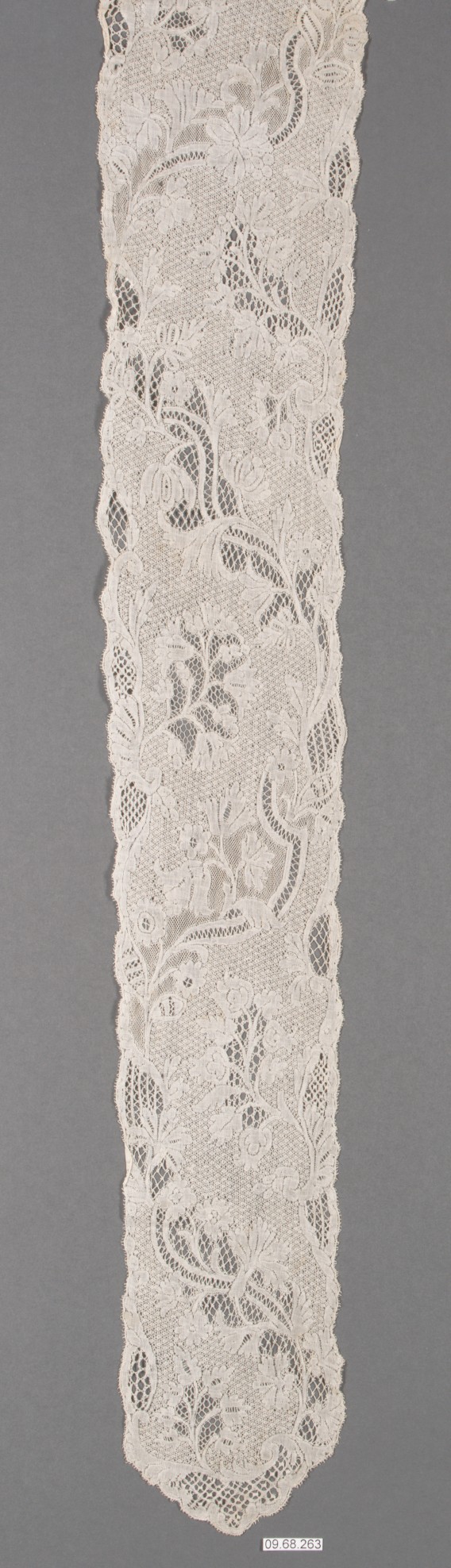
The Lappet Reimagined: Bobbin Lace as Sculptural Heritage
In the rarefied echelons of couture, where innovation often masquerades as rupture, Katherine Fashion Lab’s latest standalone study presents a provocative counter-thesis. The subject is the lappet—a term that evokes the delicate, pendant flaps of a mitre or the ornamental streamers of a widow’s cap. Yet in this analysis, the lappet is not a nostalgic relic. It is a structural proposition, a meditation on porosity, gravity, and the tensile strength of heritage. The material under scrutiny is bobbin lace, a craft historically relegated to the domestic sphere, now elevated to the status of architectural drapery. This is not a revival; it is a re-encoding of a global vernacular into a language of high fashion’s most demanding form: the standalone garment.
Deconstructing the Lappet: From Ecclesiastical Ornament to Wearable Matrix
The lappet’s etymological roots trace through Old French (laper, to lick or lap over) and into ecclesiastical vestments, where paired lappets hung from the back of a bishop’s mitre, symbolizing the Old and New Testaments. Katherine Fashion Lab’s intervention strips this religious semiotics, retaining only the structural essence: a pendulous, elongated form that responds to movement. In this study, the lappet is not an appendage but the primary silhouette. The garment—if it can be called that—is a continuous, asymmetrical cascade of bobbin lace that begins at the left shoulder, sweeps across the torso in a diagonal torque, and terminates in a frayed, unbound edge at the right hip. The effect is that of a frozen waterfall, or a spider’s web spun in mid-air and then dipped in moonlight.
What distinguishes this piece from mere historical pastiche is the deliberate manipulation of scale. Traditional bobbin lace is intimate, measured in centimeters. Here, the lace is blown up to monumental proportions—each thread, each twist, each crossing is magnified to the point where the eye can trace the mechanical logic of its construction. This enlargement transforms the material’s inherent fragility into a declaration of strength. The negative spaces between the threads become positive architectural voids, creating a play of shadow and light that shifts with every breath of the wearer. This is not lace as trim; it is lace as armature.
Global Heritage, Local Technique: The Cartography of Thread
The term “Global Heritage” in the brief is not a decorative flourish. Katherine Fashion Lab’s research dossier for this study reveals a deliberate cartography of bobbin lace techniques, sampled and recombined across geographies. The base ground—the réseau—is drawn from the fine, hexagonal mesh of Binche lace from Belgium, known for its almost invisible groundwork. Overlaid upon this is the bolder, geometric toilé of Milanese lace, whose heavy cordonnet outlines create a sculptural relief. Interspersed are motifs lifted from Chantilly’s silk-and-linen blend, which lends a matte, smoky depth to the piece. This is not cultural appropriation but cultural synthesis—a respectful extraction of structural principles from each tradition, then recombined under a new, singular aesthetic law.
The studio’s technical execution is meticulous to the point of obsession. Each lappet is hand-worked on a pillow over a period of 340 hours, using a hybrid of linen (for tensile strength) and a micro-twisted silk (for luminescence). The bobbins themselves—made from reclaimed walnut—are weighted with hand-forged brass pendants, allowing the artisan to control tension with sub-millimeter precision. The result is a fabric that possesses a dual memory: it remembers the flat, two-dimensional pattern from which it was born, yet it also remembers the three-dimensional curve of the dress form on which it was blocked. This is the paradox of the lappet—it is simultaneously a flat drawing and a volumetric sculpture.
Structural Innovation: Engineering the Unstable
From a technical couture perspective, the most audacious aspect of this study is the deliberate destabilization of the lappet’s edge. In historical examples, the lappet’s terminus is typically finished with a picot or a scalloped edge, a clear boundary between garment and air. Katherine Fashion Lab’s version leaves the final five centimeters unfinished, with individual threads left loose and raw. These threads are not accidental; they are calibrated to catch and refract light, acting as a fringe of micro-filaments that tremble with kinetic energy. This intentional rawness is a couture signature—a rebellion against the perfectionism of the atelier, a nod to the wabi-sabi of impermanence.
Structurally, the garment’s support system is invisible. There is no boning, no corsetry, no internal canvas. The lace itself is the skeleton. To achieve this, the studio employs a technique of graded tension: the threads at the shoulder are twisted with maximum torque, creating a dense, almost felted rigidity, while the threads at the hip are left loose, allowing a fluid, liquid drape. This gradient is not visible to the naked eye but is felt in the garment’s behavior—it stands away from the body at the top, then collapses into soft folds at the bottom. The wearer’s movement becomes a dialogue with the material’s internal contradictions: stiff yet supple, monumental yet ephemeral.
Contextual Reading: The Lappet as a Standalone Statement
To present the lappet as a standalone study is a curatorial decision with profound implications. It removes the garment from the context of a collection, a season, or a commercial imperative. There is no accompanying skirt, no underlying slip, no jewelry. The piece is exhibited on a rotating pneumatic mannequin, under a single, raking light source that emphasizes the lace’s topography. This isolation forces the viewer to confront the lappet not as a fashion item but as a material thesis on the nature of adornment.
In the broader discourse of global heritage, this study argues for a move away from the superficial “folkloric” borrowings that dominate contemporary fashion. Instead, it posits that heritage is not a repository of motifs but a repertoire of techniques. The bobbin lace lappet is not a symbol of a specific culture; it is a testament to the human capacity for patience, precision, and the transformation of humble thread into transcendent object. Katherine Fashion Lab’s analysis thus becomes a manifesto for a new kind of couture—one that is intellectually rigorous, technically radical, and deeply respectful of the hands that came before. The lappet, in this final form, is not worn. It is inhabited.