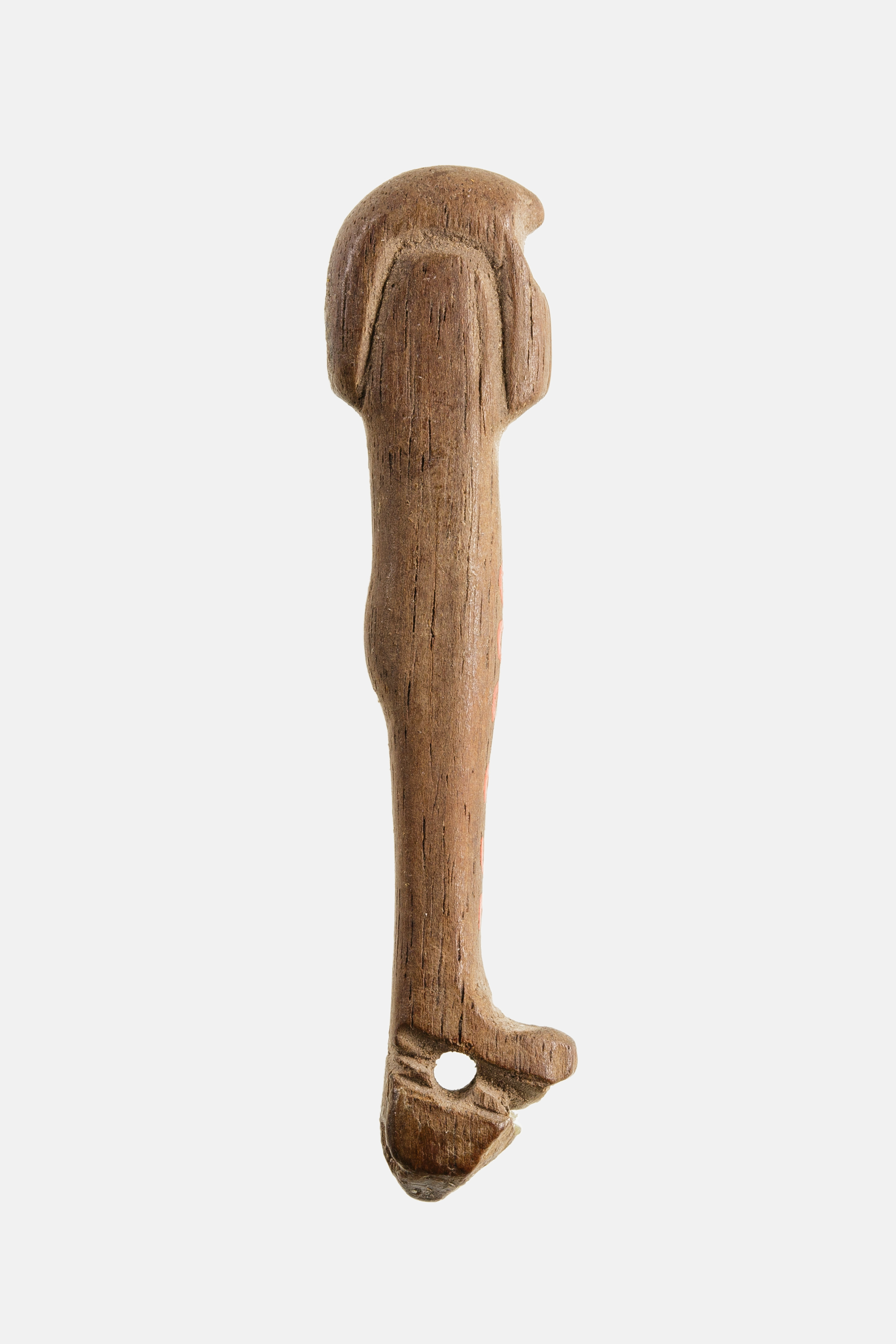
Executive Heritage Analysis: The Mummiform Horus Figure Amulet
This strategic research paper examines the mummiform Horus figure amulet, a wooden artifact from ancient Egyptian civilization, as a foundational reference for Katherine Fashion Lab’s 2026 high-end luxury strategy. The analysis decodes the amulet’s symbolic power, historical adornment context, and spiritual meaning, translating these into actionable brand narratives that transcend mere ornamentation. In an era where luxury consumers seek authenticity and metaphysical resonance, this artifact offers a potent lexicon of protection, transformation, and divine kingship—values that align seamlessly with Katherine Fashion Lab’s positioning as a curator of meaningful opulence.
Symbolic Power: The Convergence of Divine Protection and Regeneration
The mummiform Horus figure, rendered in wood, is not a passive representation but an active agent of cosmic protection. Horus, the falcon-headed deity, embodies the living pharaoh’s authority and the triumph of order over chaos. When fused with the mummiform shape—a form reserved for Osiris, god of the afterlife—the amulet synthesizes two distinct divine energies: Horus’s terrestrial sovereignty and Osiris’s promise of resurrection. For Katherine Fashion Lab, this duality translates into a brand ethos of controlled power and cyclical renewal. The 2026 collection should not merely reference Egyptian motifs; it must encode this tension between visible strength (Horus) and hidden potential (Osiris) into garment silhouettes, textile structures, and accessory hardware.
Wood, as the medium, amplifies this symbolism. Unlike precious metals or faience, wood is organic, perishable, yet enduring through preservation. It signifies grounded divinity—a sacredness that does not shout but persists. In luxury strategy, this suggests a move away from ostentatious gem-encrusted statements toward materials that age with dignity: patinated leathers, carved hardwoods, and botanical-dyed silks. The amulet’s materiality teaches that true power in 2026 will be quiet, tactile, and rooted in natural provenance, appealing to collectors who value imperfection as a marker of authenticity.
Historical Adornment: The Amulet as Wearable Theology
Ancient Egyptians did not adorn themselves for mere aesthetics. Amulets were placed on the body—often over the chest or wrapped within mummy linens—to activate specific divine protections in life and death. The mummiform Horus amulet, typically suspended by a cord or set into a pectoral, was a portable shrine. Its wearer carried a fragment of the divine, ensuring that Horus’s vigilant eye and Osiris’s regenerative power were always proximate. This historical function repositions adornment as a ritual act, not a superficial gesture.
For Katherine Fashion Lab, this historical context demands a reimagining of the jewelry and accessory category. The 2026 strategy should introduce a “Ritual Adornment” line—pieces designed to be worn with intentionality, perhaps featuring hidden compartments, magnetic closures that mimic ancient clasps, or engraved invocations on interior surfaces. The amulet’s wooden nature also suggests a palette of deep mahogany, ebony, and sandalwood tones, paired with bronze and oxidized silver to evoke aged temple relics. Each piece should be accompanied by a digital provenance card explaining its symbolic function, transforming a purchase into an initiation.
Spiritual Meaning: The Amulet as a Nexus of Transformation
The mummiform Horus amulet operates on multiple spiritual planes. First, it is a psychopomp—a guide for the soul’s journey through the Duat (underworld). Second, it is a talisman of rebirth, ensuring the wearer’s ka (life force) and ba (personality) reunite after death. Third, it is a ward against entropy, fixing the body’s form so that it may be reanimated. These functions are not archaic superstitions; they mirror contemporary anxieties about identity fragmentation and digital impermanence. Luxury consumers in 2026 will increasingly seek objects that promise continuity of self in a volatile world.
Katherine Fashion Lab can operationalize this spiritual meaning through a “Transformation Atelier” concept—limited-edition garments that include modular elements: detachable collars resembling ancient wesekh necklaces, sleeves that can be bound like mummy wrappings, and interior linings printed with hieroglyphic sequences of protection. The amulet’s mummiform shape also inspires a new outerwear silhouette: a long, columnar coat with wrapped closures, evoking both the bandaged form and the falcon’s sleek profile. This is not costume; it is wearable metaphysics, offering the wearer a tangible link to a lineage of resilience.
2026 High-End Luxury Strategy: From Artifact to Brand Archetype
The strategic translation of this amulet into Katherine Fashion Lab’s 2026 roadmap requires a multi-tiered approach. First, narrative ownership: the brand must position itself as the sole interpreter of “Neo-Horatic” luxury, a term coined for this collection that fuses ancient protective symbolism with contemporary minimalist construction. Second, material innovation: wooden amulets inspire a collaboration with master woodworkers to create sculptural belt buckles, brooches, and bag clasps, each carved with a unique variant of the Horus eye. These objects become collectible art, not mere accessories, with a resale value narrative akin to limited-edition prints.
Third, experiential retail: flagship stores should feature a “Chamber of Rebirth” installation, where clients are invited to participate in a symbolic wrapping ritual—selecting a garment, having it sealed with a wax emblem of the Horus falcon, and receiving a small wooden amulet replica as a certificate of authenticity. This transforms shopping from transaction to pilgrimage, building deep emotional loyalty. Fourth, digital phygital integration: each amulet-inspired piece will carry an NFC chip that unlocks an AR experience, allowing the wearer to see the artifact’s original context overlaid on their own body—a bridge between ancient sanctity and modern tech-savvy luxury.
Finally, pricing architecture: the amulet’s wood medium suggests a tiered strategy. Entry-level items (silk scarves with woven Horus motifs) at $450–$800; mid-tier (carved wooden pendants and cuffs) at $1,200–$3,500; and haute pieces (the mummiform wrap coat, hand-finished in limited numbers) at $8,000–$15,000. Each tier must carry the same symbolic weight, ensuring that the amulet’s power is democratized without diluting its exclusivity. The 2026 campaign tagline, “Carry the Unbroken,” directly references the amulet’s protective function while appealing to modern desires for integrity and endurance.
Conclusion: The Amulet as Strategic North Star
The mummiform Horus figure amulet is a masterclass in condensed meaning—a small wooden object that holds the weight of an entire cosmology. For Katherine Fashion Lab, this artifact provides a robust framework for a 2026 luxury strategy that is both historically literate and commercially visionary. By embracing its symbolic power, historical adornment function, and spiritual depth, the brand can differentiate itself in a saturated market where superficial trend-chasing no longer suffices. The amulet teaches that true luxury is not about addition but about essentialization—stripping away the extraneous to reveal a core of protective, transformative power. Katherine Fashion Lab’s 2026 collection, therefore, will not simply sell clothes; it will offer wearable amulets for a modern world in search of lasting meaning.