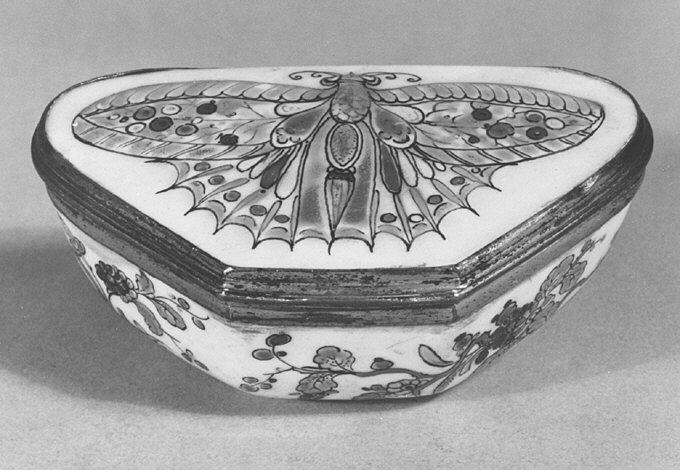
The Snuffbox as Micro-Architecture: A Couture Analysis of Katherine Fashion Lab's Global Heritage Study
In the rarefied echelons of fashion scholarship, few objects command the quiet authority of the snuffbox. At first glance, it is a utilitarian relic—a vessel for powdered tobacco, a gentleman's pocket accessory of the 18th century. Yet within the walls of Katherine Fashion Lab, this object is elevated to the status of micro-architecture, a wearable miniature that encapsulates the entire ethos of global heritage, craft transmission, and the semiotics of luxury. The subject of this standalone study—a soft-paste porcelain snuffbox adorned with gilt copper mounts—is not merely an artifact. It is a treatise on scale, materiality, and the politics of adornment, rendered in dimensions that fit the palm of a hand.
Deconstructing the Object: Materiality as Narrative
The snuffbox's primary body is soft-paste porcelain, a material that historically represented Europe's aspirational imitation of Chinese hard-paste porcelain. Unlike its East Asian predecessor, soft-paste is a hybrid—a composite of white clay, glass frit, and lime, fired at lower temperatures. This technical distinction is not a flaw but a testament to cross-cultural adaptation. In the context of Katherine Fashion Lab's "Global Heritage" lens, the soft-paste body becomes a metaphor for the fashion industry's own iterative borrowing: the West's desire to replicate the exotic, only to create a new, distinct vernacular. The porcelain's creamy, slightly translucent surface offers a canvas that is at once fragile and enduring, a paradox that mirrors the life cycle of couture itself—ephemeral in its seasonal relevance, yet archival in its preservation.
The gilt copper mounts—the hinges, the rim, the clasp—are not mere functional appendages. They are the structural exoskeleton that elevates the snuffbox from craft object to luxury commodity. Gilt copper, or ormolu, was a technique perfected in France, requiring multiple layers of mercury-gilding to achieve a burnished, almost liquid gold finish. In this standalone study, the mounts serve as a dialogue between the organic and the metallic: the porcelain's cool, matte tactility against the copper's warm, reflective brilliance. The fashion analyst must note that this juxtaposition is a precursor to modern haute couture's own material pairings—think of a silk faille bodice anchored by a sculpted metal corset, or a cashmere coat trimmed with laser-cut brass. The snuffbox, in its microcosm, prefigures the architectural tension that defines contemporary runway construction.
Provenance and the Politics of Global Heritage
The designation "Global Heritage" is not a passive label; it is a curatorial stance. This snuffbox, likely produced in a European atelier (possibly Sèvres or Meissen) but inspired by Chinese and Japanese export wares, embodies the 18th-century global supply chain. The porcelain body may have been painted with chinoiserie motifs—pagodas, birds, or floral sprays—that were themselves reinterpretations of East Asian aesthetics, filtered through European imagination. Katherine Fashion Lab's study urges us to see this not as cultural appropriation but as cultural translation, a pre-industrial form of globalized design thinking. The snuffbox is a physical record of trade routes, diplomatic gifts, and colonial exchanges. Its presence in a standalone study—removed from a larger collection—forces the viewer to confront its singularity as a bearer of multiple narratives.
In fashion terms, this is akin to the modern designer who sources ikat from Uzbekistan, brocade from Lyon, and embroidery from Mumbai, then synthesizes them into a single garment. The snuffbox's global heritage is not a footnote; it is the core thesis. The gilt copper, for instance, may have originated as South American silver or African gold, smelted and reworked in European foundries. Thus, the object is a palimpsest of colonial economies, each layer of material bearing the invisible weight of extraction and labor. Katherine Fashion Lab's analysis insists that we read the snuffbox as a supply-chain artifact, long before the term "sustainability" entered the fashion lexicon.
Scale and the Semiotics of the Pocket
One of the most profound insights of this standalone study is the role of scale. The snuffbox is designed to be held, opened, and passed among a circle of peers. Its size—typically 5 to 7 centimeters in width—demands a proxemic intimacy. Unlike a gown or a coat, which is viewed from a distance, the snuffbox is a tactile object of social performance. The act of taking snuff was ritualized: a tap on the lid, a pinch between thumb and forefinger, a delicate inhalation. Each gesture was a display of refinement, a choreography that showcased one's jewelry, lace cuffs, and the prized box itself. In this sense, the snuffbox is the ancestor of the modern wristwatch or the designer handbag—a status signal that operates in close proximity to the body.
From a couture perspective, the snuffbox's scale challenges the notion that fashion is inherently about the large or the voluminous. It argues for micro-couture, where the precision of a hand-painted porcelain panel is equivalent to the hand-stitched sequin work on a ballgown. The gilt copper mounts, with their intricate chasing and engraving, require a loupe to appreciate fully—much like the interior seams of a bespoke suit, which are invisible to the casual observer but signal the highest level of craft to the connoisseur. Katherine Fashion Lab's study thus positions the snuffbox as a pedagogical tool for understanding hidden labor in luxury fashion.
The Gilt Copper Frame: A Study in Contrast
The choice of gilt copper, rather than solid gold or silver, is economically and aesthetically significant. Copper, when gilded, offers the visual weight of gold at a fraction of the cost, but it also introduces a temporal instability. Over centuries, the gilding wears away, revealing the copper's reddish undertones—a patina that tells the story of use and age. In fashion, this is analogous to the distressed luxury trend, where new garments are artificially aged to mimic vintage authenticity. Yet the snuffbox's aging is organic, not manufactured. The worn edges of the hinge, the slight dulling of the rim where fingers have grasped it for two hundred years, are biographical markers. They transform the object from a static artifact into a witness to human interaction.
Moreover, the gilt copper provides a structural counterpoint to the porcelain's fragility. Porcelain chips, cracks, and breaks; copper bends, dents, and tarnishes. The marriage of the two materials is a study in mutual reinforcement. The copper mounts protect the porcelain's vulnerable edges, while the porcelain's rigidity gives the box its shape. This interdependence is a metaphor for the collaborative nature of couture: the embroiderer relies on the tailor, the tailor on the pattern cutter, and so on. No single element can exist without the others, and the snuffbox's survival into the 21st century is a tribute to this symbiotic engineering.
Standalone Study: The Object as Autonomous Text
By isolating the snuffbox in a "standalone study," Katherine Fashion Lab makes a deliberate curatorial choice. The object is not contextualized within a vitrine of other snuffboxes or a period room of 18th-century furniture. Instead, it is presented as a singular, autonomous text, inviting deep reading rather than comparative analysis. This approach aligns with the lab's philosophy that objects of heritage are not merely historical documents but active participants in contemporary design discourse. The snuffbox, when viewed alone, ceases to be a relic of a bygone era and becomes a living proposal for material innovation.
For the modern fashion professional, the standalone snuffbox offers three key lessons. First, material honesty: the soft-paste porcelain does not pretend to be hard-paste; it celebrates its own hybridity. Second, ornament as function: the gilt copper is not decoration applied after the fact but is integral to the box's operation. Third, scale of intimacy: luxury need not be monumental to be impactful; a two-inch object can carry more cultural weight than a ten-foot gown. These lessons are directly transferable to contemporary design briefs, from jewelry collections to compact leather goods, where the challenge is to pack narrative, craft, and utility into a small footprint.
Conclusion: The Snuffbox as a Couture Archetype
In closing, the snuffbox examined by Katherine Fashion Lab is far more than a historical curiosity. It is a micro-architectural masterpiece that condenses the complexities of global trade, material science, and social ritual into a handheld form. The soft-paste porcelain body speaks to the adaptive innovation of artisans who borrowed from the East to create a new Western identity. The gilt copper mounts exemplify the structural elegance that defines high craftsmanship. And the standalone presentation underscores the object's autonomy as a work of art, independent of its original function.
For the couture analyst, this snuffbox is a reminder that fashion's most profound statements are often found in its smallest details. The precision of a hinge, the glaze of a porcelain panel, the patina of a copper edge—these are the elements that separate a garment from a costume, an accessory from a trinket. Katherine Fashion Lab's study does not merely preserve a piece of heritage; it re-activates it as a blueprint for future design. In a world of fast fashion and disposable trends, the snuffbox stands as a quiet, enduring testament to the power of slow, deliberate, and globally informed making. It is, in every sense, a couture object for the ages.