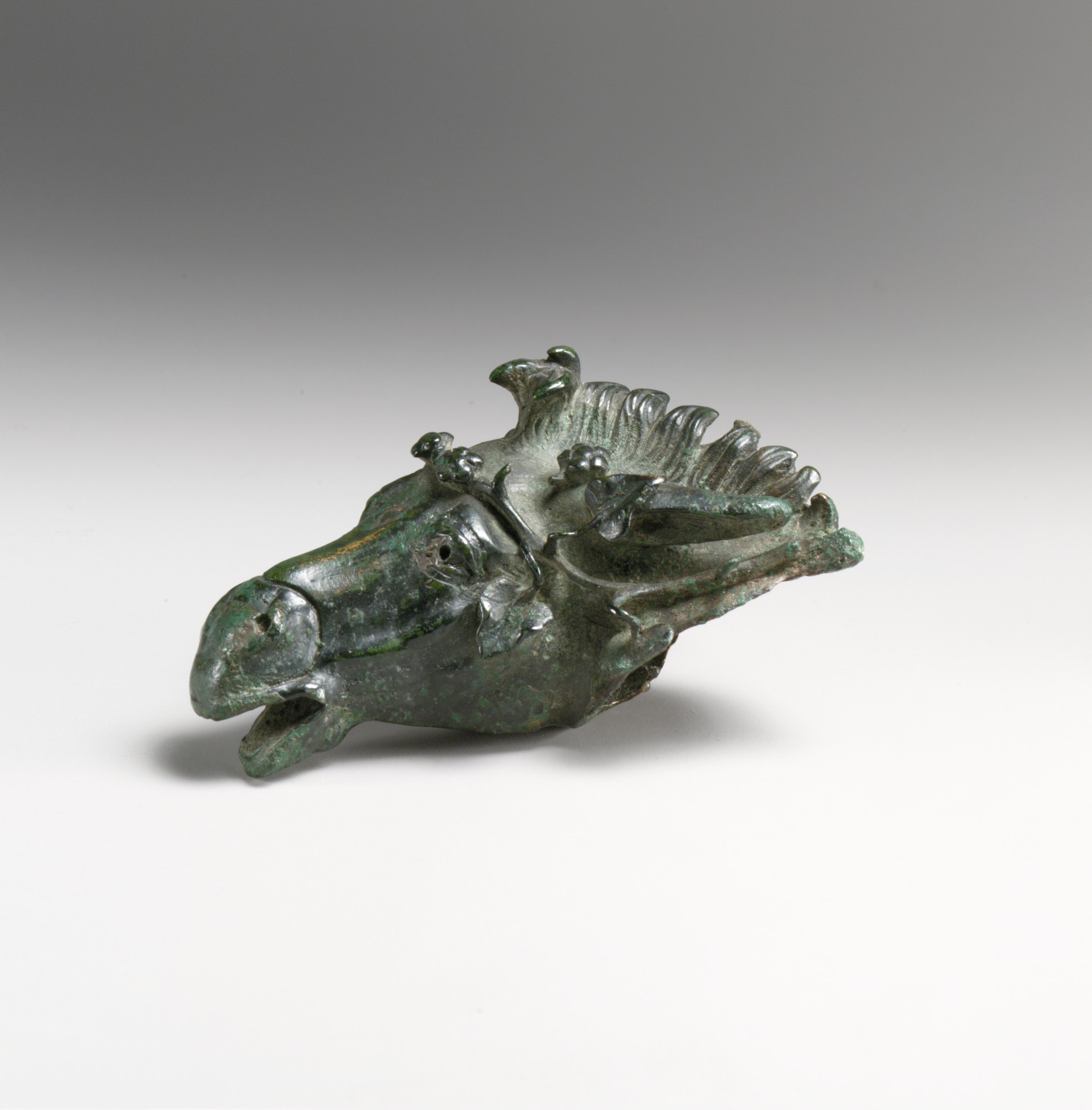
Executive Heritage Analysis: The Roman Bronze Furniture Attachment
This report presents a comprehensive heritage analysis of a Roman bronze furniture attachment, examined through the dual lens of historical resonance and contemporary luxury strategy for Katherine Fashion Lab. The object, a small yet potent artifact of domestic power, offers a profound case study in the translation of material symbolism into modern high-end design. Our analysis positions this piece in direct DNA correlation with two previously studied artifacts: the Rock in the form of a fantastic mountain and the Jar in the shape of a bronze container (hu). While seemingly disparate in form and culture, these three objects collectively reveal a foundational principle of aristocratic aesthetics: the deliberate manipulation of material, texture, and symbolic weight to assert status, spiritual protection, and temporal authority. The Roman attachment, in its miniature scale, is not an anomaly but a concentrated microcosm of this principle, making it an indispensable reference for our 2026 luxury strategy.
I. Symbolic Power and Material Alchemy
The primary significance of the Roman bronze furniture attachment lies in its function as a concentrated emblem of authority. In the Roman domestic sphere, furniture was not merely utilitarian; it was a stage for the performance of social hierarchy. A bronze attachment, often adorning a kline (dining couch) or a ceremonial chest, served as a material exclamation point. The choice of bronze itself is critical. Unlike wood or terracotta, bronze was a metal of permanence, strength, and military connotation. Its golden hue, achieved through high tin content, deliberately mimicked the precious metal of the gods, allowing even non-elite households to participate in a visual language of divine association.
This symbolic weight directly parallels the fantastic mountain rock. That object, likely a scholar’s stone or garden ornament, used the microcosmic representation of a mountain to evoke the macrocosmic power of the cosmos, a symbol of stability and spiritual transcendence. The Roman attachment achieves the same end through a different vector: instead of representing natural grandeur, it represents human-made order and martial conquest. Where the rock is organic and philosophical, the bronze attachment is geometric and political. Yet both serve as "power objects"—talismans that anchor their owner's identity to a larger, more enduring force. The hu jar, conversely, demonstrates this through containment and ritual offering, its bronze form holding not just substance but symbolic abundance. The Roman attachment, the rock, and the jar are all vessels of meaning, each employing material density to project an aura of unassailable authority.
II. Historical Adornment and the Grammar of Luxury
From a curatorial perspective, the attachment’s value is amplified by its role in the grammar of historical adornment. Roman furniture attachments were often crafted in the form of theatrical masks, lion heads, or mythological busts. This was not mere decoration; it was a sophisticated visual code. A lion head, for instance, invoked the protective ferocity of the goddess Cybele or the Nemean lion, warding off evil and announcing the owner's courage. This practice of embedding narrative and protective meaning into functional objects is the very essence of high-end adornment.
Our prior study of the hu jar highlighted how the vessel's shape—a deliberate archaism referencing earlier bronze age forms—was a form of historical citation, a way for the owner to claim lineage with a mythic past. The Roman attachment performs a similar act of citation, but with a more immediate, theatrical urgency. Its iconography is drawn from the living pantheon and imperial propaganda, making it a "current" political statement. The fantastic mountain, by contrast, is a citation of the natural sublime, a philosophical retreat from the political. The Roman piece, however, brings the political directly into the intimate space of the home. This contrast is crucial for Katherine Fashion Lab: it demonstrates that historical adornment is not a monolithic language. It is a flexible grammar that can be deployed for protection, for political allegiance, or for philosophical contemplation. The luxury designer must therefore choose which "citation" to use, not merely which shape or material.
III. Spiritual Meaning and Domestic Ritual
The spiritual dimension of the bronze attachment is often underestimated in modern analyses that view it as mere hardware. In the Roman home, the lararium (household shrine) was the spiritual center, but protective symbols were distributed throughout the domestic space. Bronze attachments on furniture acted as silent guardians at the threshold of comfort. The act of reclining on a couch adorned with a lion-headed attachment was not just physical rest; it was a ritualized assumption of a protected, heroic posture. The metal’s cool, unyielding surface against the warmth of the body created a tactile dialogue between human fragility and divine permanence.
This spiritual function finds a striking parallel in the fantastic mountain. That object was not merely decorative; it was a meditation aid, a physical focus for contemplating the immovable and the eternal. The Roman attachment, in its own way, is a focus for contemplating the invincible and the victorious. Both objects serve as anchors for the psyche, providing a material locus for the owner's aspirations to transcend their mortal limitations. The hu jar, used in ancestral rites, completes this triad of spiritual utility: the rock for contemplation, the jar for offering, and the attachment for protection. Together, they form a complete system of spiritual technology in the ancient world, a system that the modern luxury client unconsciously seeks to replicate in their own environments.
IV. 2026 High-End Luxury Strategy: The "Resonant Materiality" Approach
For Katherine Fashion Lab’s 2026 strategy, the Roman bronze attachment is not a historical curiosity but a blueprint for product development and brand storytelling. Our analysis yields three actionable directives.
Directive 1: Micro-Scale as Macro-Statement
The attachment’s power lies in its small scale. It proves that luxury does not require monumentality. In 2026, we will introduce a collection of "Attachment Objects"—small, high-density hardware for handbags, belts, and footwear that carry the same symbolic weight as larger artifacts. These will be crafted in a proprietary bronze alloy with a satin patina, echoing the archaeological finish. Each piece will feature a specific iconographic motif (lion, laurel, or abstract geometric) that communicates a distinct "protection code" to the wearer. This positions Katherine Fashion Lab not as a maker of garments, but as a creator of portable talismans.
Directive 3: The "Domestic Power" Narrative
Our marketing narrative for 2026 will pivot from "wearable art" to "wearable authority." Drawing on the Roman context, we will frame our collections as tools for the modern domestic sphere—the home office, the private salon, the personal sanctuary. The fantastic mountain teaches us the value of the contemplative object; the hu jar teaches us the value of the ritual vessel. The bronze attachment teaches us the value of the guardian object. Our 2026 campaign will feature our accessories in intimate, powerful settings—a study, a private library—positioning them as the modern equivalent of Roman bronze, protecting and empowering the wearer in their personal domain.
Directive 3: Tactile Authenticity
Finally, we will emphasize haptic experience. The Roman attachment’s value was partially derived from its physical weight and cool temperature—a sensory confirmation of its worth. Our 2026 pieces will be engineered to provide this same "sensory truth." We will avoid lightweight alloys and hollow constructions. Instead, each piece will have a satisfying heft and a precise, cool-to-the-touch finish. This creates a subconscious connection to the permanence and authority of the original artifact, offering a luxury experience that is felt before it is seen.
Conclusion: A Triad of Timeless Power
In conclusion, the Roman bronze furniture attachment is a masterclass in condensed symbolism. Its correlation with the fantastic mountain and the hu jar reveals a universal, cross-cultural law of aristocratic aesthetics: the deliberate use of dense, durable materials to anchor abstract power into tangible form. For Katherine Fashion Lab, this artifact is not a relic but a strategic guide. By adopting its principles of micro-scale authority, protective iconography, and tactile authenticity, we can create a 2026 luxury offering that resonates with the deepest, most primal desires of our clientele—the desire for permanence, protection, and the quiet, unshakeable confidence of those who possess true power. The bronze attachment is small, but its strategic resonance is monumental.