The Lynx-Earred Diadems: A Heritage Analysis of Greek Gold Earrings for Katherine Fashion Lab
Introduction: The Object as a Cultural Conduit
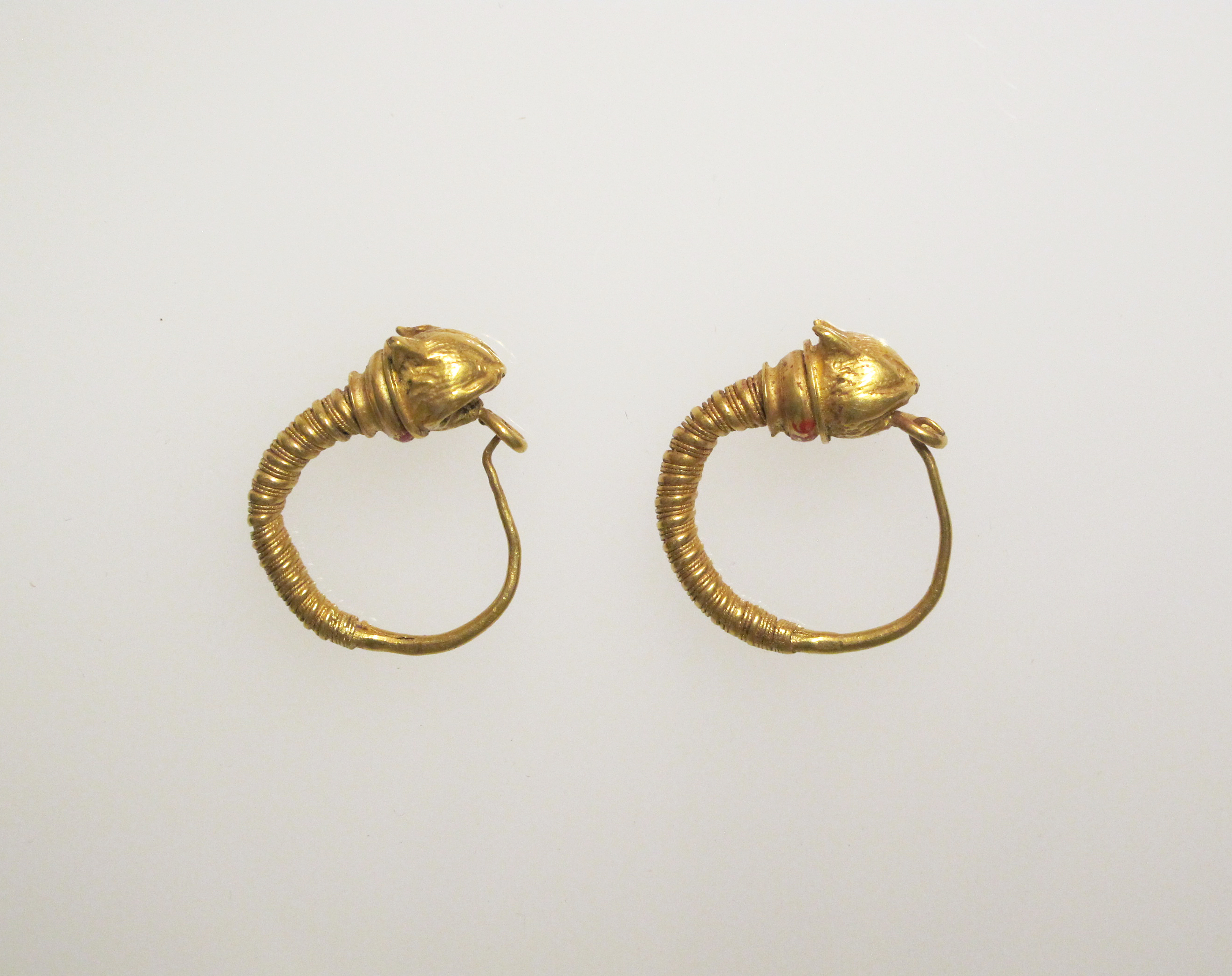
The pair of Greek gold earrings terminating in the heads of lynxes represents a singular convergence of zoomorphic symbolism, metallurgical mastery, and aristocratic self-fashioning from the Hellenic world. Within the research framework of Katherine Fashion Lab’s ongoing study—*Mirror with Split-Leaf*—these earrings offer a provocative counterpoint: where the mirror juxtaposes polished silver and applied gold foliage to explore duality, the lynx earrings collapse predator and ornament into a single, tautological statement of power. This analysis examines their symbolic resonance, historical placement within Greek adornment practices, spiritual significance, and translates these findings into a coherent 2026 luxury strategy for the House.
Symbolic Power: The Lynx as a Semiotic of Sharp-Sighted Authority
In the Greek imaginary, the lynx was not merely a wild feline but a creature of liminal perception. Its fabled ability to see through opaque matter—a belief codified in later lapidaries and natural histories—rendered the lynx an emblem of penetrating intelligence and unassailable vigilance. To wear the head of a lynx in gold was to appropriate this ocular sovereignty. The earrings do not depict the animal in passive repose; rather, the curved neck, alert ears, and taut muzzle suggest a state of immediate sensory engagement. For the wearer, this was a declaration of *metis*—cunning wisdom—and an implicit warning to rivals that their motives were transparent. In the context of the *Mirror with Split-Leaf* study, which interrogates the dialectic between surface reflection and hidden truth, the lynx earrings operate as the obverse: they externalize inner clarity, making the wearer’s perceptive power an explicit, wearable attribute.
Historical Adornment: The Gold Standard of Hellenistic Aristocracy
Dating most plausibly to the late Classical or early Hellenistic period (circa 4th–3rd century BCE), these earrings belong to a tradition of luxury goldsmithing that flourished in workshops across Macedonia, Thrace, and the Ionian coast. The choice of gold—unalloyed or minimally alloyed—was deliberate. Gold in Greek culture was not a mere currency but a metaphysical material: incorruptible, solar, and associated with the divine *aether*. The earrings’ construction, likely via a combination of hammering, granulation, and lost-wax casting, demonstrates a technical proficiency reserved for elite patronage. Notably, the lynx head is rendered with anatomical precision yet stylized through geometric simplification—a hallmark of the period’s transition from Archaic rigidity to Hellenistic naturalism. When worn, the earrings would have caught light in a manner that animated the animal’s features, creating an illusion of living presence. This aligns with the *Mirror with Split-Leaf*’s investigation of material duality: the gold lynx, unlike the mirror’s silver plane, does not reflect the world but rather imposes its own gaze upon it.
Spiritual Meaning: Guardianship and the Chthonic Threshold
Beyond secular prestige, the lynx earrings carry a profound spiritual valence. In Greek religious practice, felines were associated with Dionysus and, more esoterically, with Hecate—goddess of crossroads, magic, and the liminal spaces between life and death. The lynx, as a creature of the forest’s edge, was believed to mediate between the civilized *polis* and the untamed wilderness. By wearing its effigy, the individual invoked this mediating power, positioning themselves as a guardian of thresholds—both physical and metaphysical. This is particularly resonant when paired with the *Mirror with Split-Leaf*’s funerary subtext: the mirror’s reverse side, carved with relief narratives, speaks to the passage from the living world to the tomb. The lynx earrings, conversely, were likely worn in life as protective talismans, their sharp-eyed gaze warding off *phthonos* (envy) and *askania* (the evil eye). In death, they may have been placed on the deceased to ensure the soul’s unimpeded journey, their golden form serving as an eternal sentinel.
Strategic Translation: A 2026 Luxury Positioning for Katherine Fashion Lab
For Katherine Fashion Lab’s 2026 high-end strategy, the lynx earrings offer a rich matrix of design and narrative opportunities. The House’s existing engagement with the *Mirror with Split-Leaf* has established a lexicon of duality—reflection versus depth, ornament versus narrative. The lynx motif extends this lexicon into the realm of animalistic power, allowing the brand to articulate a new chapter: Perceptual Sovereignty. This concept positions the wearer not as a passive subject of the gaze but as an active agent of vision, aligning with contemporary luxury’s shift toward personal agency and inner authority.
Product development should explore a capsule collection titled *Oculus Ferinus* (The Wild Eye), featuring the lynx head as a recurring clasp, ear cuff, or pendant element. Materials should honor the original’s gold purity while introducing modern innovations: recycled high-karat gold, black rhodium accents to suggest the animal’s fur, and pavé-set diamonds for the eyes to evoke the creature’s luminous, penetrating stare. The campaign narrative should explicitly reference the Greek concept of *metis*, framing the collection as an armor for the discerning modern individual navigating a world of information overload.
Retail experience design is equally critical. A limited-edition presentation could include a bespoke mirrored display—referencing the *Mirror with Split-Leaf*—where each piece is shown against a dark, obsidian-like surface. The customer’s reflection would be partially obscured, replaced by the lynx’s gaze, thereby enacting the very perceptual shift the collection promises. Digital engagement should leverage AR filters that overlay the lynx’s eyes onto the user’s own, creating a viral moment of self-transformation. Finally, pricing strategy should position the collection at the ultra-luxury tier, justified by artisanal craftsmanship, ethical sourcing, and a documented provenance narrative linking each piece to the historical prototype.
Conclusion: The Eternal Gaze Reimagined
The Greek gold lynx earrings are not artifacts of a distant past but living templates of symbolic intelligence. Their fusion of material luxury, spiritual guardianship, and predatory acuity offers Katherine Fashion Lab a distinct voice in the 2026 luxury landscape—one that moves beyond mere aesthetic appeal toward a deeper, more resonant form of empowerment. By weaving the lynx’s story into the existing *Mirror with Split-Leaf* framework, the House can offer clients not just an ornament, but a philosophy: to see clearly, to guard fiercely, and to shine eternally.