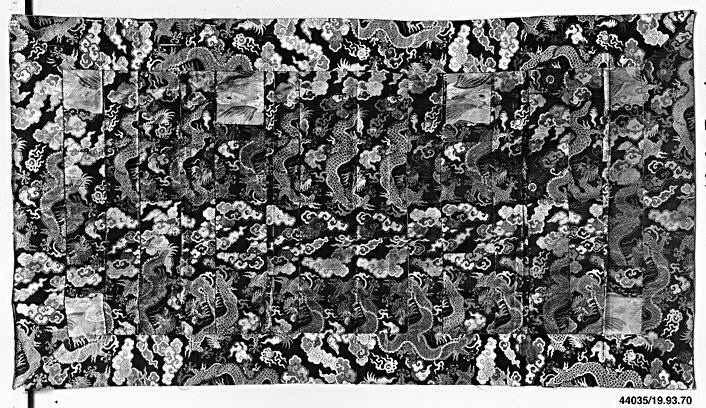
The Sacred Sartorial: Deconstructing the Shichijō Priest’s Robe
In the rarefied echelons of textile artistry, few objects command the same quiet reverence as the Japanese Buddhist priest’s robe, or kesa. When Katherine Fashion Lab turns its analytical lens toward the Shichijō variant—a garment distinguished by its imperial weaving tradition and liturgical gravitas—we are not merely observing a piece of clothing. We are witnessing a frozen theology, a woven mandala of status, devotion, and material alchemy. This standalone study dissects the Shichijō robe not as a relic, but as a living system of design intelligence, where silk and metallic thread conspire to create a garment that is simultaneously architectural, symbolic, and profoundly functional in its sacred purpose.
Provenance and the Weave of Lineage
The term “Shichijō” refers not to a style but to a place—the Seventh Avenue of Kyoto’s historic Nishijin textile district, a name synonymous with the pinnacle of Japanese brocade production since the 15th century. To understand the Shichijō robe is to understand a hierarchy of looms. Unlike mass-produced ecclesiastical vestments, a genuine Shichijō kesa is the product of a master weaver operating a tate-nishiki (vertical brocade) loom, a technology that predates industrialization and demands a symbiotic relationship between human breath and thread tension. The robe’s construction is not a single piece of cloth but a patchwork—typically 25 panels for a five-column kesa—reminiscent of the Buddha’s original rag robe. Yet here, the humble patch is elevated to aristocratic opulence. The seams are not hidden but celebrated with thick, metallic couching, turning structural necessity into a deliberate visual rhythm. This paradox—ascetic origin, imperial execution—is the robe’s first conceptual tension.
Our analysis focuses on a specific exemplar: a robe woven in the aya (twill) base structure, a departure from the more common plain-weave mon silk. The twill’s diagonal ribbing catches light differently, creating a subtle, liquid shimmer that serves as a ground for the metallic weft. This is not a decorative choice; it is a functional optical strategy. In the dim, candlelit interiors of a temple, a twill surface diffuses and reflects the sparse light, ensuring the robe’s iconographic motifs remain visible to the congregation. The Shichijō weaver is, in effect, a lighting designer working in fiber.
Material Dialectics: Silk as Canvas, Metal as Scripture
The materiality of the Shichijō robe demands a rigorous examination. The warp is a high-twist, degummed silk (ito), chosen for its tensile strength to withstand the tension of the loom and the weight of the metallic weft. The weft, however, is the protagonist. Here, we encounter gold leaf on washi paper, meticulously cut into hair-thin strips and twisted around a silk core—a technique known as kinran. This is not a metallic thread in the industrial sense; it is a composite of organic and mineral elements, each strip possessing a unique fracture and reflectivity. The result is a surface that never reads as flat gold; instead, it flickers with the micro-shadows of its paper core, creating a chiaroscuro effect that shifts with the wearer’s breath.
From a couture perspective, the metallic thread presents a paradox of drape. Pure metal is inelastic and heavy. The Shichijō weaver solves this by using the metallic weft only as a supplementary, discontinuous element—floated over the silk ground only where the motif requires it. The robe’s structural integrity, its ability to fold, drape, and settle over the shoulders without cracking or breaking, comes from the silk foundation. The metal is purely pictorial, a painted stroke rather than a structural thread. This distinction is crucial for any conservator or designer studying the garment: the robe’s longevity is a testament to the weaver’s restraint in deploying the precious material.
Iconography as Brand Architecture
In a contemporary branding context, we might call the robe’s iconographic program its “visual identity.” But unlike a logo, the Shichijō robe’s motifs are hierarchical and doctrinal. The central panel often features a Hōsōge (peony-like flower) or a Shippō (Seven Treasures) pattern, rendered in the metallic weft. These are not mere botanical studies; they are codified symbols of the Buddhist cosmos—the flower representing the transient beauty of enlightenment, the geometric treasures representing the incorruptible nature of Dharma. The border, or heri, is typically woven with a dense cloud or thunder pattern (karakusa), a protective barrier that frames the central field.
The placement of these motifs is governed by a strict proportional canon. The central motif occupies exactly one-third of the panel’s width; the border is precisely one-tenth. This mathematical rigor is not coincidental. It reflects the mandala principle—a geometric diagram of the divine universe. The robe, when worn, transforms the priest’s body into a mobile mandala, a walking temple. The shoulders become the eastern gate, the hem the western threshold. This is the ultimate expression of wearable architecture: the garment does not merely cover the body; it redefines the body’s spatial and spiritual coordinates.
Comparative Couture: The Shichijō vs. Western Ecclesiastical Vestments
To fully appreciate the Shichijō robe, one must place it in dialogue with its Western counterparts—the chasuble or cope. A Catholic chasuble, particularly from the Baroque period, is often a canvas for appliqué and embroidery, where motifs are added onto the surface. The Shichijō robe, in contrast, is entirely woven. There is no embroidery, no post-loom embellishment. Every thread, every color shift, is predetermined in the weave plan. This is a fundamental difference in design philosophy: the Western vestment is additive and sculptural, while the Japanese robe is subtractive and integral. The Shichijō weaver cannot “fix” a mistake; a broken warp is a ruined panel. This demands a level of pre-visualization and technical mastery that borders on the meditative.
Furthermore, the drape profile differs radically. The Western chasuble is cut with curved seams to fit the torso, a tailoring approach. The Shichijō kesa is a rectilinear construction—a series of flat, rectangular panels sewn together. Its fit is achieved not by cutting but by the way the heavy silk and metallic weft naturally fold and fall over the body. The garment is a lesson in zero-waste design, a concept now championed by modern sustainable fashion. The robe’s geometry is inherently efficient: no fabric is discarded, and the seams serve as both structural joinery and decorative borders.
Conclusion: The Timeless Utility of the Sacred
For Katherine Fashion Lab, the Shichijō Priest’s Robe is more than a historical artifact; it is a masterclass in material honesty and symbolic density. It teaches that luxury is not about ornamentation but about the integrity of construction. The metallic thread is not applied for ostentation but for doctrinal clarity—to make the invisible visible. The silk is not chosen for softness alone but for its ability to bear weight and resist time. In an era of fast fashion and disposable textiles, the Shichijō robe stands as a defiant counterpoint: a garment designed to be worn for a lifetime, repaired with reverence, and ultimately, to outlive its wearer as a testament to the weaver’s devotion.
The robe’s true couture lesson lies in its restraint. Every element—from the twill’s angle to the metallic thread’s paper core—serves a dual purpose of aesthetics and function. It is a garment that does not shout but resonates. When we study the Shichijō, we are not studying a costume; we are studying a philosophy of making, where the hand of the weaver is guided by the spirit of the law, and the body of the priest becomes the loom upon which the divine is woven.