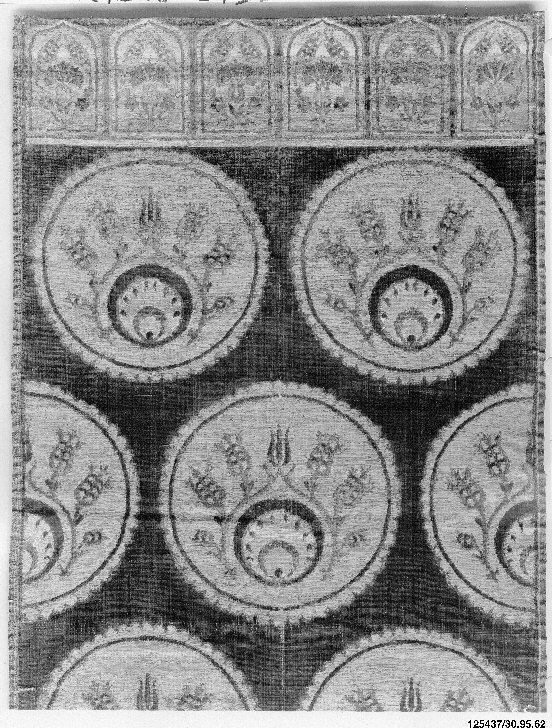
The Panel: A Cartography of Heritage in Silk and Void
Within the rarefied atmosphere of Katherine Fashion Lab’s atelier, the standalone study of a single textile artifact—the Panel—transcends mere object analysis. It becomes a masterclass in the dialectic between cultural memory and material innovation. This is not a garment awaiting a body, nor a swatch destined for a sketchbook. It is a complete, autonomous composition, a cartography of global heritage rendered in the most demanding of mediums: cut and voided velvet, silk, and metal-wrapped thread. The Panel demands to be read not as a fragment, but as a thesis on the enduring power of craft as a form of intellectual and aesthetic expression.
Deconstructing the Void: The Semiotics of Absence
The technical foundation of the Panel lies in the ancient and arduous process of voided velvet, a technique perfected across the silk routes of Persia, Italy, and Spain. Here, Katherine Fashion Lab does not merely employ the technique; she reinterprets its very grammar. The “void” is not a negative space but a positive, sculptural force. In traditional voided velvet, the pile is cut away to reveal a ground weave, creating a pattern of contrasting textures. Yet in this Panel, the void is manipulated with such precision that it reads as a topographical depression—a carved canyon of silk satin emerging from a raised, plush plateau of dyed pile.
The strategic use of cut pile creates a luminous, almost liquid surface that catches light in slow, undulating waves. In juxtaposition, the voided areas—where the metallic ground is exposed—function as fractured lines of a map, suggesting rivers, trade routes, or the fissures of geological time. This is a deliberate choreography of light absorption and reflection. The metal-wrapped thread, likely a composite of silk core and gilded silver, is not merely decorative; it is structural. It anchors the void, providing a stiff, reflective counterpoint to the softness of the silk pile. The result is a panel that appears to shift under observation, its surface a mutable terrain where plush darkness yields to hard, brilliant light.
Global Heritage as a Linguistic System
To label this piece as merely “inspired by” global heritage would be a gross simplification. The Panel operates as a syncretic text, weaving together distinct, non-contiguous traditions into a new, coherent language. One observes the structural logic of Safavid Persian textile design in the rhythmic, almost architectural spacing of the motifs—a sense of infinite repeat that suggests the cosmos. Yet, the execution of the forms, with their sharp, angular intersections, recalls the Mudejar aesthetic of post-Reconquista Spain, where Islamic geometric abstraction merged with Christian iconographic density.
Furthermore, the choice of metal thread is a direct nod to the Byzantine and Venetian luxury trade, where cloth of gold was a currency of empire, a portable treasury. However, Katherine Fashion Lab subverts the imperial connotation. There is no heraldic rigidity here. Instead, the metallic threads are used to draw what appear to be calligraphic flourishes—not literal script, but the *gesture* of writing. This is a profound act of translation. The Panel speaks of the Silk Road not as a historical relic, but as a living network of exchange, where motifs migrate, mutate, and merge. The design is a palimpsest: beneath the velvet’s surface, one senses the ghost of a Chinese cloud collar, the structure of an Ottoman caftan sleeve, and the fluidity of an Indian jamavar shawl pattern.
Material Alchemy: The Economics of Rarity
In an era of fast fashion and digital printing, the Panel stands as a defiant assertion of material authenticity. The production process is inherently slow, requiring a hand-operated loom or a highly specialized jacquard mechanism that can handle the tension of multiple warps—one for the silk pile, one for the ground, and one for the metallic weft. The labor is not hidden; it is celebrated in the density of the weave. Each centimeter of this Panel contains thousands of individual threads, each one a decision, a calculation of tension and hue.
The silk itself is a study in chromatic intelligence. The base is not a flat, uniform color. Instead, it is a deep, undyed ecru that has been mordanted to accept a spectrum of natural dyes—indigo for the deep blues, madder for the oxblood reds, and weld for the golden yellows that peek through the metallic grid. This is not the color of a Pantone swatch; it is the color of organic matter, of roots and insects and minerals. The metal-wrapped thread, conversely, offers a stark, inorganic brilliance. This contrast is the core of the Panel’s alchemy: the organic softness of the silk, which breathes and moves, against the rigid, eternal quality of the metal. It is a dialogue between the ephemeral and the permanent, the body and the relic.
Standalone Study: The Panel as Sculpture
The decision to present this as a “standalone study” is critical to its interpretation. Removed from the utilitarian context of a garment, the Panel is liberated from the constraints of drape, fit, and wearability. It becomes a sculptural relief, a two-dimensional architecture that invites frontal contemplation. It is a canvas, but one where the paint is woven, not applied. In this context, the edge of the panel—the selvedge—becomes a deliberate frame, a boundary that contains the chaotic energy of the design.
This curatorial choice elevates the textile from the realm of craft to the realm of fine art. The viewer is forced to confront the piece on its own terms: the physics of the light, the depth of the pile, the precision of the void. It is a study in haptic visuality; one’s eyes are compelled to “touch” the surface, to feel the difference between the smooth, cool metal and the warm, plush silk. The Panel, therefore, is not a preparatory sketch for a future collection. It is the final destination. It is a manifesto, woven in silk and metal, declaring that heritage is not a static archive to be referenced, but a dynamic, material force to be inhabited and re-imagined. Katherine Fashion Lab has not created a textile; she has created a world, compressed into a single, luminous plane of cloth.