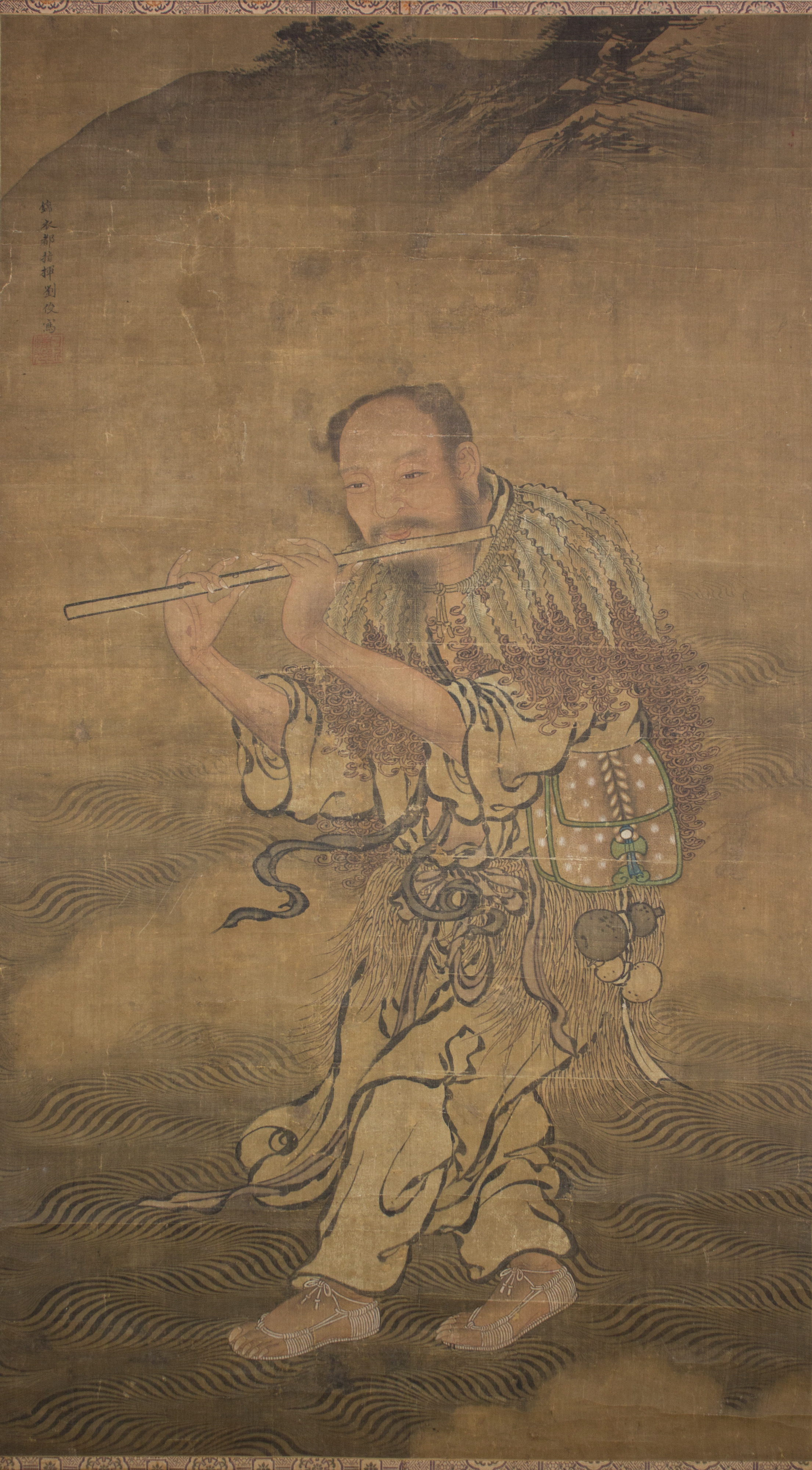
The Daoist Immortal Han Xiangzi: A Study in Transcendent Elegance
In the rarefied world of high fashion, where the ephemeral meets the eternal, Katherine Fashion Lab’s latest curatorial acquisition—a framed hanging scroll depicting the Daoist Immortal Han Xiangzi—offers a masterclass in sartorial transcendence. This is not merely a work of art; it is a foundational text on the aesthetics of movement, the poetry of restraint, and the power of narrative embedded in fabric. Executed in ink and color on silk, this standalone study transcends its physical medium to become a blueprint for the modern couturier’s imagination. It challenges us to reconsider the very essence of drape, silhouette, and the metaphysical weight of adornment.
Deconstructing the Immortal’s Wardrobe: The Philosophy of Wu Wei
The central figure, Han Xiangzi, is rendered not as a static deity but as a being in perpetual, effortless motion—a visual embodiment of the Daoist principle of wu wei (action through non-action). For the fashion analyst, this is the ultimate lesson in garment engineering. His flowing robes are not simply draped; they are choreographed. The silk, caught in an invisible zephyr, billows outward with a controlled chaos that suggests both weightlessness and immense gravitational pull. The artist’s brushstrokes, varying from hairline finesse to bold, sweeping washes, mimic the behavior of high-thread-count silk under stress—how it pools, how it resists, how it ultimately surrenders to the body’s kinetic energy.
Observe the collar line. It is high, almost architectural, yet rendered with a softness that avoids rigidity. This is a masterclass in the high-neck silhouette, a recurring motif in contemporary luxury. The scroll teaches us that the neckline is not a boundary but a launchpad. It frames the face as a precious jewel, drawing the eye upward to the subject’s serene, almost androgynous features. The sleeves, impossibly wide, are not mere appendages but sculptural volumes. They function as negative space, allowing the figure’s slender form to emerge as the positive focal point. In a modern atelier, this translates to the use of structured organza or crisp taffeta to create exaggerated sleeve caps that amplify the gesture of the arm without compromising the integrity of the torso.
The Palette of the Celestial: Ink, Mineral, and the Art of Restraint
The color palette in this scroll is a study in deliberate austerity—a stark contrast to the opulent, jewel-toned excesses of imperial court dress. Here, the artist employs a limited spectrum: the deep, absorbing black of ink, the warm ivory of the silk ground, and subtle accents of mineral pigments—perhaps a whisper of cinnabar red at the lips, a hint of azurite blue in the sash. This restraint is not a lack of imagination but a supreme act of curation. It is the couture equivalent of the "quiet luxury" movement, where the value lies not in embellishment but in the perfection of the base material and the precision of the cut.
The monochromatic discipline of the ink wash creates a tonal depth that rivals any three-dimensional fabric manipulation. The artist builds form through gradation—the dark, saturated ink at the hem of the robe gradually dissolving into a pale, translucent wash at the shoulders. This mimics the effect of ombre dyeing or hand-painted silk chiffon, where the color appears to breathe, moving from density to ethereal transparency. For Katherine Fashion Lab, this scroll is a reminder that the most powerful statements are often made in silence. The absence of gold thread or intricate brocade is a deliberate choice; the wealth here is intellectual, spiritual, and purely aesthetic.
The Flute as Accessory: Narrative and the Archetype of the Artist
Han Xiangzi is famously associated with the flute, and in this study, the instrument is not an afterthought but a critical accessory that defines the entire composition. It is held with a casual grace, its long, slender form echoing the verticality of the figure and the hanging scroll format itself. In fashion terminology, this is the ultimate statement piece—an object that transforms an outfit into an identity. The flute is not merely carried; it is an extension of the Immortal’s spiritual essence, suggesting that true style is the integration of one’s craft into one’s being.
This presents a profound lesson for the modern fashion house. Accessories are not additive; they are transformative. The scroll argues for a holistic approach to dressing, where the handbag, the jewelry, or the shoe must be in dialogue with the garment, creating a unified narrative. The flute’s polished, unadorned surface also speaks to the beauty of functional minimalism. It is a tool, an instrument of art, and a symbol of status all at once. It is the ancestor of the modern architect’s bag or the sculptor’s oversized ring—an object that tells the story of the wearer’s vocation before a single word is spoken.
Composition and the Body: The Vertical Line as a Couture Principle
Standalone studies of Daoist immortals are often characterized by a pronounced verticality, and this painting is no exception. The figure dominates the silk panel, creating an unbroken line from the crown of the head to the tip of the trailing robe. This is the empire silhouette taken to a metaphysical extreme. The artist’s deliberate elongation of the torso and the sweeping, uninterrupted flow of the skirt create a sense of ascension—a visual metaphor for the soul’s journey toward enlightenment. For the couturier, this is a directive to prioritize line over ornamentation. A gown that follows this principle will lengthen the figure, create a sense of ethereal grace, and imbue the wearer with an aura of unshakeable calm.
Consider the negative space surrounding the figure. The artist has left vast expanses of unadorned silk, allowing the figure to breathe. This is the art of the strategic pause in design—knowing when to stop. In a world saturated with logos and maximalist prints, this scroll is a radical manifesto for the power of blank space. It suggests that the most luxurious fabric is the one that is left untouched, its natural sheen and texture allowed to speak for themselves. The frame itself, likely of dark, aged wood, acts as the ultimate tailoring seam, containing the energy of the piece and preventing it from spilling into the chaos of the outside world.
Conclusion: A Living Text for the Modern Atelier
Katherine Fashion Lab’s acquisition of this Han Xiangzi scroll is far more than a cultural artifact; it is a strategic investment in design philosophy. It serves as a permanent, silent mentor within the studio, reminding every designer, pattern cutter, and embroiderer that fashion is a branch of the metaphysical. The Immortal’s robes are not clothes; they are an attitude towards existence. They teach us that elegance is a form of discipline, that movement is a language, and that the most profound luxury is the freedom to be both present and transcendent.
As we translate these ancient brushstrokes into modern silhouettes, we are not copying a costume but channeling a spirit. We are learning to design garments that do not cling to the body but collaborate with it, creating an aura of effortless power. The Daoist Immortal Han Xiangzi, frozen in ink and silk, is the ultimate fashion icon—a figure whose style is inseparable from his soul. In his flowing robes, we find the eternal answer to the question of what it means to dress not just for the world, but for the cosmos.