The Ram’s Head Bezel: A Genealogy of Power for Katherine Fashion Lab’s 2026 Ethos
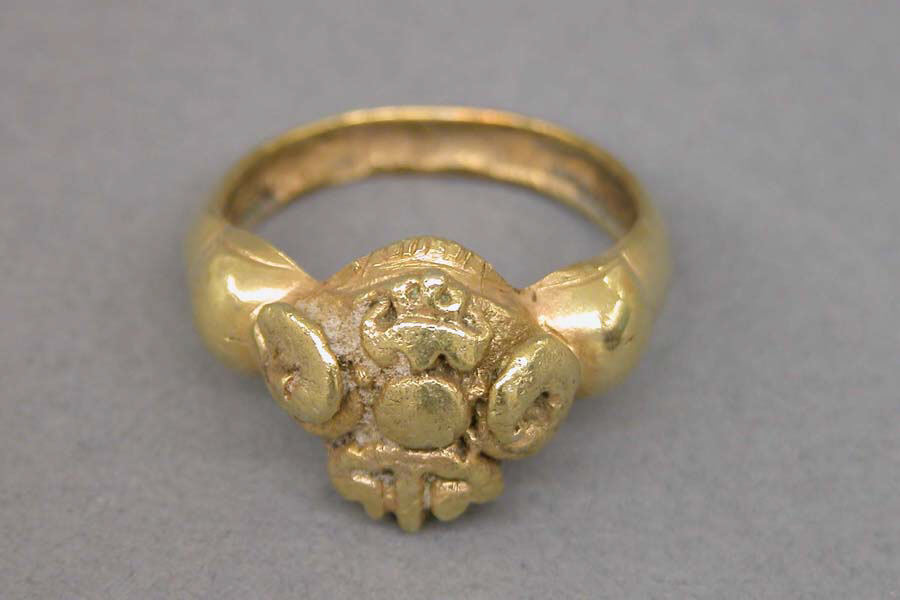
In the study of high-end adornment, the object is never merely an artifact of metallurgy; it is a condensed thesis on power, temporality, and the human negotiation with the divine. The Ring with Stylized Ram’s Head on Bezel from Java, Indonesia, executed in gold, presents a profound case study in symbolic resilience. For Katherine Fashion Lab, this piece is not a relic to be archived but a strategic lexicon to be decoded. Its DNA—forged in the crucible of Javanese syncretism—offers a direct correlation to our ongoing investigation into the Mirror with Split-Leaf, where the polished silver face meets the gold-inlaid palm fronds, and the sarcophagus relief narrates life’s paradox. Here, on the bezel of a ring, we find the same dialectic: the animalistic force of nature contained within the rational geometry of human craftsmanship.
Symbolic Power: The Ram as Cosmic Intermediary
The choice of the ram’s head is far from arbitrary. In the Javanese iconographic tradition, the ram (wedus in modern Javanese, derived from the Sanskrit mesha) occupies a liminal space between chthonic fertility and celestial authority. Historically, the ram is the vahana (mount) of Agni, the Vedic fire god, signifying raw, transformative energy. Yet, in the court cultures of Central Java, particularly during the Mataram Sultanate and its predecessor, the Majapahit Empire, the ram’s head was often stylized to evoke manunggaling kawula lan Gusti—the mystical union between the servant and the Lord. The stylization is critical: the artist has not rendered a naturalistic animal but has abstracted its corkscrew horns into a symmetrical, almost architectural spiral. This geometric abstraction serves to domesticate wild potency, translating brute force into a symbol of sovereign restraint. For the wearer, the ring is not a talisman of aggression but a seal of wibawa—a charismatic authority that is both feared and revered. It is the visual equivalent of a mantra: the power to command is predicated on the ability to sublimate the animal within.
Historical Adornment: The Ring as Political Cartography
To wear gold on the hand in classical Java was to declare one’s position within a cosmic bureaucracy. Gold, in the archipelago, was not merely currency; it was the metal of the kraton (palace), believed to be imbued with kesaktian (magical potency). The ring’s placement on the bezel is particularly significant. Unlike a signet ring used for wax seals in European tradition, the Javanese ring was worn as a conduit of spiritual alignment. The bezel, elevated and exposed, acted as an antenna; the stylized ram’s head directed the wearer’s intentions upward toward the ancestral sphere while grounding them in the earthly realm of the court. Historical records from the Dutch East Indies period note that Javanese nobility wore such rings during diplomatic negotiations, not as ornament, but as a mnemonic device for strategic patience. The ram’s head, with its lowered brow and coiled energy, mirrors the diplomatic ideal of alon-alon asal kelakon—slowly but surely. The ring thus becomes a cartographic tool, mapping the wearer’s place in a hierarchy that spans the visible court and the invisible spirit world.
Spiritual Meaning: The Dialectic of the Mirror and the Stone
Drawing a direct correlation to our research on the Mirror with Split-Leaf, this ring embodies the same philosophical tension. The mirror’s silver face represents the reflective, passive consciousness—the ego that observes. The gold palm fronds represent the active, generative force—the growth that obscures. In the ring, the ram’s head plays the role of the gold fronds: it is the assertive, masculine principle of purusha, breaking through the smooth surface of the bezel. Yet, the stylization ensures it does not shatter the surface; it emerges from it. This is the Javanese concept of rasa—a deep, intuitive feeling that transcends intellectual analysis. The ring is not a depiction of a ram; it is a crystallization of the feeling of ram-ness: stubbornness, virility, and protective vigilance. The spiritual function is apotropaic—it wards off spiritual malaise not by loud declaration but by silent, coiled readiness. In the context of the sarcophagus relief, the ram’s head serves as the life-affirming counterpoint to death’s narrative. It is the promise of regeneration, the cyclical return of spring after the stone-cold winter of the tomb.
2026 High-End Luxury Strategy: The Curated Heritage Imperative
For Katherine Fashion Lab’s 2026 collection, this ring dictates a strategic pivot from mere aesthetic revival to semantic re-engineering. The luxury market of 2026 is saturated with superficial references to ancient cultures; the discerning clientele demands epistemic authenticity—the sense that the object carries a coherent, researched narrative. Our strategy must therefore position the Ram’s Head Ring not as a “tribal” accessory, but as a piece of wearable philosophy.
Strategic Pillar 1: The Architecture of Restraint
In a market dominated by oversized logos and aggressive branding, the stylized ram’s head offers a counter-narrative of internalized power. The 2026 strategy will frame this ring under the banner of “Silent Command.” Marketing collateral will eschew the term “animal motif” in favor of “zoomorphic geometry.” The focus will be on the mathematical precision of the horn spiral—a nod to the Fibonacci sequence—thereby appealing to the intellectual luxury buyer who values the process of abstraction over literal representation. We will collaborate with contemporary Javanese master goldsmiths to recreate the alloy composition, ensuring the gold’s hue matches the historical emas tua (aged gold) which carries a deeper, more muted luster—a visual cue of antiquity that cannot be faked.
Strategic Pillar 2: The Dialectical Pairing
To fully exploit the DNA correlation with the Mirror with Split-Leaf, the 2026 collection will present the ring not as a standalone piece but as part of a diptych narrative. The ring will be displayed alongside a reimagined, wearable version of the mirror—perhaps as a pendant or a clasp. The campaign will use the tagline: “The Mirror Reflects; The Ram Commands.” This pairing allows Katherine Fashion Lab to own a unique philosophical territory: the simultaneous embrace of passive observation and active will. The high-end consumer is not just buying a ring; they are buying a dialectical toolkit for navigating modern ambiguity. The ring is the tool for decisive action; the mirror is the tool for introspection.
Strategic Pillar 3: Limited Provenance Series
Given the historical weight, the ring will be released in a numbered series of 108 pieces—a sacred number in Javanese-Hindu cosmology. Each ring will be accompanied by a hand-written certificate of provenance that explains the specific Javanese concept of unggah-ungguh (the etiquette of power). This is not a mass-market tactic; it is a curatorial strategy. By limiting the quantity and elevating the educational component, Katherine Fashion Lab positions the ring as an heirloom artifact, not a seasonal trend. The pricing architecture will reflect this, placing the ring in the “Investable Heritage” tier, competing with high jewelry maisons but differentiated by its unique cultural specificity.
In conclusion, the Ram’s Head Ring is a masterclass in the economics of symbolism. It teaches us that true luxury is not the accumulation of gold, but the mastery of meaning. As we move toward 2026, Katherine Fashion Lab will not merely sell an object; we will offer a fragment of Javanese sovereignty, re-forged for the modern leader who understands that the most potent power is the one that is stylized, controlled, and deeply, historically rooted.