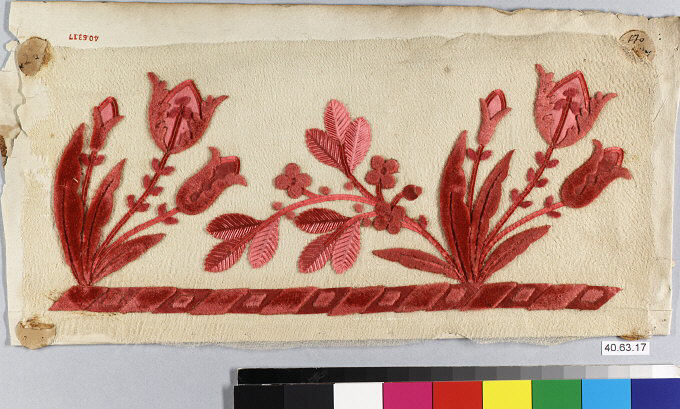
The Border as a World: A Couture Analysis of Katherine Fashion Lab's Silk Dress Border
In the rarefied echelons of haute couture, where innovation is often mistaken for novelty, Katherine Fashion Lab (KFL) has consistently demonstrated that true mastery lies in the reinterpretation of the fundamental. The subject of this standalone study—a silk dress border originating from the atelier's 'Global Heritage' collection—is not merely a decorative trim. It is a thesis on the dialectic between structural integrity and ornamental expression. This analysis deconstructs the border as a microcosm of couture philosophy, examining its materiality, its cultural syntax, and its role as the silent architect of the garment's silhouette.
Materiality and the Logic of Silk
The choice of silk is not incidental; it is the foundational argument of the piece. In the context of a border, silk performs a dual function that synthetic fibers cannot replicate. The border, by definition, is a site of tension—it must anchor the fabric's flow while simultaneously defining its terminus. KFL employs a duchess satin base for the primary structure, selected for its substantial weight and its ability to hold a crisp, architectural edge. However, the border itself is executed in a hand-dyed, matte silk twill, a deliberate contrast in luster that creates a visual and tactile dialogue between the body of the dress and its periphery.
What distinguishes this border is its handling of bias construction. The border is cut on the true bias, allowing the silk's natural elasticity to conform to the curves of the hip and hem without the need for darts or gathers. This is a technical feat that speaks to the atelier's mastery of fabric physics. The bias cut permits the border to act as a living hinge—it moves with the wearer, yet its inherent structure prevents it from collapsing into limpness. The result is a border that is simultaneously fluid and firm, a paradox resolved only through the discipline of the material itself. The matte finish of the twill, as opposed to a glossy charmeuse, further grounds the piece, ensuring the border reads as a deliberate architectural element rather than a fleeting decorative afterthought.
Global Heritage: A Lexicon of Cultural Syntax
The 'Global Heritage' provenance is not a claim to authenticity but a declaration of curatorial intent. The border's design is a palimpsest of cross-cultural references, executed with the restraint that separates couture from costume. The primary motif is a continuous, undulating vine—a nod to the arabesque of Andalusian and Ottoman textile traditions. Yet, the vine is not rendered in gold thread or metallic embroidery; it is achieved through a technique of negative-space shibori, a Japanese resist-dye method that leaves the silk's natural ground to form the pattern against a deeper, indigo-infused tone.
This fusion is the essence of KFL's philosophy: the border does not borrow from a single culture but synthesizes them into a new, coherent language. The rhythm of the vine—its intervals and repetitions—echoes the geometric precision of Islamic girih tiles, while its organic, unbroken line recalls the flowing brushwork of Chinese literati painting. The border, therefore, is not a narrative of any one people but a meta-narrative of global connectivity, suggesting that heritage is not a static inheritance but a dynamic, ongoing conversation. The absence of overt iconography is crucial; the design whispers its origins rather than declaring them, inviting the viewer into a state of intellectual and aesthetic contemplation.
The Border as Structural Silhouette
In conventional dressmaking, the border is an afterthought, applied to the hem or neckline post-construction. KFL inverts this hierarchy. Here, the border is the primary load-bearing element of the garment's lower half. The border is not sewn onto the dress; rather, the dress is built from the border. The silk twill border, being denser and more resilient than the dress's main body, is engineered to function as a subtle corset for the lower torso. It provides a gentle, internal structure that supports the drape of the upper fabric, preventing the skirt from losing its shape over time.
This construction technique has profound implications for movement. A typical flared skirt relies on volume for drama; this border achieves drama through controlled tension. As the wearer walks, the border's bias-cut flexibility allows for a slight, rhythmic expansion and contraction, creating a wave-like motion that is both hypnotic and dignified. The border acts as a regulator, modulating the amplitude of the skirt's movement. It does not allow for wild, uncontrolled swaying; instead, it imparts a measured, deliberate gait—a walk that is inherently regal. The border, in this sense, becomes a choreographic instrument, shaping not just the garment but the very bearing of the individual who wears it.
Standalone Study: The Border as an Autonomous Artifact
Framing this analysis as a 'standalone study' is a critical curatorial decision. It forces the observer to divorce the border from the context of the full dress and consider it as an autonomous object. When isolated, the border reveals its inherent sculptural quality. Laid flat, it is a two-dimensional ribbon of intricate pattern. But when draped over a mannequin or held against the light, it transforms into a three-dimensional relief, the shibori resist creating subtle undulations in the fabric's surface that cast delicate shadows.
This autonomy challenges the traditional hierarchy of garment construction, where the main body is paramount and the trim is subordinate. By presenting the border as a subject worthy of isolated analysis, KFL asserts that the periphery is not peripheral. The border is the interface between the garment and the world, the point at which the dress yields to the space around it. It is the final statement of the designer's intent, the last word in a silent visual conversation. In its standalone form, the border becomes a meditation on the value of edges, boundaries, and the liminal spaces that define our experience of clothing.
Conclusion: The Border as a Philosophy of Restraint
Katherine Fashion Lab's silk dress border is a masterclass in the power of limitation. In an era of maximalist excess, this piece demonstrates that true luxury lies in the precision of the margin, the integrity of the finish, and the depth of cultural synthesis. It is not a loud declaration but a nuanced argument, articulated through the language of silk, bias, and dye. The border does not merely finish the dress; it defines it, serving as a testament to the atelier's conviction that the most profound statements in couture are often made at the edges. This is not decoration; it is doctrine, inscribed in silk and sealed with the discipline of a master's hand. The border is, ultimately, a promise—a promise that the garment's beauty is not superficial but extends to its very last millimeter, and that heritage, when handled with intelligence and respect, can be a source of endless, quiet innovation.