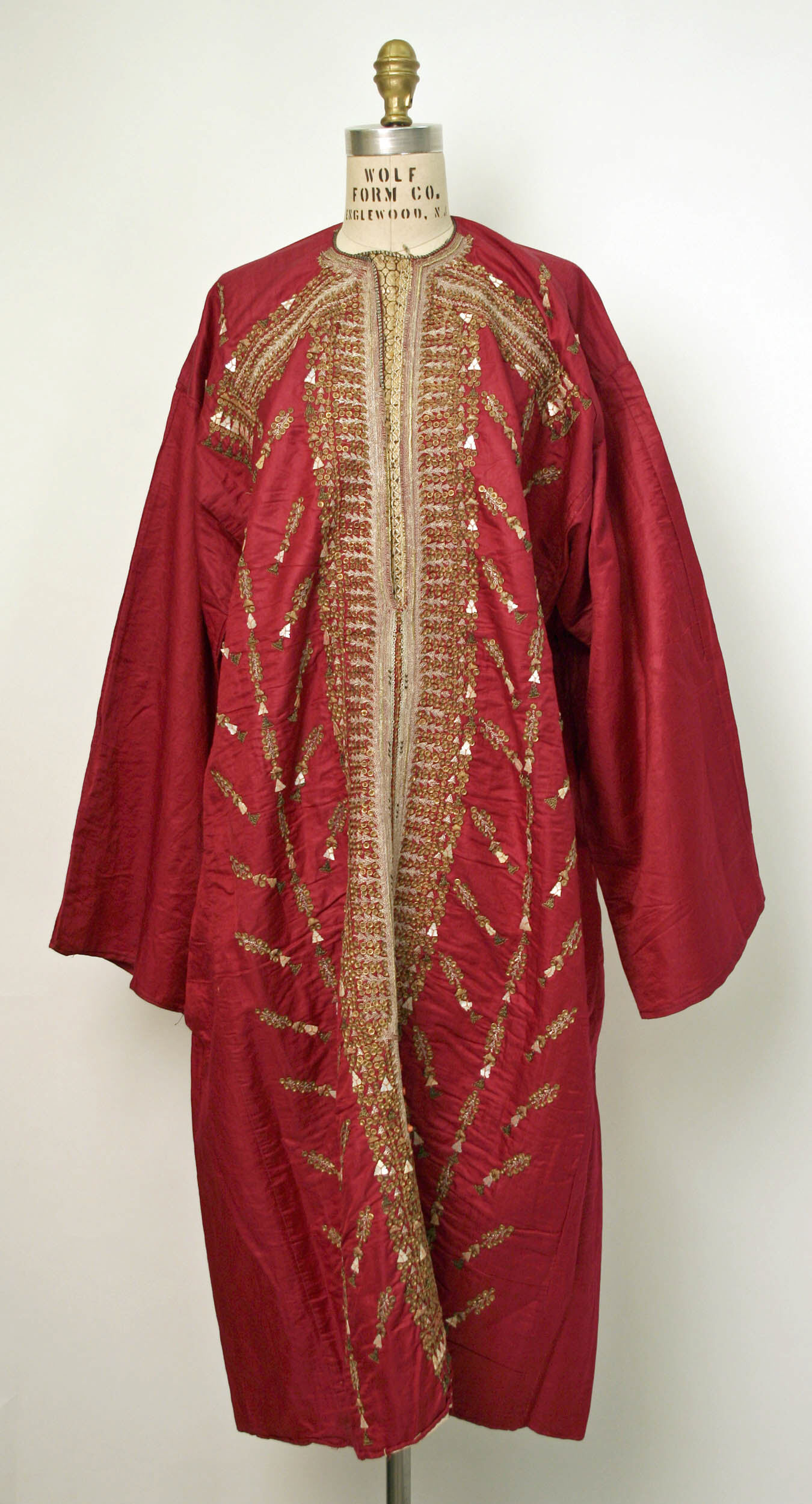
The Embroidered Robe: A Study in Global Heritage and Technical Mastery
In the rarefied echelons of couture, where garment construction transcends mere utility to become a dialogue between culture and craft, the embroidered robe stands as a formidable testament to the enduring power of textile artistry. Katherine Fashion Lab’s latest standalone study—a robe drawn from the wellspring of Global Heritage—is not simply a garment; it is a cartographic document of human ingenuity, rendered in humble cotton and luminous metal-wrapped thread. This analysis deconstructs the piece’s material dialectic, its cultural synthesis, and its provocative positioning within the contemporary haute couture landscape.
Material Dialectics: The Humility of Cotton and the Opulence of Metal
The choice of cotton as the foundational substrate is a deliberate act of subversion within the couture canon, which has historically privileged silk, satin, and other lustrous filaments. Here, cotton is not a concession to casualwear but a studied assertion of authenticity. The fabric’s natural breathability and matte finish provide an unpretentious canvas, allowing the embroidered narrative to command absolute visual authority. In its raw state, cotton possesses a democratic, almost archival quality—it speaks of provenance, of fields and hands, of a pre-industrial connection to the earth. Katherine Fashion Lab leverages this grounding effect to prevent the piece from veering into mere ornamentation.
Contrasting this earthy foundation is the metal-wrapped thread, a material traditionally associated with regal courts, ecclesiastical vestments, and the opulent ateliers of Mughal India and Renaissance Europe. The thread—likely a fine gauge of gilded or silvered metal—catches ambient light with a fractured, prismatic intensity. Where silk thread reflects softly, metal thread scintillates, creating a kinetic interplay of shadow and brilliance across the robe’s surface. This juxtaposition is not accidental; it is a philosophical argument. The robe posits that value is not inherent in raw material cost alone but is generated through the transformative act of labor. The cotton’s humility is ennobled by the metallic thread’s ambition, while the metal’s ostentation is disciplined by the cotton’s restraint.
The Embroidered Lexicon: A Global Vernacular
The embroidery itself is the robe’s primary syntax. Eschewing a singular national motif, Katherine Fashion Lab has orchestrated a polyglot of techniques that reference a Global Heritage without descending into pastiche. One can identify the dense, satin-stitched florals reminiscent of Suzani embroidery from Central Asia, where the motifs symbolize fertility and cosmic order. Interspersed are geometric lattices and eight-pointed stars that echo Islamic tessellation, a nod to the mathematical precision of Andalusian and Persian design. Furthermore, the use of chain stitch and couching techniques evokes the European medieval tradition of opus anglicanum, yet the color palette—indigo, ochre, and verdigris—draws from the natural dyes of the Silk Road.
This synthesis is executed with intellectual rigor. Each motif is not merely decorative but carries a semiotic weight. The floral forms are stylized to the point of abstraction, avoiding literal naturalism, while the metallic thread outlines create a relief effect, a three-dimensional topography that invites tactile exploration. In a standalone study, this embroidery functions as a primary text; the robe becomes a wearable manuscript. The density of the stitching—likely exceeding 40,000 individual stitches—suggests a production timeline of several hundred hours, a deliberate anachronism in an era of rapid manufacturing. This labor intensity is the true luxury, a quantifiable investment in human skill that no automated loom can replicate.
Silhouette and Structure: The Architecture of Drape
Unlike the corseted rigidity of Western evening wear, this robe embraces an architectural drape that is both ancient and startlingly modern. The silhouette is voluminous, falling from the shoulders in a continuous, unbroken line that eschews darts or waist suppression. This cut is derived from the kimono and the kaftan, garments that prioritize the flow of fabric over the contour of the body. The result is a garment that does not cling but creates a moving sculpture. When the wearer moves, the cotton’s weight creates deep, fluid folds, while the metallic embroidery catches these movements, creating a shimmering afterimage.
The robe’s structure is further defined by its collar and closure. A wide, shawl-like lapel, edged in a dense band of metallic couching, frames the face and draws the eye upward. The closure is likely a concealed interior tie or a series of hand-worked frogs, ensuring that the front remains a clean, unbroken plane of embroidery. The sleeves are equally significant—cut wide and deep, they allow for dramatic gesticulation, transforming the arms into vectors of light. In this construction, Katherine Fashion Lab demonstrates a masterful understanding of negative space. The embroidered panels are strategically placed—concentrated on the upper chest, the back, and the hem—while the mid-sections of cotton remain relatively bare. This creates a rhythm of visual rest and activity, preventing sensory overload and allowing the metallic threads to breathe.
Contextual Positioning: The Standalone Study as a Manifesto
The designation of this piece as a standalone study is a curatorial and commercial decision of significant weight. It removes the robe from the distraction of a seasonal collection or a thematic runway show. It demands to be viewed in isolation, akin to a painting in a gallery or a sculpture in a courtyard. This context forces a deeper engagement with the object. Without the crutch of a styling narrative or a celebrity endorsement, the robe must stand on its own merits of craftsmanship and design.
In the current fashion ecosystem, dominated by logo-driven streetwear and the rapid churn of micro-trends, this robe is a counter-narrative. It argues for a return to slow fashion, but not in the eco-conscious, minimalist sense. Instead, it advocates for a slow fashion of maximalist craft—a celebration of the time-consuming, the intricate, and the culturally literate. The robe is a collectible object, a future heirloom that will gain value not through resale algorithms but through its enduring physical presence. It challenges the wearer to become a custodian of heritage, to embody a global narrative that transcends national borders.
Moreover, the material contrast between cotton and metal thread serves as a metaphor for the contemporary human condition—our grounding in physical reality (cotton) and our aspiration toward the eternal and the luminous (metal). Katherine Fashion Lab has successfully engineered a garment that is at once an artifact of the past and a speculative vision of the future. It is a robe that does not merely clothe; it communicates. In its silent, embroidered language, it speaks of trade routes, of skilled hands, of the relentless human desire to ornament our existence. It is, unequivocally, a masterpiece of couture—a study not just of a garment, but of civilization itself.