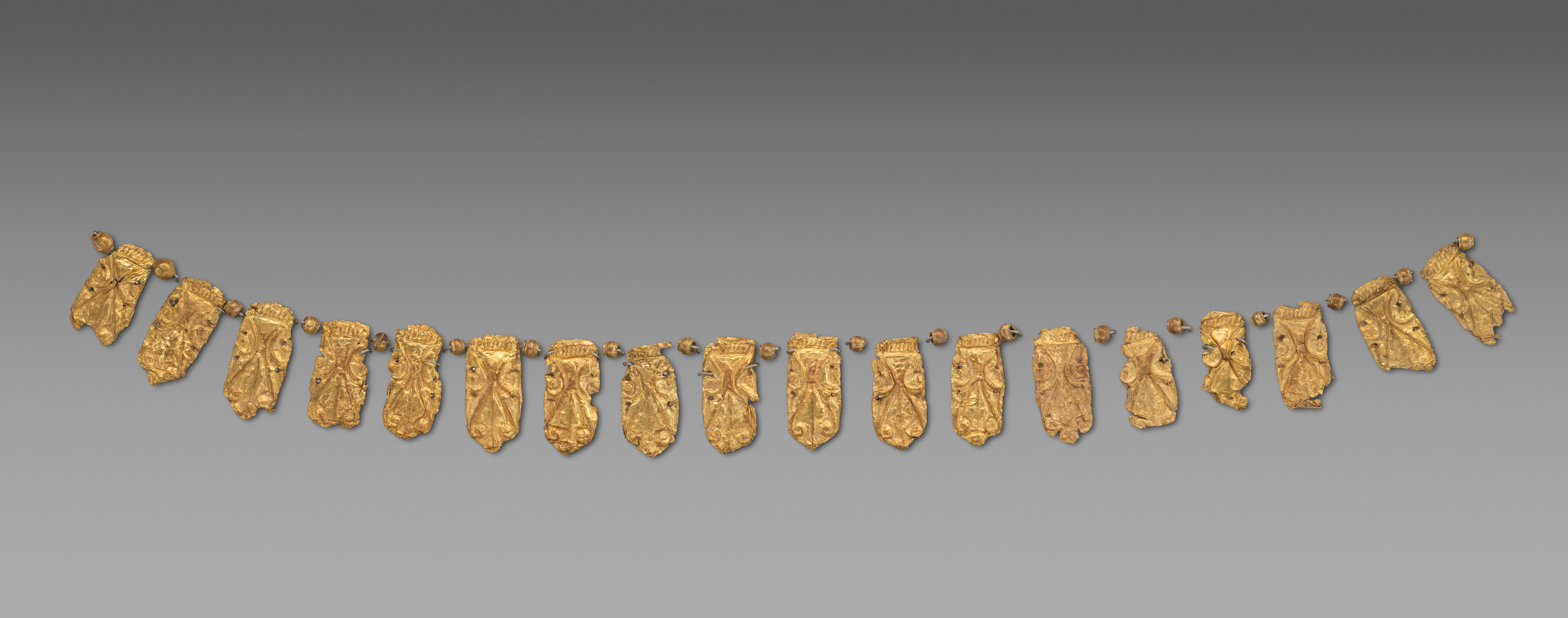
Heritage Analysis: The Cypriot Gold Necklace and the Dialectics of Luminosity
At Katherine Fashion Lab, our curatorial mandate extends beyond the mere cataloging of artifacts; we engage in the extraction of immutable cultural codes and their translation into contemporary luxury vernacular. The subject of this analysis—a gold necklace of Cypriot or Aegean provenance—presents a profound case study in the symbology of power and the metaphysics of adornment. When correlated with our ongoing research into the Mirror with Split-Leaf motif—a piece that juxtaposes the gleaming silver mirror inlaid with golden palmettes against the cold, narrative relief of a sarcophagus—this necklace emerges not merely as an object of beauty, but as a philosophical instrument. It is a physical manifestation of the tension between ephemeral reflection and eternal narrative.
Symbolic Power and the Metallurgy of Divinity
In the Aegean and Cypriot Bronze Age contexts, gold was not a currency of trade but a substance of solar transubstantiation. The necklace, rendered in high-karat gold, was the prerogative of priest-kings and high priestesses, individuals who straddled the mortal and divine realms. The choice of gold is critical; unlike silver, which was associated with lunar cycles and the reflective, passive qualities of water, gold was the solar metal. It did not reflect light; it became light.
The Necklace as a Solar Chakra
Positioned at the throat, the necklace functioned as a resonant chamber for the voice of authority. In Cypriot iconography, the throat is the conduit of breath—the pneuma—that animates speech. To encircle this conduit with gold was to imbue the wearer’s decrees with the weight of cosmic law. The weight of the metal on the clavicle was not a burden but a grounding force, anchoring the wearer to the earth while the sheen connected them to the heavens. This dual function—terrestrial gravity and celestial luminosity—is the essence of hierarchical magnetism. The necklace was a political statement rendered in metallurgy, a silent declaration that the wearer possessed the authority to command the sun itself.
Historical Adornment: The Body as a Narrative Surface
Our research context draws a critical parallel between the necklace and the Mirror with Split-Leaf. The mirror’s silver face offers a fleeting, narcissistic reflection—the immediate, perishable self. In contrast, its reverse side, etched with golden palmettes and sarcophagus reliefs, speaks to the permanent, ancestral self. The Cypriot necklace operates within this same dialectical framework. When worn, it interacts with the skin, catching light and creating a dynamic, living tableau. Yet, its material permanence ensures its survival long after the wearer’s demise, transitioning it from an object of adornment to an object of ancestral memory.
Adornment as a Temporal Bridge
Historically, the necklace was often deposited in tombs, not as mere grave goods, but as narrative anchors for the afterlife. The gold did not decay, symbolizing the indestructibility of the soul’s essence. The act of adorning the living was a rehearsal for the adornment of the dead. This cyclical temporality—where the jewelry serves the living body and then the mummified or cremated remains—establishes gold as the ultimate temporal bridge. It defies the linear progression of life and death, suggesting a spiral where the past, present, and future coexist. For the luxury strategist, this translates to a product that is not "owned" but stewarded—a heirloom that transcends the buyer’s lifetime.
Spiritual Meaning: The Chthonic and the Celestial
The spiritual resonance of the Cypriot necklace is deeply rooted in the duality of the chthonic and the celestial. While the gold represents the sun (Apollonian clarity), the craftsmanship often incorporated motifs of serpents or spirals—symbols of the earth’s regenerative powers (Dionysian mystery). This synthesis is crucial. The necklace is not a purely ethereal object; it acknowledges the darkness of the sarcophagus from which it must emerge.
The Split-Leaf Correlation: A Study in Contrast
Our Katherine Fashion Lab study on the Mirror with Split-Leaf identifies the palm leaf as a symbol of victory over death—the split representing the bifurcation between the mortal realm and the divine. The gold necklace, when analyzed through this lens, becomes a wearable sarcophagus relief. It tells a story of resurrection through materiality. The spiritual function of the necklace was to protect the wearer against the "evil eye" and spiritual entropy. The gold acted as a spiritual conductor, channeling divine energy into the wearer’s aura while deflecting negativity. It was, in essence, a portable temple.
2026 High-End Luxury Strategy: The Heirloom Imperative
For the 2026 luxury market, the modern consumer is exhausted by the ephemeral—the fast-fashion cycle and the digital saturation of imagery. They crave the permanence of the sarcophagus relief, not the fleeting reflection of the silver mirror. Katherine Fashion Lab’s strategy must pivot from selling "newness" to selling "archaeological futurism".
Strategic Pillar 1: The Anti-Trend Asset
In a market dominated by seasonal trends, the Cypriot gold necklace stands as an anti-cyclical asset. Our 2026 strategy positions this piece not as a "collection item" but as a wealth preservation instrument. We will reframe the necklace’s narrative from "fashion accessory" to "portable patrimony." The marketing language will emphasize the irreplaceable nature of the material and the irreplicable nature of the craft. This is a direct response to the Gen-Z and Millennial investor-buyer who views luxury through the lens of asset diversification. The necklace becomes a wearable bond, secured by 4,000 years of cultural significance.
Strategic Pillar 2: The "Mirror and Stone" Experience
To fully realize the DNA correlation with our Split-Leaf study, the 2026 retail experience will be a dualistic sensory journey. Clients will be invited to view the necklace in two distinct settings: first, under a brilliant, high-frequency light (the silver mirror—representing desire and vanity), and second, within a dim, textured space with tactile stone surfaces (the sarcophagus—representing legacy and memory). This adornment ritual will allow the client to experience the necklace’s spiritual duality. The sales narrative will pivot on the question: "Do you wish to be remembered, or merely seen?"
Strategic Pillar 3: Custom Patination and Provenance
Unlike modern gold which is polished to a sterile, uniform shine, our 2026 line will reintroduce micro-patination techniques that mimic the geological aging of Cypriot artifacts. This is not a flaw; it is a narrative texture. Each necklace will be "finished" with a subtle, dark recess in the filigree—a nod to the shadows of the tomb—allowing the gold to pop with greater contrast against the skin. Furthermore, we will launch a blockchain provenance ledger that traces the design lineage directly to the Aegean motifs, providing the tech-savvy collector with verifiable "archaeological authenticity."
Conclusion: The Resonance of Weight
The Cypriot gold necklace is not a relic; it is a resonant frequency that modern luxury must tune into. It teaches us that true power is not loud but heavy—it has mass, history, and gravity. As we move toward 2026, Katherine Fashion Lab will not merely sell jewelry; we will consecrate investments. We will bridge the split leaf—uniting the ephemeral joy of the mirror with the enduring truth of the stone. This necklace, with its solar gold and chthonic shadows, is our blueprint for a luxury that does not chase time, but rather, owns it.