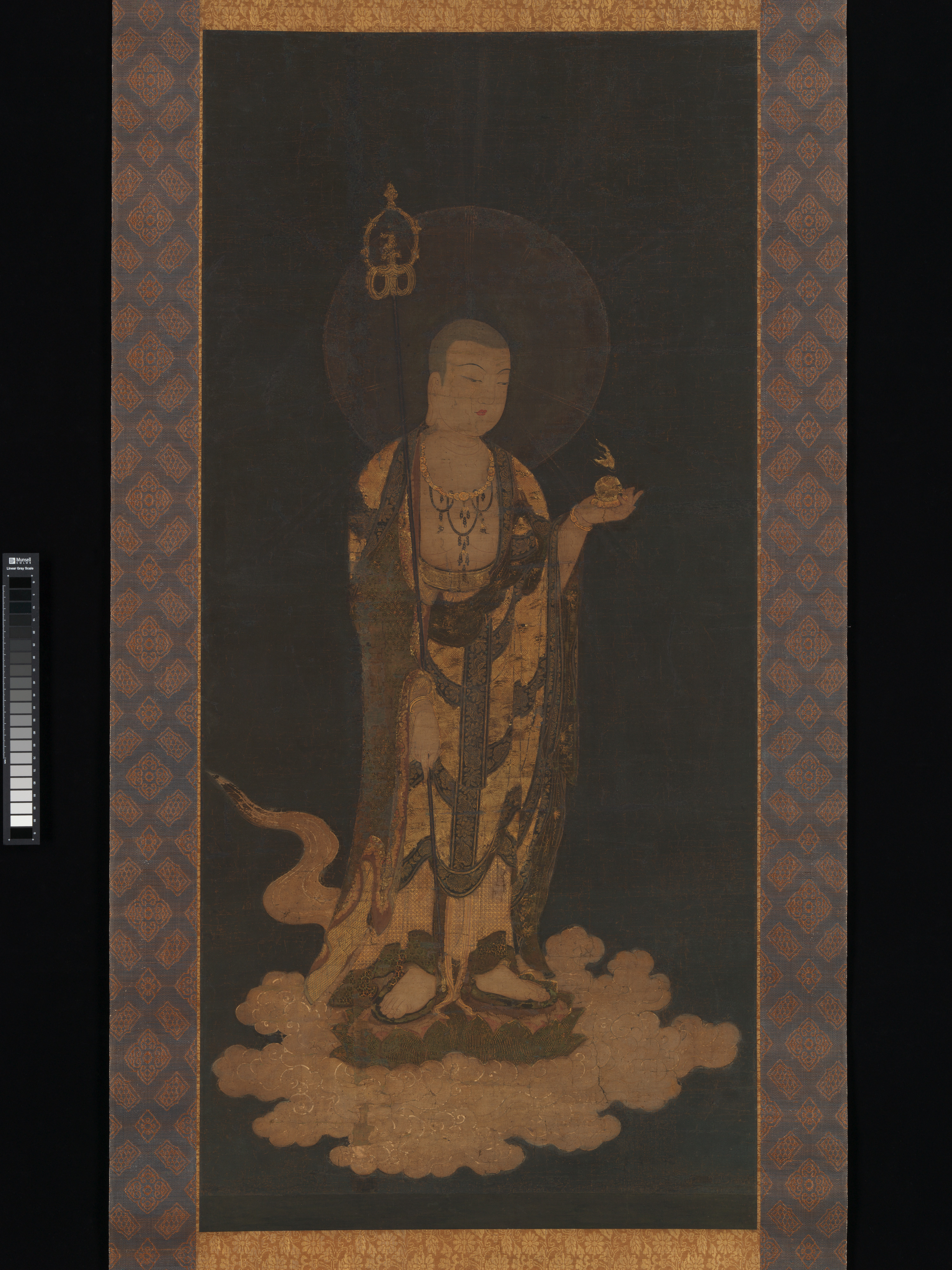
Jizō Bosatsu: A Study in Sacred Minimalism
Within the hallowed canon of Japanese Buddhist art, the figure of Jizō Bosatsu occupies a singularly profound space. As the guardian of children, travelers, and the souls of the departed, Jizō embodies a compassionate accessibility that distinguishes him from more austere deities. In the hands of Katherine Fashion Lab, this subject is not merely reproduced; it is analyzed, deconstructed, and reimagined through a couture lens. The piece in question—a hanging scroll executed in ink, color, gold paint (kindei), and cut gold leaf (kirikane) on silk—transcends its religious function to emerge as a masterclass in the principles of high fashion: restraint, texture, and the strategic deployment of luminosity.
This analysis will dissect the work across three principal axes: the architectural logic of the composition, the material semiotics of gold and silk, and the sartorial implications of the iconography itself. By examining these elements, we can understand how this devotional study functions as a precursor to the minimalist ethos that defines contemporary luxury—an ethos that Katherine Fashion Lab seeks to interrogate and celebrate.
I. The Architecture of Compassion: Composition as Structural Couture
The scroll’s composition is a study in deliberate negative space, a quality that any seasoned couturier would recognize as the foundation of structural elegance. Jizō is depicted in his canonical form—a shaven-headed monk, robed in simple clerical garments, standing upon a lotus pedestal. Yet, the artist’s hand is not concerned with narrative complexity. Instead, the figure is isolated against a vast, unadorned silk ground. This is not an omission; it is a decisive editorial choice. In fashion terms, this is the equivalent of a pristine, unadorned canvas of heavyweight silk crepe, where the cut of the garment must bear the entire weight of the aesthetic argument.
The verticality of the scroll is paramount. Jizō’s elongated, almost columnar silhouette draws the eye upward, creating a line of aspiration. His posture—weight evenly distributed, hands forming the an-in (the gesture of wish-granting) or holding a jewel—is one of absolute equilibrium. This is akin to the perfect shoulder seam or the impeccable fall of a bias-cut gown. The artist’s use of ink outlines (hakubyō influences) is remarkably precise, yet the lines are not brittle. They possess a fluid, calligraphic confidence, suggesting the controlled gesture of a master atelier. The folds of his robe are rendered with minimal strokes, each crease serving a dual purpose: to delineate the form beneath and to create a rhythmic visual cadence that mimics the pleats of a haute couture skirt.
Herein lies the first lesson in Katherine Fashion Lab’s methodology: true luxury is found in the absence of excess. The scroll’s background is not empty; it is a field of potential energy. The eye is forced to rest on the subject, to meditate on the purity of the line. This is the same principle that governs the design of a modern, architectural gown—where a single, unbroken seam can be more compelling than a thousand embellishments.
II. Material Semiotics: The Alchemy of Gold and Silk
Moving from the macro to the micro, the materiality of this scroll is a veritable treatise on the use of precious substances. The support is silk, a material whose very etymology is entwined with notions of refinement and imperial status. The weave of the silk creates a subtle, irregular texture that catches ambient light, lending the painted surface a gentle, breathing quality. This is the antithesis of the flat, digital print. It is the tactility of a hand-beaded evening jacket or a hand-embroidered organza—an investment in surface that rewards close, intimate inspection.
The application of kindei (gold paint) and kirikane (cut gold leaf) is where the piece achieves its most spectacular sartorial effect. The gold is not used indiscriminately. It is reserved for the halo (kōhai) behind Jizō’s head and for delicate accents on the robe’s trim. The kirikane technique—in which infinitesimal strips of gold leaf are applied to create geometric or floral patterns—is a testament to patience and precision. In the context of couture, this is the equivalent of micro-embroidery or the application of paillettes by a master artisan. The gold does not shout; it whispers.
The strategic placement of this gold is crucial. It creates a hierarchy of visual interest. The halo, executed in a more solid form of gold, anchors the head as the seat of enlightenment. The robe’s accents, in contrast, are more diffuse, catching light as the viewer shifts perspective. This is a lesson in light management—a core competency of any luxury designer. The gold is not a surface covering; it is a tool for directing the viewer’s gaze, for creating a subtle, kinetic shimmer that mimics the movement of a high-end fabric under a runway light. The contrast between the matte, absorbent quality of the ink and the reflective, brilliant quality of the gold is a study in tonal opposition—a visual tension that is deeply sophisticated.
III. The Sartorial Iconography: Robes as a Language of Power and Humility
The garment worn by Jizō is deceptively simple, yet it is a lexicon of sartorial meaning. The monk’s robe, or kesa, is traditionally made from discarded cloth, symbolizing humility. However, in this artistic rendering, the robe is elevated to a plane of ethereal elegance. The artist’s use of color—likely muted earth tones with subtle gradations—imbues the fabric with a sense of weight and volume. The drapery is not naturalistic; it is idealized. It falls in cascading, rhythmic folds that suggest a fabric far more luxurious than simple cotton. This is the paradox of the kesa: it is a garment of renunciation, yet it is rendered with the aesthetic sophistication of a royal court robe.
From a fashion analysis perspective, the robe’s silhouette is a precursor to the minimalist androgyny that dominates contemporary runways. It is unstructured, fluid, and genderless. It does not cling to the body but rather creates a secondary architecture around it. This is the essence of the modern kimono-inspired silhouette that designers like Yohji Yamamoto and Rei Kawakubo have made famous. The robe is a statement of non-ego, a deliberate erasure of the physical form in favor of a spiritual presence. Yet, the artist’s focus on the geometric precision of the folds—the way they catch the kindei—introduces an element of formalist beauty that is undeniably worldly.
This tension between the ascetic and the aesthetic is the very essence of the piece’s couture value. It asks a provocative question: can a garment that signifies the rejection of material desire be, in itself, a supreme object of material desire? Katherine Fashion Lab posits that this is precisely the point. The scroll does not depict a mere monk; it depicts a state of being that is so refined, so perfectly composed, that it becomes a paradigm of style. The staff (shakujō) he carries, with its six rings, is not just a tool; it is an accessory—a piece of jewelry that announces his role as a wanderer between worlds.
Conclusion: The Eternal Atelier
The hanging scroll of Jizō Bosatsu is far more than a religious artifact; it is a document of artistic intelligence that speaks directly to the principles of high fashion. Its composition is a lesson in restraint; its materials are a testament to the power of preciousness; and its iconography is a sophisticated commentary on the relationship between dress and identity. The artist’s decision to render the figure in a standalone study, devoid of narrative context, forces a pure, formal appreciation.
For Katherine Fashion Lab, this work serves as a foundational reference point. It demonstrates that true elegance is achieved through the mastery of line, the curation of texture, and the deliberate manipulation of light. The Jizō scroll is not a historical curiosity; it is a living blueprint for creating garments that possess spiritual weight and timeless appeal. In its silent, gilded presence, we find the ultimate couture statement: that the most profound luxury is the ability to convey the infinite through the finite, the sacred through the silk, and the divine through the drape.