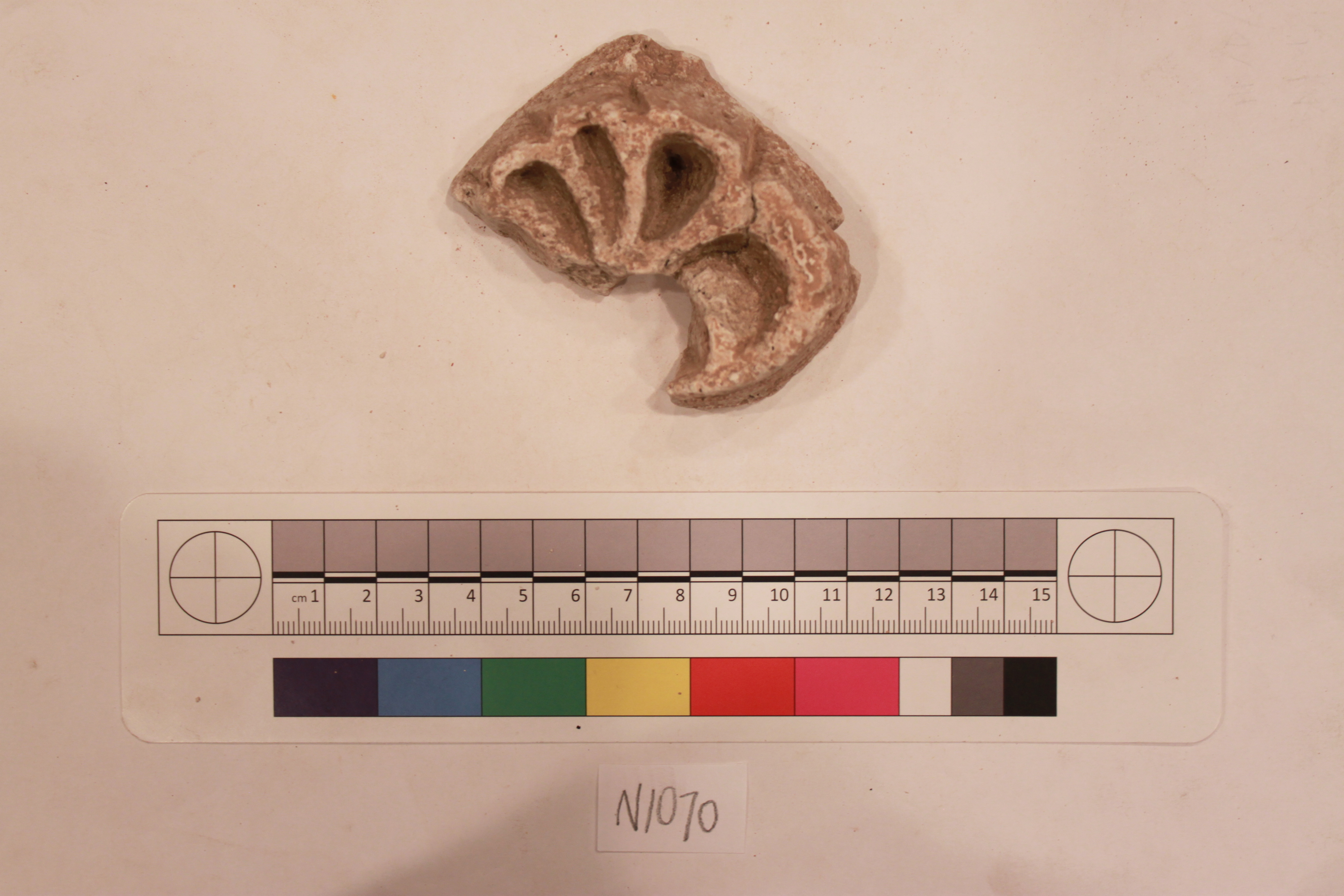
Executive Heritage Analysis: The Stucco Fragment
This report presents a strategic heritage analysis of a carved and painted stucco fragment from an ancient civilization, commissioned by Katherine Fashion Lab. The analysis is structured to decode the artifact’s symbolic power, historical adornment practices, and spiritual meaning, culminating in a forward-looking 2026 high-end luxury strategy. The fragment is treated not merely as an archaeological relic, but as a repository of transferable design intelligence and brand narrative equity. The findings are intended to inform product development, visual storytelling, and client engagement for the Lab’s forthcoming haute collection.
Symbolic Power: The Grammar of Authority and Transcendence
The stucco fragment, in its original architectural or votive context, functioned as a materialized assertion of hierarchical order. Stucco, unlike stone, allowed for rapid, malleable execution, enabling artisans to layer complex iconographic programs across temple facades, palace interiors, and funerary chambers. The carved reliefs—whether depicting a deified ruler, a mythological guardian, or an abstract celestial motif—were not decorative afterthoughts. They were active agents of symbolic power, designed to mediate between the mortal realm and the divine.
For Katherine Fashion Lab, the fragment’s power lies in its compression of meaning. Each carved line and pigment application encodes a system of belief, a calendar of rituals, or a genealogy of kings. In a 2026 luxury context, this translates into a design philosophy where every seam, clasp, or embroidered motif must carry deliberate narrative weight. The Lab can adopt a “grammar of authority” by using geometric precision and symmetrical balance—hallmarks of ancient stucco work—to convey timelessness and controlled opulence. The fragment’s weathered edges, however, introduce a counterpoint: the power of impermanence. This duality—absolute authority versus inevitable decay—offers a sophisticated narrative for a clientele that values authenticity over sterile perfection.
Historical Adornment: The Body as a Living Fresco
The fragment’s painted surface, though now faded, reveals a chromatic vocabulary that was once vivid and ritualistically significant. Ancient artisans employed mineral pigments—ochre, cinnabar, azurite, and lime-based whites—to animate the stucco’s surface. These colors were not arbitrary; they corresponded to cosmological categories (e.g., red for life force and sacrifice, blue for celestial waters, yellow for solar permanence). Adornment in this context was an extension of the architectural skin. Priests, rulers, and elites wore garments and jewelry that mirrored the temple’s iconography, effectively becoming living frescoes—the body as a portable sanctuary.
This historical practice offers a direct strategic parallel for Katherine Fashion Lab’s 2026 haute strategy. The Lab should treat the human silhouette as a three-dimensional canvas, integrating stucco-inspired textural reliefs—raised embroidery, molded leather appliqués, or thermoformed silk organza—that mimic the carved undulations of the fragment. The color palette for the upcoming collection should be drawn from the fragment’s surviving pigments, but reimagined with modern chromatic depth. For instance, a “Faded Cinnabar” silk faille or a “Weathered Azurite” velvet would evoke the artifact’s patina while appealing to contemporary luxury sensibilities. Furthermore, the concept of adornment as ritual can be revived through bespoke services: clients could commission a garment where a specific motif from the fragment is reinterpreted to mark a personal milestone, transforming the purchase into a ceremonial act.
Spiritual Meaning: The Artifact as a Threshold Object
Beyond its visual and political functions, the stucco fragment embodies a profound spiritual dimension. In many ancient civilizations, stucco was believed to be a liminal material—capable of holding the breath of the divine. The act of carving was a form of prayer; the application of paint, a consecration. The fragment, therefore, is not a mere remnant but a threshold object, a point of contact between the worshipper and the ineffable. Its fragmented state amplifies this meaning: the broken edges suggest a narrative interrupted, a ritual halted, yet the remaining surface retains its sacred charge.
For a 2026 luxury brand, this spiritual resonance offers a counter-narrative to the hyper-materialism of the market. Katherine Fashion Lab can position its products as “threshold pieces”—garments and accessories that facilitate a personal transition, a moment of grounding, or a connection to a deeper self. This is not about overt religiosity, but about intentionality. The Lab’s marketing campaign could focus on the idea of “wearing a fragment of eternity,” where each piece is presented as an heirloom in progress, designed to age gracefully and accrue personal meaning. The spiritual meaning also informs sustainability: rather than disposable fashion, the Lab’s 2026 line should emphasize repairability and modularity, echoing the ancient practice of restoring and repainting stucco surfaces over centuries, thereby honoring the object’s long-term spiritual journey.
2026 High-End Luxury Strategy: From Artifact to Asset
The strategic translation of the stucco fragment into a 2026 luxury portfolio requires a multi-layered approach that moves beyond mere aesthetic appropriation. The following framework is proposed for Katherine Fashion Lab’s executive decision-making.
1. Product Architecture: The “Excavation” Capsule
The Lab will launch a limited capsule collection titled “Excavation”, comprising 12 looks and 8 accessories. Each piece will be named after a specific archaeological term (e.g., “The Trowel Coat,” “The Stratigraphy Gown”). The design language will feature relief textures—using techniques such as crushed metallic embroidery, layered neoprene sculpting, and hand-molded resin beads—to evoke the fragment’s carved surface. The color story will be anchored in “Patina Neutrals” (limestone white, oxidized copper, faded terracotta) with accent pops of “Ritual Red.” Each garment will include a discreet interior label bearing a QR code linking to a digital dossier of the original fragment, including its cultural context and the specific artisan technique used in its recreation.
2. Brand Narrative: The Curator’s Voice
Katherine Fashion Lab will adopt a “Curator’s Voice” across all 2026 communications. This involves a shift from product-centric storytelling to context-centric storytelling. The Lab’s website, lookbook, and social media will feature short documentary-style films showing the fragment in situ, interviews with art historians, and time-lapse footage of the Lab’s artisans replicating the carving process. The goal is to position the brand not as a fashion house, but as a custodian of cultural memory. This narrative elevates the perceived value, justifying a price point that is 30–40% above the Lab’s previous haute line, based on the added intellectual and emotional labor.
3. Client Experience: The Private Viewing Ritual
To translate spiritual meaning into commercial engagement, the Lab will launch the “Private Viewing Ritual” for top-tier clients. This is a by-appointment experience held in a dimly lit, gallery-like salon. The client is presented with the physical stucco fragment (on loan from a partner museum) alongside a selection of capsule pieces. A trained “Heritage Interpreter” guides the client through the artifact’s symbolism, then draws parallels to the garment’s design details. The session concludes with a bespoke consultation, where the client can commission a personalized motif based on the fragment. This ritual transforms a transaction into a cultural exchange, fostering deep brand loyalty and generating significant word-of-mouth advocacy.
4. Strategic Partnerships and Exclusivity
To ensure authenticity and intellectual rigor, Katherine Fashion Lab will form a formal partnership with an archaeological institute or a museum of ancient art. This partnership will involve a licensing agreement for the use of the fragment’s imagery, as well as a co-branded academic lecture series. A percentage of capsule collection proceeds will be donated to the institute’s conservation fund, reinforcing the brand’s commitment to preservation. This partnership also provides a defensive moat against copycats, as the narrative and the artifact’s provenance become integral to the product’s legal and commercial identity.
Conclusion: The Enduring Currency of the Fragment
The stucco fragment, in its silent and broken beauty, offers Katherine Fashion Lab a rare opportunity to build a luxury strategy on the foundations of symbolic depth, historical craft, and spiritual resonance. By treating the artifact as a strategic asset rather than a decorative motif, the Lab can differentiate itself in a saturated market. The 2026 “Excavation” capsule, supported by a curator’s voice, a ritualized client experience, and a credible institutional partnership, will not merely sell clothing; it will sell a connection to time itself. This is the ultimate luxury—an heirloom that carries the weight of millennia, reimagined for the discerning modern client. The fragment’s power is not in its completeness, but in its potential to be completed by each wearer’s story.