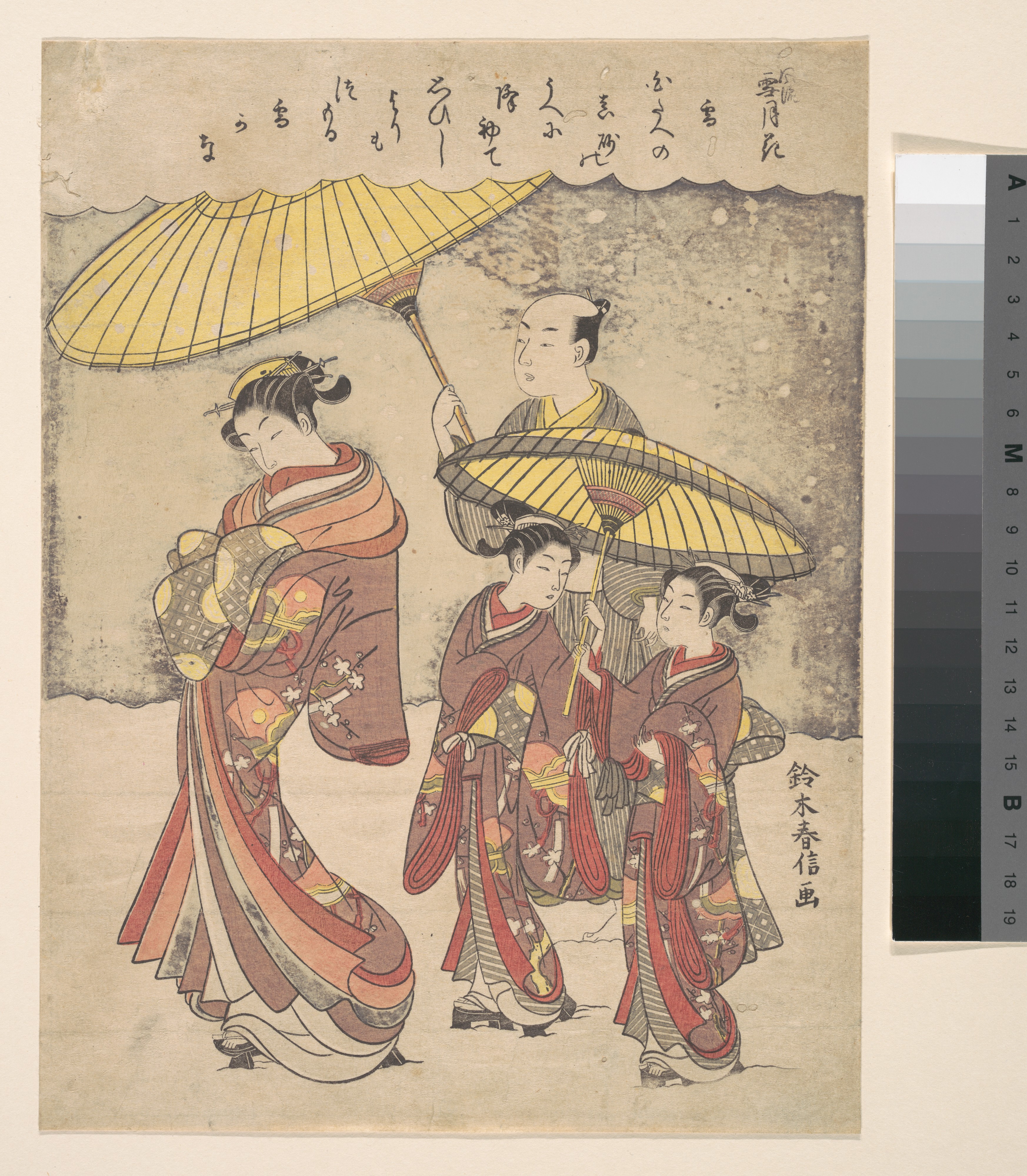
Katherine Fashion Lab Couture Analysis: Snow (Yuki) from *Fūryū Setsugekka*
In the rarefied world of haute couture, where fabric meets philosophy and silhouette becomes narrative, few artifacts rival the quiet authority of a Japanese woodblock print. Katherine Fashion Lab’s latest archival deep-dive turns to Snow (Yuki), a standalone study from the celebrated series Fūryū setsugekka (Fashionable Snow, Moon, and Flowers). Rendered in nishiki-e—the polychrome “brocade print” technique perfected in Edo-period Japan—this work is not merely a decorative image. It is a masterclass in materiality, negative space, and the semiotics of winter dressing, offering a lexicon that contemporary designers still mine for its radical restraint.
Deconstructing the Silhouette: Layering as Architecture
At first glance, Yuki presents a female figure enveloped in a kimono whose volumes defy the body’s natural contours. The print’s genius lies in its deliberate obfuscation of anatomy—the garment swallows the wearer, transforming the human form into a mobile pavilion. This is not accidental; it is the essence of kosode construction, where straight lengths of silk are folded, tucked, and bound to create a cylindrical mass. Katherine Fashion Lab’s analysis highlights how the artist manipulates the hemline’s weight to suggest a gravitational pull unique to snow-laden fabric. The lower third of the kimono swells outward, mimicking the accumulation of precipitation on a still surface. In couture terms, this is the “snow bell” effect—a precursor to Christian Dior’s post-war corolle line, yet executed with far greater subtlety and no structural boning.
The obi, or sash, is rendered as a rigid horizontal band, slicing the composition into two distinct zones. Above it, the upper torso is compressed, the collar pulled high to shield the nape—a gesture of modesty that paradoxically heightens erotic tension. Below, the skirt expands into a gentle trapezoid. This diagonal tension between compression and release is a recurring motif in avant-garde fashion, from Issey Miyake’s pleats to Rei Kawakubo’s sculptural deformations. The print teaches us that volume need not be soft; it can be architectural, even geological. The snow, after all, is not a blanket but a structure.
Materiality and Texture: The Illusion of Weight
What separates a mere illustration from a couture-level study is the artist’s manipulation of surface texture. In Yuki, the kimono’s fabric is not depicted through realistic shading but through a sophisticated system of line density and pigment layering. The upper sleeves feature fine, parallel strokes that suggest a stiff, starched silk—perhaps rinzu (figured silk) with a subtle damask weave. In contrast, the lower skirt employs broader, looser brushwork, implying a softer, napped textile like momen (cotton) or a nubby tsumugi. This dichotomy is crucial: the garment is not one fabric but a composite, a deliberate juxtaposition of tactile experiences.
The snow itself is rendered through negative space—the white of the paper is allowed to stand as the print’s ground, while the figure’s dark indigo and muted ochre tones push forward. Katherine Fashion Lab’s curators note that this is a radical inversion of Western painting, where snow is typically depicted as a white pigment atop a darker ground. Here, the snow is absence, the unprinted void. This conceptual move parallels the modern couturier’s use of unbleached muslin or raw silk to suggest frost, as seen in Yohji Yamamoto’s 1990s collections. The print argues that luxury is not additive but subtractive—a lesson in restraint that fast fashion has yet to learn.
Color Palette: The Chromatics of Cold
The palette of Yuki is deceptively simple, yet each hue carries a specific thermal and emotional weight. The dominant indigo (aizome) is a dye derived from fermented indigo leaves, renowned for its depth and colorfastness. In the print, it functions as the cold shadow of a winter evening, absorbing light rather than reflecting it. Against this, the artist places small accents of vermilion—perhaps the lining of the collar or a tucked obi-age (sash scarf). This single warm note acts as a pulse, a reminder of the body’s heat beneath the layers. Couture houses from Valentino to Dries Van Noten have replicated this trick: a single scarlet thread in a sea of navy to create a focal point of ikigai—a reason for being.
The mica-dusted highlights in the original print (visible under raking light) add a subtle shimmer to the snowflakes scattered across the kimono’s shoulder. This is not glitter; it is go fun, a powdered shell white that catches light like frozen dew. In modern fabric terms, this translates to lame threads or a glazed organza overlay—used sparingly, not as a full surface treatment but as a strategic glimmer. The print’s color logic is one of thermal hierarchy: cold dominates, warmth punctuates, and light is rationed like a precious fuel.
The Standalone Study: A Lesson in Compositional Focus
Unlike the full triptychs of setsugekka, which often include landscape elements or secondary figures, this standalone study isolates the subject entirely. The background is a flat, unmodulated grey—neither sky nor wall, but a conceptual void. This forced focus is a deliberate editorial choice, akin to a fashion plate in a contemporary magazine. The artist compels the viewer to read the garment as a complete text, without environmental distraction. Katherine Fashion Lab’s curatorial notes emphasize that this isolation amplifies the gestural quality of the figure. The slight tilt of the head, the hidden hands inside the sleeves—these micro-movements become monumental when framed by emptiness.
For the modern designer, this is a masterclass in presentation. A runway look, stripped of accessories, music, and set design, must carry its own narrative. The Yuki print demonstrates that a single, well-constructed garment can generate immense drama through silhouette, texture, and color alone. It is a rebuke to the over-styled, the over-layered, the over-thought. The figure stands in snow, yet we never see the ground—only the suggestion of a cold embrace. This ambiguity is the hallmark of enduring couture: it leaves space for the wearer’s story, not just the designer’s.
Cultural Resonance and Modern Iterations
The influence of Yuki extends far beyond its historical moment. When John Galliano designed his 2007 Dior haute couture collection inspired by Japanese kamon crests, he cited prints like this for their asymmetrical drape. More recently, Junya Watanabe’s 2023 winter collection featured wool coats with exaggerated, snow-shedding shoulders—a direct homage to the volumetric hem of this very figure. The print’s concept of “frozen movement”—the idea that clothing can capture a moment of weather in its folds—has become a recurring trope in sustainable fashion, where designers like Marine Serre use recycled materials to create garments that appear to be in a state of thermal flux.
Critically, the print also challenges Western assumptions about seasonal dressing. In Edo-period Japan, winter attire was not about insulation alone but about visual poetry—the layering of white on white, the subtle shift of a collar to reveal a lining patterned with snowflakes. This is a precursor to the modern concept of “quiet luxury,” where status is communicated through texture and drape rather than logos. The Yuki figure is wealthy, yes, but her wealth is expressed through the quality of her restraint—a lesson that resonates in an era of climate-conscious consumption.
Conclusion: The Couture of Stillness
Katherine Fashion Lab’s analysis of Snow (Yuki) concludes that this woodblock print is not a historical artifact but a living design document. Its lessons in negative space, thermal color theory, and layered architectural volume are as applicable to a 2025 runway as they were to an Edo-era wardrobe. The print teaches us that true elegance is not about adding more—more embellishment, more structure, more spectacle—but about subtraction with intention. The snow falls, the fabric folds, and the body remains a quiet mystery. In a world of noise, this is the ultimate luxury: the couture of stillness.