The Connoisseur’s Arsenal: A Study of Three Knives with Sheath
In the rarefied echelons of material culture, the utilitarian object often transcends its function to become a vessel of narrative, status, and aesthetic philosophy. At Katherine Fashion Lab, our curatorial lens is trained not merely on garments, but on the artifacts that define the rituals of power and protection. The subject of this standalone study—a trio of Indian knives accompanied by a singular, ornate sheath—presents a compelling paradox. Here, instruments of violence are transmuted into objects of profound beauty, their lethal edges softened by the opulence of their dress. This is not a study of weaponry; it is a dissection of imperial taste, regional craftsmanship, and the silent language of possession in the Indian subcontinent.
Material Alchemy: The Confluence of Steel and Splendor
The foundational narrative of this set begins with its materials, each selected not for mere durability but for its symbolic resonance. The steel blades, likely forged from high-carbon wootz or its regional equivalent, exhibit a subtle, watery damascene pattern—a testament to metallurgical prowess that was the envy of the world. Yet, the steel is deliberately subordinated to its accompaniments. The bone handles, possibly from ivory or antler, are carved with a precision that suggests they were shaped for a specific, aristocratic hand. They are warm to the touch, a stark contrast to the cold metal, creating a sensory dialogue between the weapon and its wielder.
However, it is the deployment of gold and silver that elevates this set from a functional tool to a ceremonial statement. The gold, likely applied via koftgari—a technique of inlaying fine gold wire into etched steel—delineates the guards and pommels with floral and geometric motifs. The silver, used in the sheath’s fittings and possibly as a base for the gold work, provides a luminous counterpoint. This is not gilding for vanity; it is a calculated assertion of wealth. In the courts of India, the ownership of such a set was a declaration of one’s rank, a visual shorthand for access to the finest ateliers and the most precious raw materials.
The Sheath: A Velvet Cradle for Power
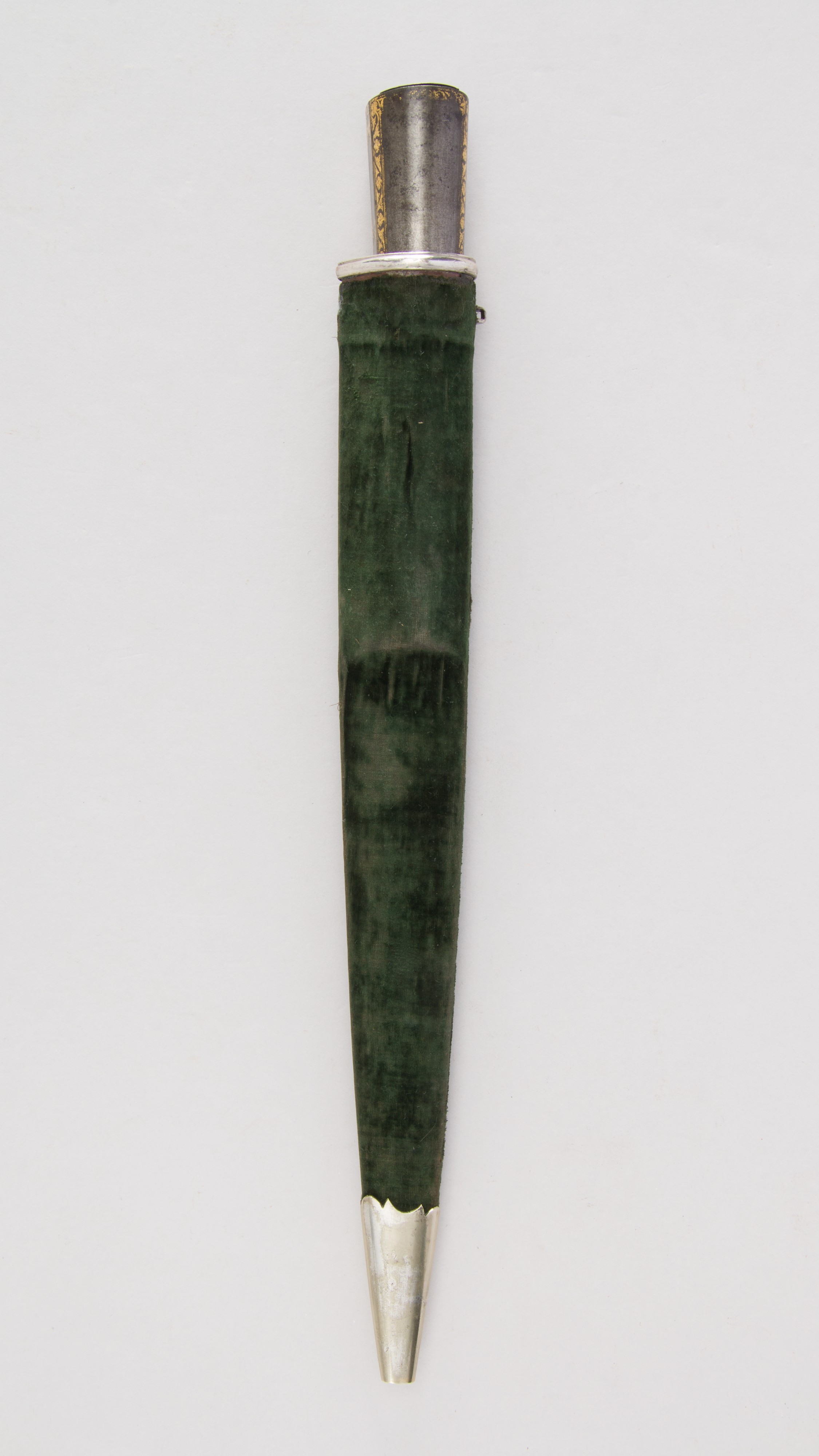
The accompanying sheath is arguably the most intellectually stimulating component of the ensemble. Constructed from wood to provide structural rigidity, it is then swathed in a deep, jewel-toned velvet—a fabric that, in the Indian context, was often imported from Persia or Europe, adding a layer of global trade narrative to the piece. The velvet is not merely a covering; it is a textural statement of softness enveloping the threat of the blade. The contrast between the plush exterior and the hard, metallic interior mirrors the duality of the courtier’s life: the exterior of civility and diplomacy, the interior of readiness and defense.
Functionally, the sheath is engineered to house three distinct blades, suggesting a sophisticated system of utility. This is not a single-purpose dagger but a kit, likely comprising a primary katar or jamdhar for thrusting, a secondary chilanum or curved blade for slashing, and a smaller, more delicate knife for precision work or ceremonial use. The wooden core, shaped to fit each blade’s unique profile, prevents rattling and ensures a silent draw—a detail that speaks to the tactical awareness of its original owner. The silver chape and throat, reinforced and engraved, protect the velvet from wear, demonstrating that even the most luxurious objects were designed for real-world application.
Regional Dialects in Craftsmanship
Attributing this set to a single region is a delicate exercise in connoisseurship. The use of bone and the specific curvature of the secondary blade may suggest a northern or central Indian provenance, possibly from the Rajput courts of Rajasthan or the Mughal-influenced Deccan. The koftgari work, however, is a technique perfected in the Punjab and Sindh regions, known for their exceptional gold inlay. This hybridity is not a flaw but a feature. It indicates that the knives were either commissioned from a traveling master craftsman or assembled from components sourced across the subcontinent, a common practice for high-status commissions.
Furthermore, the iconography engraved on the gold—if one observes the subtle lotus motifs and interlocking vines—aligns with the syncretic aesthetic of the 18th and 19th centuries, where Hindu and Islamic artistic vocabularies merged seamlessly. The absence of figural representation, in favor of pure ornamentation, suggests a patron who adhered to aniconic traditions, possibly within a court that prized calligraphic and floral abstraction. This analytical layer moves the study beyond mere description, positioning the knives as a historical document of cultural synthesis.
Semiotics of the Set: Beyond Utility
In a standalone study, one must interrogate the raison d’être of the trio. Why three? In Indian martial tradition, the number three often signifies the trinity of creation, preservation, and destruction—or, in a more terrestrial sense, the three stages of combat: defense, offense, and counter. The inclusion of a third, smaller blade is particularly telling. It may have served as a chakmak, a sharpening steel used to hone the other blades, yet its ornate handle suggests it was not relegated to mere maintenance. It could have been a letter opener, a tool for cutting fruit at court, or a symbolic "mercy" blade, used to dispatch a fallen enemy.
This multiplicity of purpose is the hallmark of high couture, whether in fashion or in armament. The pieces are designed to be seen, handled, and discussed. The weight of the gold, the smoothness of the bone, the whisper of the velvet against a sash—these are all tactile experiences that reinforce the owner’s identity. The knives are an extension of the body, a prosthetic of power that communicates without words. In a contemporary fashion context, we recognize this as the ultimate form of personal branding: the deliberate curation of objects to project an image of refined, unassailable authority.
Conclusion: An Heirloom of Intent
The Three Knives with Sheath from the Indian subcontinent is a masterclass in the architecture of desire. It challenges the viewer to reconcile the brutality of its purpose with the sublimity of its execution. For the modern connoisseur at Katherine Fashion Lab, it serves as a profound reminder that luxury is not the absence of function, but the elevation of it. Every element—from the resilient steel to the plush velvet—has been considered, weighed, and perfected. This set is not merely an artifact of a bygone era; it is a timeless study in how material, form, and context coalesce to create an object of enduring, almost hypnotic, allure. It is, in the final analysis, a weapon dressed for a ball, a contradiction that remains exquisitely, irrevocably beautiful.