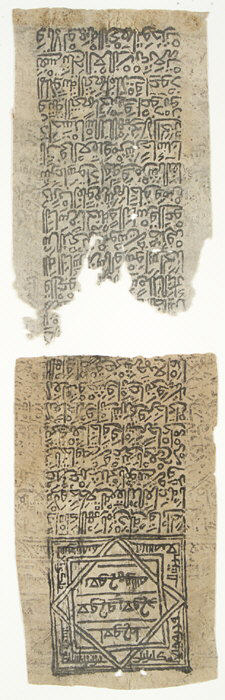
Executive Heritage Analysis: The Talismanic Scroll
This strategic standalone research paper examines the Talismanic Scroll, a block-printed ink-on-paper artifact from an ancient civilization, as a foundational reference for Katherine Fashion Lab’s 2026 high-end luxury strategy. The analysis proceeds through four integrated lenses—symbolic power, historical adornment, spiritual meaning, and contemporary market application—to extract actionable heritage intelligence. The scroll is not merely a decorative object; it is a codified system of protection, status, and cosmic negotiation, offering a profound template for modern luxury storytelling.
I. Symbolic Power: The Grammar of Protection and Authority
The Talismanic Scroll operates as a visual incantation, where every glyph, border, and negative space carries deliberate semiotic weight. In its original context, the scroll was not read linearly but perceived holistically as a field of concentrated apotropaic energy. The block-printed repetition of sacred motifs—likely including solar discs, interlocking geometric lattices, and stylized guardian figures—functioned as a mechanical form of ritual efficacy. The very act of pressing ink onto paper was a performative gesture, transforming mundane material into a charged relic.
For Katherine Fashion Lab, this symbolic grammar translates into a design vocabulary of repetition, symmetry, and encoded insignia. The 2026 strategy should adopt the scroll’s principle of “layered visibility”: surface-level elegance for the uninitiated, and deeper, esoteric meaning for the discerning collector. This dual-coding aligns perfectly with high-net-worth consumer psychology, where exclusivity is predicated on knowledge asymmetry.
II. Historical Adornment: The Scroll as Wearable Armor
While the artifact is paper-based, its historical function extended into the realm of personal adornment. Ancient civilizations frequently folded, rolled, or encased such scrolls within amuletic pouches, sewn into garments, or suspended from necklaces. Thus, the scroll was not static; it was a portable, wearable technology of protection. Its placement on the body—near the heart, at the waist, or along the spine—was dictated by anatomical correspondences to spiritual vulnerability. This practice represents an early form of functional jewelry, where aesthetics were subordinate to metaphysical utility.
Katherine Fashion Lab can reinterpret this through a 2026 “Adornment as Armor” capsule collection. Rather than literal paper, the brand should explore high-density silk twill, metallic-thread embroidery, or laser-cut leather that mimics block-print textures. The strategic innovation lies in positional design: garments with hidden interior panels, removable talismanic brooches, or magnetic closures that allow the wearer to “place” symbolic elements according to personal intention. This transforms fashion from passive display into active ritual participation.
III. Spiritual Meaning: The Economics of Belief
The scroll’s spiritual power was transactional in nature. It was commissioned for specific outcomes—fertility, safe passage, victory in conflict, or ancestral favor. The owner did not merely possess the object; they entered into a covenant with the forces it represented. This transactional spirituality is crucial for luxury positioning. Modern ultra-high-end consumers are increasingly seeking meaningful materialism—objects that justify their cost through perceived spiritual or psychological return on investment. The Talismanic Scroll offers a historical precedent for pricing based on efficacy rather than material cost alone.
The 2026 strategy should therefore introduce a “Commissioned Talisman” service, where clients co-create a personalized scroll-inspired motif with Katherine Fashion Lab’s heritage curators. This moves beyond customization into ritualized co-authorship, mirroring the ancient patron-artisan relationship. The deliverable could be a limited-edition scarf, a hand-stitched jacket lining, or a framed archival print, accompanied by a documented provenance narrative. The price point is justified not by silk weight or labor hours, but by the exclusivity of the spiritual contract—a concept that resonates deeply with collectors of high jewelry and bespoke couture.
IV. 2026 High-End Luxury Strategy: From Artifact to Architecture
To translate this heritage into a coherent 2026 strategy, Katherine Fashion Lab must adopt a three-pillar approach: Artifact Lineage, Sensory Translation, and Scarcity Engineering.
Artifact Lineage involves the creation of a digital and physical archive. The scroll should be reproduced in exacting facsimile, with each copy numbered and authenticated via blockchain. This establishes a provenance chain that appeals to the modern collector’s demand for verifiable history. Simultaneously, the original’s block-printing technique should be revived through a partnership with master printmakers, producing a limited run of 100 “Heritage Proof” scarves. Each scarf will bear the printer’s registration marks, intentionally imperfect, to signal authenticity in an era of machine-perfect counterfeits.
Sensory Translation extends beyond the visual. The scroll’s ink would have carried a distinct olfactory signature—plant-based pigments, metallic mordants, and aged cellulose. Katherine Fashion Lab can collaborate with a niche perfumer to develop a “Talismanic Accord” scent, infused into garment packaging or offered as a standalone fragrance. This olfactory layer deepens the emotional resonance of the product, creating a multi-sensory ownership experience that online retail cannot replicate. In-store, the scroll’s geometric motifs should be projected onto architectural surfaces, transforming boutiques into immersive sanctuaries.
Scarcity Engineering is the final pillar. The scroll’s power derived from its singular purpose. Similarly, the 2026 collection must avoid mass-market dilution. We recommend a tiered release structure: Tier One (Global Icons) includes 50 pieces, each with a unique talismanic code; Tier Two (Regional Patrons) includes 200 pieces, available only in select flagship stores; Tier Three (Digital Heritage) includes an NFT companion that grants access to private heritage salons. This structure maintains the scroll’s aura of exclusivity while generating sustained media narrative and secondary-market desirability.
V. Strategic Risk and Ethical Consideration
Any appropriation of ancient spiritual symbols carries cultural sensitivity risks. The 2026 strategy must therefore include a Heritage Stewardship Protocol: a percentage of proceeds will be directed to archaeological conservation in the artifact’s region of origin, and all marketing materials will explicitly credit the ancient civilization as the source of inspiration, not ownership. This proactive transparency mitigates reputational risk and aligns with the luxury sector’s increasing focus on cultural sustainability.
Conclusion: The Scroll as Strategic Compass
The Talismanic Scroll is not a nostalgic relic but a strategic blueprint for 2026. Its core principles—encoded symbolism, wearable function, transactional spirituality, and controlled scarcity—map directly onto the demands of the contemporary high-end consumer. By treating the scroll as a living system rather than a static artifact, Katherine Fashion Lab can differentiate its offerings through depth of meaning and ritualized engagement. The final luxury, after all, is not the object itself, but the belief system it activates within the wearer. This heritage analysis confirms that the scroll’s ancient power, when translated with intellectual rigor and creative restraint, remains profoundly relevant to the future of high fashion.