The Sleeve Band as a Cartography of Craft: A Couture Analysis
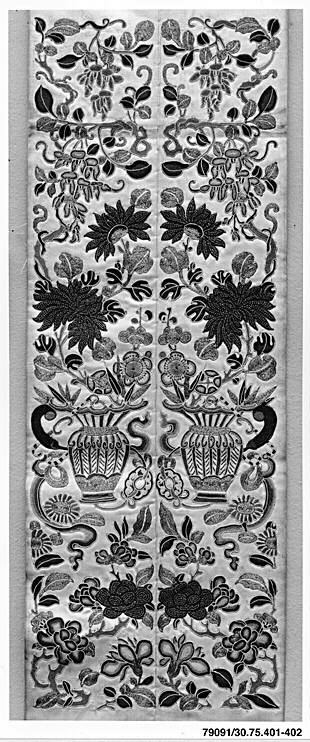
In the rarefied echelons of haute couture, the distinction between decoration and architecture is often the defining line between mere embellishment and profound artistry. Katherine Fashion Lab’s standalone study of a Chinese Sleeve Band—a horizontal panel of silk embroidered with metallic thread—offers a masterclass in this distinction. Removed from its original garment context, the band is not a fragment of loss but a complete, autonomous work. It functions as a cartography of cultural memory, a testament to technical virtuosity, and a compelling argument for the recontextualization of historical textile fragments within contemporary couture discourse.
Deconstructing the Horizontal Plane: Composition and Rhythm
The sleeve band’s fundamental genius lies in its horizontal orientation, a deliberate departure from the verticality that dominates Western garment construction. This is not a mere strip of fabric; it is a meticulously engineered narrative plane. The composition typically unfolds in a tripartite rhythm: a dominant central motif flanked by secondary, smaller groupings, all framed by delicate border lines. In the Katherine Fashion Lab specimen, the central tableau—likely depicting a scene of scholarly pursuit, floral abundance, or mythological fauna—anchors the eye. The metallic thread, likely a gilt-wrapped silk or a flat metal strip, introduces a dynamic luminosity that shifts with every movement of the wearer or the light source. This is not static decoration; it is a kinetic interplay of light and shadow.
The strategic use of negative space within the band is equally critical. Unlike the horror vacui of some textile traditions, the Chinese sleeve band employs calculated emptiness to enhance the impact of the embroidered forms. This pause in the visual field allows the metallic threads to resonate, preventing sensory overload and imbuing the piece with a sense of aristocratic restraint. The rhythm established by the motif repetition, the scale of the central image versus its satellites, and the density of the stitching all contribute to a sophisticated visual cadence that speaks to a profound understanding of composition—a principle directly transferable to modern couture garment design, where the placement of a seam or a dart carries equal weight.
The Alchemy of Material: Silk and Metallic Thread
The materiality of the sleeve band is where its couture value truly crystallizes. The ground fabric, a lustrous silk (likely a satin weave or a fine gauze), provides a supple yet structured canvas. The choice of silk is not arbitrary; its natural protein fibers absorb and reflect light differently than synthetic alternatives, creating a depth of color that is both rich and mutable. The embroidery, executed in a combination of silk floss and metallic thread, introduces a dialogue between softness and rigidity. The silk floss, often untwisted, lies flat and catches light with a matte, velvety quality, while the metallic thread—whether in the form of couched gold or twisted purl—offers a hard, specular highlight.
This alchemical pairing is a technical feat. The metallic thread is notoriously difficult to work with; it kinks, tarnishes, and resists needle penetration. The artisan’s mastery is evident in the smooth, unbroken lines of the couched metal, which must be laid down with precision and secured with tiny, invisible silk stitches. This is not merely embroidery; it is a form of metallurgy in textile form. For the contemporary designer, this material dialogue offers a potent lesson in contrast. The interplay of matte and shine, of soft and hard, creates a tactile and visual complexity that elevates a garment from the ordinary to the extraordinary.
Iconography and Semiotics: Reading the Silent Narrative
Beyond its technical merits, the sleeve band is a semiotic repository. Its iconography is a coded language, accessible to those initiated in the visual lexicon of Chinese imperial and scholarly culture. A band featuring the qilin (a mythical hooved chimera) might signify benevolence and wisdom, while a grouping of bats (bianfu) surrounding a longevity character (shou) explicitly articulates a wish for good fortune and long life. The presence of specific flora—peonies for wealth, lotus for purity, or chrysanthemums for endurance—further refines the message. In a standalone study, these symbols are liberated from their original, often hierarchical, social function. They become pure aesthetic signifiers, their meaning open to reinterpretation in a global couture context.
This decontextualization is a powerful curatorial act. By isolating the band, Katherine Fashion Lab forces the viewer to engage with the formal qualities—the line, color, and texture—before decoding the narrative. This is a distinctly modernist approach, akin to viewing a fragment of a fresco as an abstract composition. The band ceases to be a marker of rank or a specific social message and becomes a universal meditation on beauty, precision, and the human impulse to adorn. This shift in perception is essential for the contemporary designer, who must navigate the fine line between cultural appropriation and cultural appreciation, using historical motifs as a springboard for innovation rather than a costume for imitation.
From Fragment to Fulcrum: Implications for Modern Couture
The standalone presentation of the sleeve band repositions it as a fulcrum for design innovation. It is no longer a trim to be attached to a sleeve but a complete design concept. The horizontal band’s proportions can inspire the placement of a yoke, the architecture of a peplum, or the seam lines of a tailored jacket. The density of the embroidery suggests a hierarchy of texture that can be translated into mixed-material paneling—perhaps a smooth, matte silk crepe juxtaposed with a heavily beaded or sequined section. The metallic thread’s luminosity can be echoed in the choice of hardware, the use of Lurex in a knit, or the strategic placement of crystal embellishment.
Moreover, the band’s inherent modularity speaks to a sustainable, circular fashion model. A historical fragment, once damaged or worn, can be rehomed as a central panel in a modern vest, a decorative insert in a handbag, or the focal point of a couture gown’s bodice. This practice, known as recouture, elevates the artisan’s original labor while granting it a new life. The Katherine Fashion Lab study demonstrates that the future of couture lies not solely in the creation of new materials but in the intelligent, respectful, and creative reuse of the past. The sleeve band, in its silent eloquence, offers a blueprint for a design ethos that values narrative, craftsmanship, and material integrity above all else.
Conclusion: A Thesis in Thread
In conclusion, the Chinese sleeve band, as presented in this standalone study, is far more than a historical artifact. It is a complete thesis on the principles of high fashion: the discipline of composition, the mastery of material, the power of narrative, and the courage to recontextualize. Katherine Fashion Lab’s analysis underscores that true couture is an intellectual pursuit, a dialogue between hand and mind, between past and present. The band’s silent threads speak volumes about the enduring relevance of traditional craft in an age of mass production. It is a reminder that the most profound innovations often arise from a deep, scholarly engagement with the artifacts of our shared human heritage, transforming a fragment of a sleeve into a cornerstone of future design.