Executive Heritage Assessment: The Barong as a Cultural Archetype for Luxury Positioning
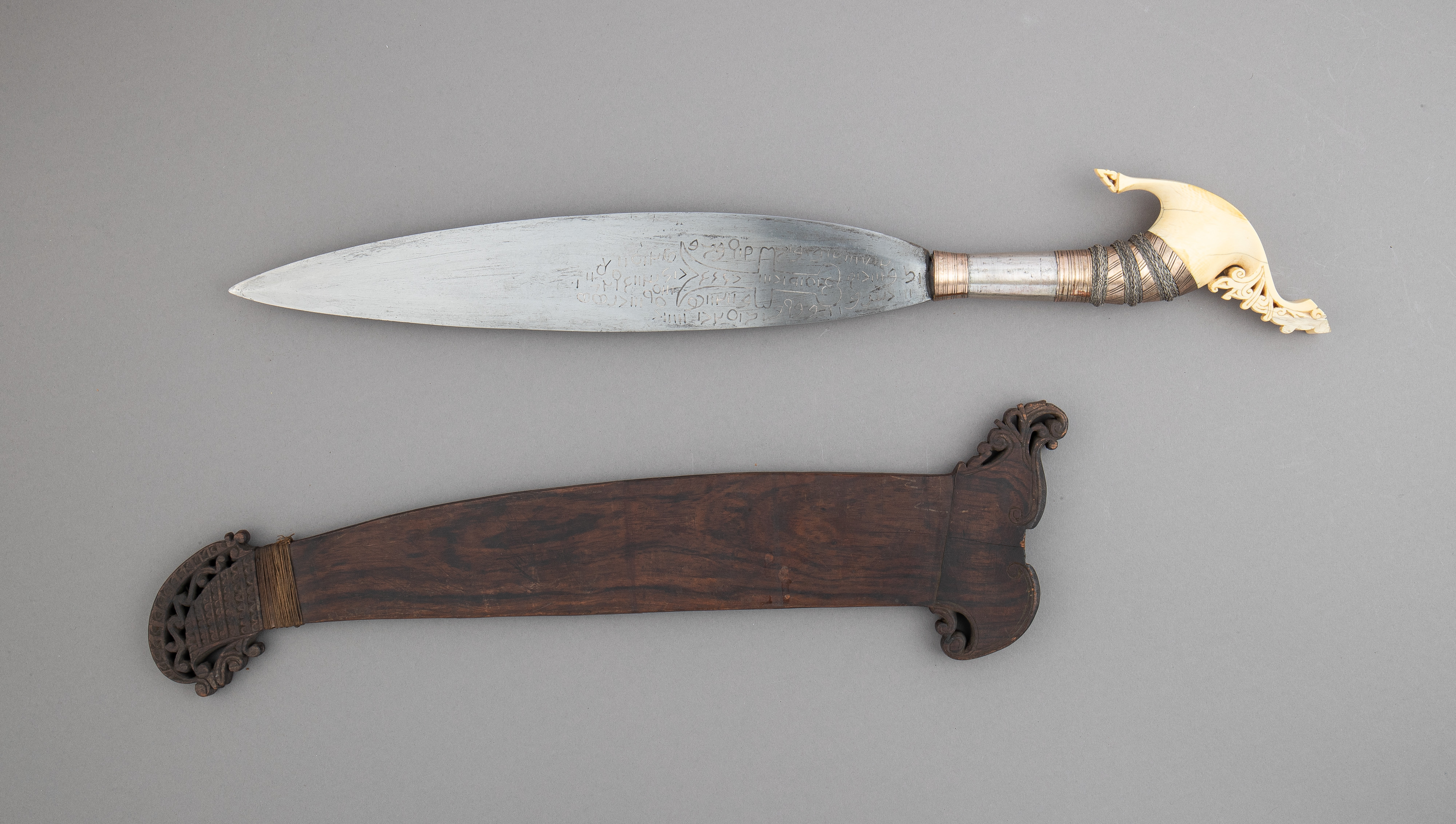
Katherine Fashion Lab presents this strategic heritage analysis of the Philippine Barong (knife) with its accompanying sheath, originating from the Jolo Island or Zamboanga Peninsula. This object, rendered in steel, wood, ivory, silver, copper, and gold, is not merely a weapon of utility but a condensed archive of cultural sovereignty, martial aristocracy, and spiritual cosmology. For a luxury maison seeking to transcend superficial ornamentation, the Barong offers a profound lexicon of symbolic power and historical adornment that can be translated into a 2026 collection strategy grounded in authenticity and narrative depth.
Symbolic Power: The Blade as a Social Contract
In the cultural matrix of the Sulu Archipelago and the Zamboanga Peninsula, the Barong is a signifier of personal honor and communal obligation. Unlike the longer, slashing Kris, the Barong is a leaf-shaped, heavy-bladed knife designed for close-quarter efficacy. Its symbolism, however, transcends its martial function. The blade’s form—broad at the tip and tapering toward the hilt—is often read as a metaphor for focus and decisive resolution. In the context of the Tausug and Yakan peoples, the Barong was not a tool of aggression but a marker of readiness, a physical extension of a man’s word. To draw the Barong was to commit to a course of action with irrevocable finality. This imbues the object with a potent semantic charge: the knife is a social contract made tangible.
For Katherine Fashion Lab, this translates into a design philosophy where silhouette communicates intent. A 2026 luxury piece inspired by the Barong should not mimic its shape but replicate its energetic density. We propose garments and accessories that feature sharp, assertive shoulder lines or metallic closures that suggest a "drawn" state—pieces that empower the wearer with a sense of resolved purpose. The luxury consumer of 2026 is not seeking passive elegance; they seek armor for the psyche. The Barong provides the archetype for that armor.
Historical Adornment: The Metallurgical Hierarchy
The material composition of the Barong is a study in stratified value. The steel blade represents function and resilience, but its true prestige lies in the pamor—the layered forging patterns that are both a technical achievement and a visual signature. The sheath, however, is where historical adornment reaches its zenith. The use of ivory, silver, copper, and gold is not arbitrary. Each metal occupies a specific rank in the cultural hierarchy of adornment:
The Metallurgical Code
- Steel (Blade): Represents the utilitarian soul—the unadorned truth of action.
- Copper (Base Accents): Often used as a foundational layer, symbolizing the earth-bound nature of the bearer.
- Silver (Intermediate Inlay): Denotes lunar clarity, purity of intention, and the social standing of a warrior-chieftain.
- Gold (Apex Ornamentation): Reserved for the highest echelons—rajahs and datus—signifying divine favor and untouchable authority.
This hierarchy is a masterclass in material storytelling. For Katherine Fashion Lab, this suggests a strategic layering of materials in product development. A 2026 luxury accessory line should not use a single precious metal uniformly. Instead, we advocate for a gradient of value—where base materials (oxidized brass or darkened steel) form the structural core, rising to silver accents and culminating in 18k gold micro-details. This creates a tactile and visual journey for the wearer, mirroring the historical stratification of the Barong’s sheath. The consumer is not buying a metal; they are buying a ranked narrative.
Spiritual Meaning: The Anito and the Talismanic Field
The Barong is not merely an object; it is a vessel for spiritual agency. In pre-Islamic and indigenous animist traditions that persist in the region, the blade is believed to house an anito (spirit). The ivory hilt often features carved figures or abstract motifs intended to invoke protection, courage, and the favor of ancestral warriors. The sheath’s intricate carvings serve a dual purpose: to protect the blade and to contain its spiritual energy until release. The act of unsheathing is thus a ritual of invocation, not just a physical action.
This spiritual dimension offers a powerful counter-narrative to the sterile rationalism of contemporary luxury. In 2026, high-end consumers are increasingly drawn to objects with perceived energetic properties—stones, talismans, and heirloom pieces. Katherine Fashion Lab can leverage this by positioning the Barong-inspired collection as talismanic dress. We propose integrating hidden compartments, magnetic closures that require a deliberate "pull" to open, or interior linings with embroidered geometric patterns reminiscent of the sheath’s carvings. These features transform a garment or accessory from a passive object into an interactive ritual tool. The wearer becomes a custodian of a spiritual field, not just a consumer of aesthetics.
Strategic Synthesis: The 2026 Luxury Positioning
To translate this heritage into a commercially viable and culturally respectful 2026 strategy, Katherine Fashion Lab must adopt a curatorial luxury approach, moving beyond mere "inspiration" toward documented provenance. The following strategic pillars are recommended:
1. The "Drawn State" Silhouette
Develop a capsule line of outerwear and structured separates that feature asymmetrical closures, inspired by the Barong’s ergonomic grip. The key is the kinetic moment—the visual suggestion of a blade being drawn. Use sharp, engineered lapels and high-tensile fabrics that hold a rigid form, echoing the steel’s unyielding nature.
2. The Metallurgical Gradient
Launch a "Hardware Collection" of belts, clasps, and bag hardware that follows the steel-copper-silver-gold hierarchy. This is not about cost-cutting; it is about narrative sequencing. Each piece will be numbered and accompanied by a "material provenance card" explaining the role of each metal in the historical context. This adds a layer of collectible intelligence that justifies a premium price point.
3. The Ritual Unsheathing Experience
Redefine the unboxing experience as a ceremony of release. Packaging should be a rigid, sheath-like structure (using sustainable wood composites) that requires a deliberate sliding motion to open. Inside, the product should be wrapped in a fabric with a subtle, custom-developed scent profile—sandalwood and vetiver—evoking the historical environment of the Sulu archipelago. This multi-sensory ritual elevates the purchase from transaction to initiation.
4. Cultural Stewardship Protocol
To avoid accusations of cultural appropriation, Katherine Fashion Lab must implement a stewardship model. This involves a formal collaboration with museums in Zamboanga or academic institutions specializing in Moro art. A percentage of proceeds from the collection will fund the preservation of indigenous metalworking techniques. This is not a marketing afterthought; it is a supply-chain of meaning that authenticates the brand’s narrative.
Conclusion: Beyond the Artifact
The Barong is a synthesis of martial pragmatism, imperial adornment, and spiritual protection. For Katherine Fashion Lab, it offers a strategic blueprint for creating luxury goods that are heavy with meaning in an era of ephemeral trends. By isolating its three core attributes—decisive power, material hierarchy, and talismanic energy—the maison can construct a 2026 collection that is both historically literate and commercially avant-garde. The goal is not to reproduce the knife but to reproduce its effect: to grant the wearer an aura of resolved authority, wrapped in the language of precious metals and ritualistic design. This is the definition of heritage-driven luxury: not the display of the past, but the deployment of its power in the present.