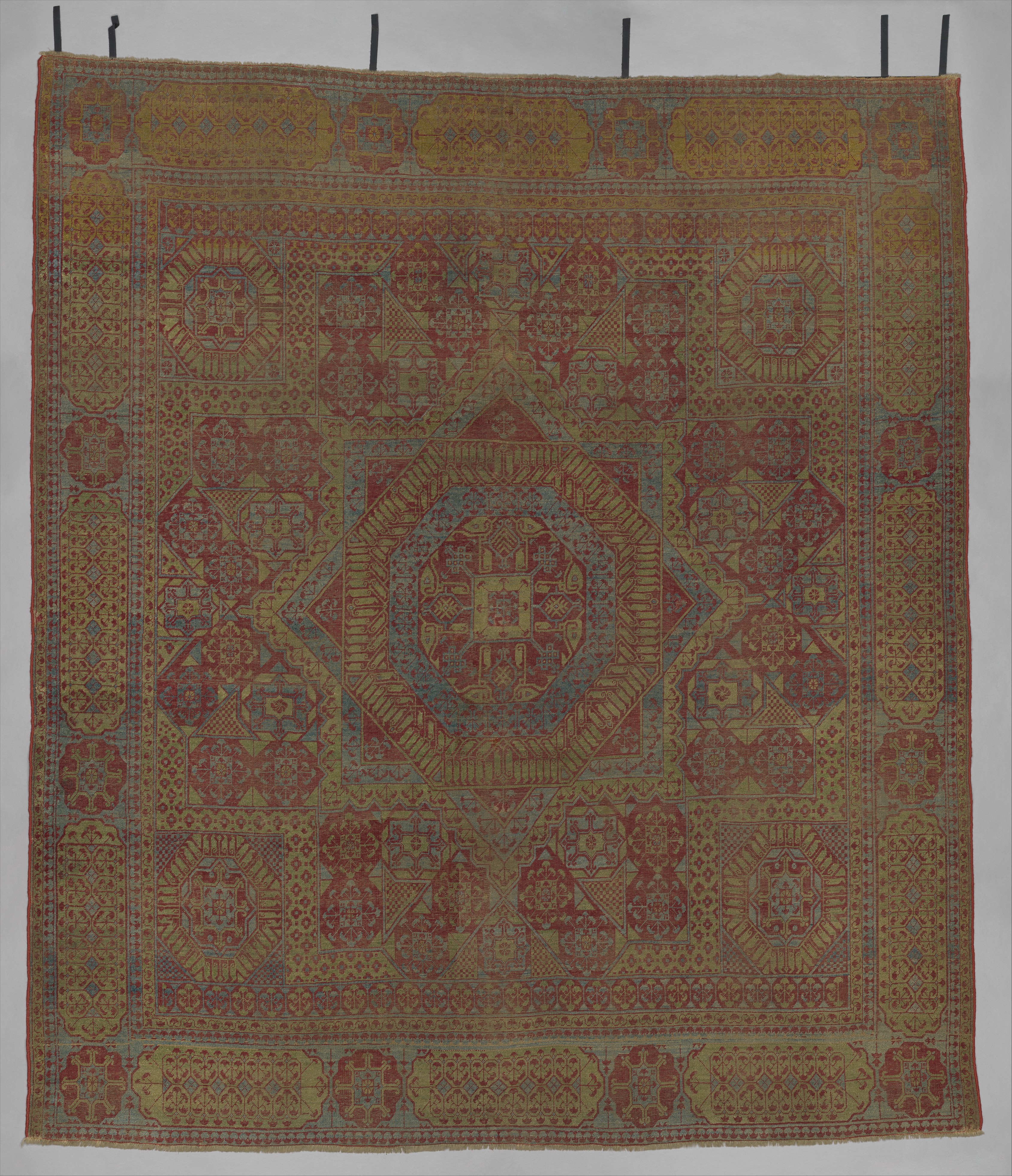
The Weaver’s Calculus: Deconstructing the Carpet as a Couture Artifact
In the rarefied echelons of haute couture, where fabric is often treated as a pliable canvas for drapery and silhouette, Katherine Fashion Lab presents a radical departure: the carpet as a standalone study in structural integrity and textural narrative. This is not a garment, nor an accessory in the conventional sense. It is a manifesto woven in wool, a deliberate interrogation of what constitutes "wearable" architecture. By isolating the carpet from its domestic or ceremonial context, the Lab elevates it to the status of a sculptural object, demanding a re-evaluation of the tactile and visual language that defines high fashion.
The Asymmetric Knot: A Deliberate Disruption of Order
The central thesis of this study lies in the carpet's construction: a warp and weft of undyed wool, punctuated by an asymmetrically knotted pile. In traditional carpet weaving, the symmetrical (or Turkish) knot is prized for its density and durability, while the asymmetrical (or Persian) knot allows for finer detail and more fluid lines. Katherine Fashion Lab subverts this convention by employing the asymmetrical knot not for precision, but for deliberate irregularity. Each knot is tied with a slight variance in tension, creating a pile that undulates like a topographical map of a forgotten terrain. This is not a flaw; it is a calculated aesthetic. The surface becomes a study in light absorption and reflection, where shadows pool in the valleys of looser knots and gleam on the peaks of tighter ones.
The choice of wool as the sole material is equally significant. Wool, in its raw state, is a fiber of memory—it retains the scent of the sheep, the texture of the pasture, the trace of the hand that sheared it. In this carpet, the wool is left un-dyed, presenting a spectrum of ivory, oatmeal, and heather grey that is both monastic and opulent. This restraint in color forces the observer to engage with the materiality of the object itself. The lanolin in the wool lends a subtle, organic sheen that no synthetic fiber can replicate. It is a sensory experience: the scent of the earth, the coolness of the fiber against the skin, the slight prickle of the pile that reminds us of the animal origin of all luxury.
Global Heritage as a Silent Vocabulary
The "Global Heritage" origin of this piece is not a mere provenance footnote; it is an active design principle. The asymmetrical knot is a technique that spans from the Anatolian plateau to the steppes of Central Asia, from the royal looms of Isfahan to the nomadic encampments of the Caucasus. By abstracting this shared technique, Katherine Fashion Lab creates a universal textile dialect. There is no overt cultural motif—no floral arabesque, no geometric medallion. Instead, the heritage is embedded in the *process*. The rhythm of the hand, the repetitive motion of tying and cutting, the patience required for a single square inch—these are the intangible heirlooms that the Lab has chosen to honor.
This approach challenges the contemporary fashion industry's penchant for cultural appropriation. Rather than borrowing a pattern or a silhouette, the Lab borrows a *methodology*. The carpet becomes a tribute to the anonymous weavers whose hands have historically been the engines of textile innovation, yet whose names are lost to history. In this standalone study, the carpet is a monument to that anonymity, a silent acknowledgment that couture is not born in an atelier alone, but in a lineage of global craftsmanship that predates the fashion house itself.
Structural Integrity: The Carpet as an Architectural Garment
One might ask: where is the fashion in a carpet? The answer lies in the concept of wearable architecture. The carpet's construction—a dense, interlocked system of warp and weft with a plush pile—is a study in tension and support. The warp threads run longitudinally, providing the tensile strength; the weft threads interlace perpendicularly, adding stability; and the pile rises vertically, offering a soft, tactile surface. This tri-axial system is analogous to the human skeleton, musculature, and skin. The Lab posits that if this carpet were to be draped over a form, it would not conform to the body, but rather assert its own volume.
In a series of conceptual sketches accompanying the study, the carpet is imagined as a rigid, cocoon-like shell—a carapace for the modern nomad. The asymmetry of the knots becomes a functional feature, allowing the material to bend in specific directions while remaining stiff in others. This is not the fluidity of silk or the stretch of jersey; it is the uncompromising structure of a building. The wearer would not move *with* the garment; they would move *within* it, their body becoming a living plinth for the textile. This is couture as a form of habitation, a portable shelter that speaks to our primal need for protection and place.
The Tactile Economy: Slow Fashion’s Apotheosis
In an era of fast fashion and digital renderings, the carpet stands as a testament to the slow, deliberate hand. Each asymmetrical knot is a discrete unit of time. A single square meter of this carpet might contain upwards of 100,000 knots, representing hundreds of hours of labor. This is the antithesis of mass production. Katherine Fashion Lab has positioned this piece as a "standalone study," meaning it is not intended for serial reproduction. It is a unique object, a pièce unique, in the truest sense of the term. Its value is not determined by its marketability, but by its ontological weight—the sheer fact of its existence as a concentrated form of human intention.
The tactile economy of this carpet also redefines the relationship between the consumer and the object. To possess such a piece is not to own a commodity, but to become a custodian of a craft tradition. The owner is implicated in the narrative of the wool, the knots, and the hands that made it. This is a luxury that cannot be photographed or replicated; it must be felt. The carpet, therefore, is a challenge to the visual-centric nature of contemporary fashion media. It demands a physical presence, a haptic engagement that is increasingly rare in our digitized world.
Conclusion: A New Lexicon for Textile Art
Katherine Fashion Lab's carpet study is a provocative thesis on the future of couture. By stripping away color, pattern, and conventional form, the Lab has distilled fashion to its most essential element: the fiber itself. The asymmetrical knot is not a decorative choice but a philosophical one, embodying a worldview that celebrates imperfection, asymmetry, and the beauty of the hand-made. This is not a nostalgic retreat to the past, but a forward-looking proposal for a fashion that is more material, more honest, and more deeply connected to the global heritage of textile making.
The carpet, in this context, is no longer a floor covering. It is a sculptural garment for the environment, a standalone object that commands the space it occupies. It whispers of nomadic tents, royal courts, and the silent, patient labor of generations. In its dense, woolen mass, we find a radical proposition: that true luxury is not in the speed of production, but in the depth of time embedded in every knot. This is couture as a form of meditation, a tactile prayer for a world that has forgotten how to slow down. And in that slowing, Katherine Fashion Lab has woven not just a carpet, but a new lexicon for the future of textile art.