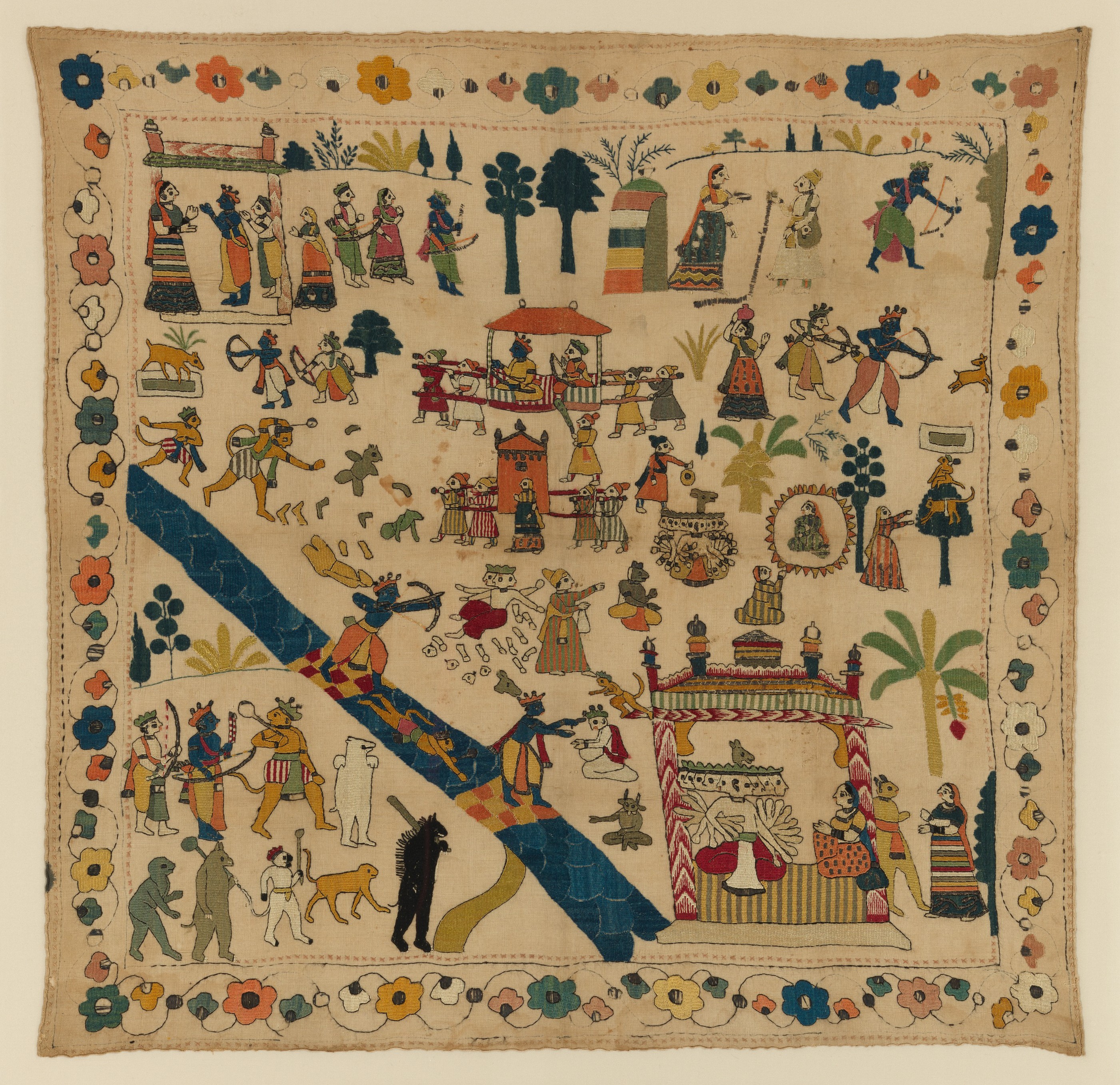
The Rumal as Epic: A Couture Analysis of Katherine Fashion Lab’s Ramayana Embroidery
In the rarefied echelons of haute couture, where fabric is not merely material but manuscript, Katherine Fashion Lab’s Rumal with Scenes from the Ramayana transcends the boundaries of textile craft to occupy the realm of narrative art. Hailing from the storied valleys of Jammu and Kashmir, this piece—a cotton ground enriched with silk, tinsel, and metal embroidery—is not a garment in the conventional sense. It is a portable epic, a devotional cartography, and a masterclass in the semiotics of luxury. For the discerning connoisseur, this rumal is not an accessory; it is an heirloom of cultural capital, a standalone study in how couture can encapsulate mythology, geography, and technical virtuosity within a single, square frame.
Deconstructing the Palimpsest: Materiality and Technique
The foundational choice of cotton is a deliberate act of aesthetic subversion. In a Western couture context, cotton is often relegated to utilitarian status. Here, however, it serves as the tabula rasa—the humble earth upon which divine drama unfolds. The cotton’s plain weave provides a matte, absorbent surface that contrasts starkly with the luminous exuberance of the embroidery. This is not a fabric of opulence; it is a fabric of patience, a substrate that allows the narrative to breathe without the distraction of a self-aggrandizing ground.
The true protagonists, however, are the silk, tinsel, and metal threads. The silk, likely a filament of mulberry origin, introduces a chromatic depth that shifts with the angle of light. It is used to delineate the flesh tones of the figures, the folds of their garments, and the delicate flora of the forest settings. The tinsel—a flattened, metallic ribbon—creates a shimmering, almost liquid quality on the surface, evoking the glint of armor, the sparkle of royal jewels, and the reflective surface of the Sarayu River. Finally, the metal embroidery, likely employing zardozi or tilla techniques, provides the structural architecture of the piece. The raised, coiled metal threads (often silver or gold gilt) add a third dimension, transforming the flat surface into a low-relief sculpture. The interplay between the soft, absorbent cotton and the rigid, reflective metal creates a tactile dialectic—a conversation between the earthly and the divine, the mortal and the immortal.
Narrative Cartography: The Ramayana in Thread
Unlike a linear painting, the rumal operates on a synchronic narrative principle. It does not tell the story sequentially but rather simultaneously. The composition is a radial or grid-based arrangement where multiple key episodes from the Ramayana coexist. This is not a chaotic collage; it is a deliberate spatial hierarchy. The central panel typically anchors the primary scene—often the coronation of Rama or the battle with Ravana—while the borders and quadrants depict subsidiary episodes: Sita’s abduction, Hanuman’s leap to Lanka, the burning of the golden city, and the final reunion.
For the couture analyst, this structural choice is a profound statement on temporal fluidity. The wearer or viewer is not invited to read a story but to inhabit a cosmology. The rumal becomes a mandala of devotion, where every glance captures a different facet of the divine play. The border, often the most intricate, serves as a pradakshina—a circumambulatory path—guiding the eye in a clockwise ritual around the central deity. The metal threads here act as the gilded gates of a temple, enclosing the sacred narrative within a protective, luminous frame.
The Aesthetic of Restraint: Color and Composition
Katherine Fashion Lab’s curation of this piece highlights a nuanced understanding of chromatic restraint. The palette is not the riotous explosion of color found in some Rajasthani miniatures. Instead, it relies on the inherent contrast between the natural, undyed or lightly dyed cotton and the metallic threads. The silk accents—perhaps in deep madder reds, indigo blues, and saffron yellows—are used sparingly, as punctuation marks within a predominantly monochromatic metallic field. This is a sophisticated aesthetic choice. It elevates the piece from mere folk art to a proto-minimalist luxury object, where the absence of color amplifies the presence of texture.
The composition itself is a study in horror vacui—the fear of empty space—yet it is executed with impeccable balance. Every inch of the cotton is accounted for, yet the density is not claustrophobic. The figures are stylized, with elongated eyes, graceful postures, and expressive hand gestures (mudras) that convey emotion without the need for facial detail. This stylization is not a limitation but a sophisticated abstraction, aligning the work with the classical canons of Indian aesthetic theory, where bhava (emotion) is evoked through suggestion rather than representation.
Contextualizing the Object: From Courtly Craft to Couture Statement
Historically, the rumal (literally “handkerchief” or “cover”) was a functional object—used to wrap gifts, cover trays, or serve as a ceremonial cloth. In the courts of the Dogra and Sikh rulers of Jammu and Kashmir, these embroidered textiles became markers of royal patronage and regional identity. The Kashmiri rumal is distinct from its Chamba or Kangra counterparts due to its use of metal thread and its often more geometric, less painterly style.
In the context of a standalone study, Katherine Fashion Lab reframes this historical artifact within the discourse of contemporary luxury. The rumal is no longer a domestic textile but a wearable sculpture or a wall-mounted installation. Its placement in a couture collection challenges the Western hierarchy of garment construction. It asks: Is couture defined by the silhouette, or by the narrative it carries? The answer, as this piece demonstrates, is the latter.
The technical mastery required to produce such a piece is staggering. It is estimated that a single square foot of dense metal embroidery can take weeks of labor by a skilled artisan. The rumal, therefore, is an investment in time itself—a counterpoint to the fast-fashion ethos of disposability. It embodies the philosophy of slow luxury, where the value is intrinsic to the process, not the product. This aligns perfectly with the modern couture client’s desire for pieces that carry profound provenance, ethical production narratives, and a unique, non-replicable artistic vision.
Conclusion: A Thread of Divinity
In final analysis, the Rumal with Scenes from the Ramayana is a testament to the enduring power of textile as a medium for theological and cultural transmission. Katherine Fashion Lab’s presentation of this piece elevates it beyond ethnographic curiosity, positioning it as a cornerstone of a global couture language. The cotton speaks of humility; the silk speaks of desire; the tinsel and metal speak of the eternal. Together, they weave a narrative that is at once deeply regional and universally resonant.
For the collector, this is not merely an acquisition of an embroidered cloth. It is an acquisition of 800 years of storytelling, a fragment of the Ramayana rendered in a material lexicon that predates the printed word. It is a reminder that the most profound luxury is not in what we own, but in what we can carry—both physically and spiritually. The rumal, in its perfect square geometry, is a universe folded into a handkerchief, and Katherine Fashion Lab has had the foresight to present it not as a relic, but as a living, breathing masterpiece of couture art.