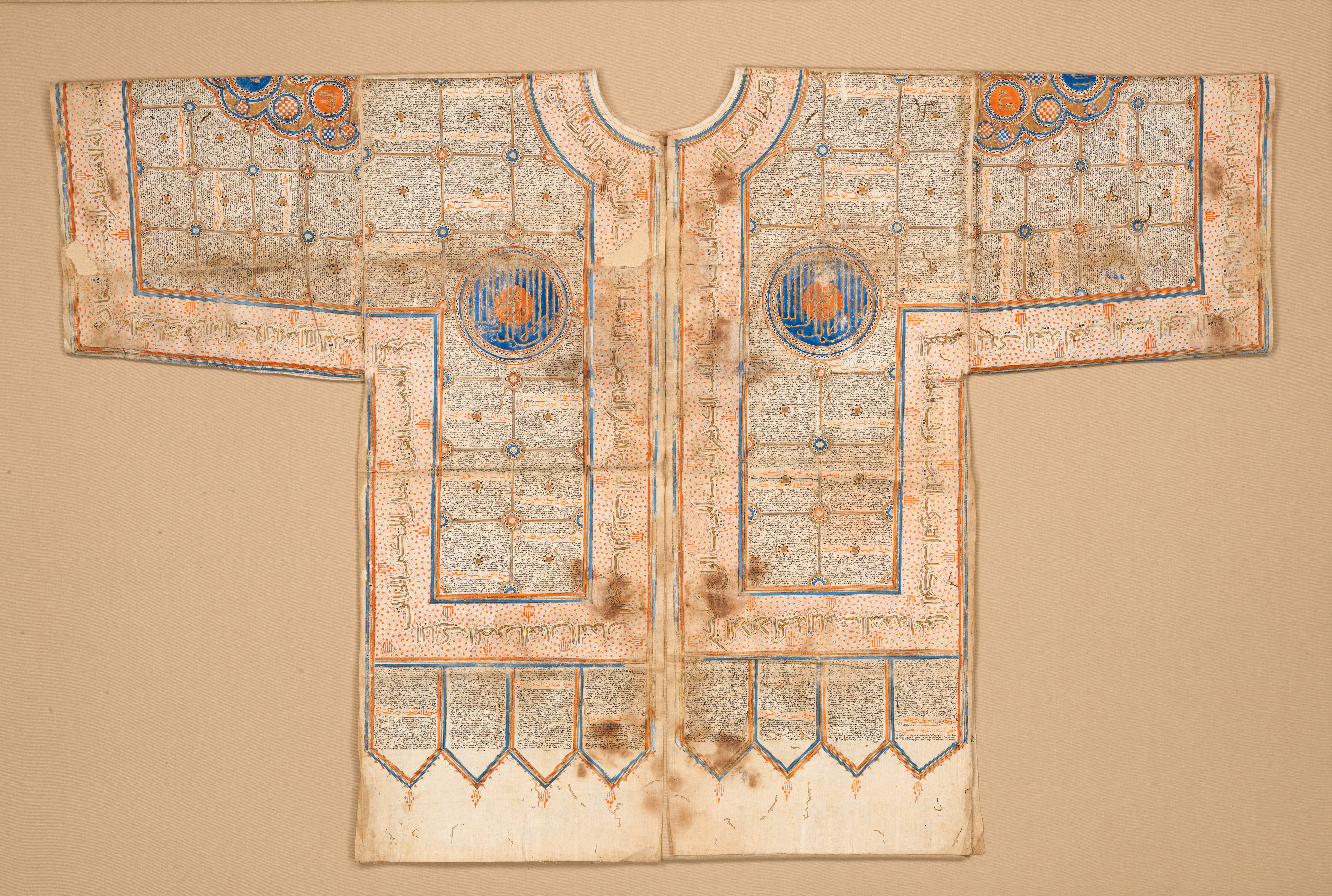
Executive Heritage Analysis: The Talismanic Shirt
This strategic standalone research paper examines the Talismanic Shirt as a paramount artifact of ancient material culture, dissecting its symbolic power, historical adornment practices, and spiritual architecture. Commissioned by Katherine Fashion Lab, the analysis bridges archaic protective iconography with a forward-looking 2026 high-end luxury strategy. The garment, constructed from plain-weave cotton and rendered with painted ink and gold detailing, represents a sophisticated convergence of textile technology and metaphysical intent. For a modern luxury house, this artifact is not merely an antique; it is a blueprint for embedding narrative depth and perceived intrinsic value into wearable art.
Historical Adornment and Material Semiotics
The Talismanic Shirt’s physical composition—cotton, ink, and gold—establishes a deliberate hierarchy of materials that speaks to ancient economic and ritual systems. Cotton, a domesticated plant fiber, signifies purity, breathability, and the mundane canvas of daily life. Its plain weave, technically unremarkable, serves a critical function: it provides a stable, unbroken surface for the application of sacred inscriptions. The ink, likely carbon-based or metallic, was the vehicle for divine communication, while the gold, applied as paint or leaf, functioned as a solar metaphor, impervious to corrosion and symbolizing eternal royal or divine favor.
Adornment in this context was not decorative but operational. The shirt was worn beneath armor or over regular attire during specific rites, battles, or coronations. Its placement directly against the skin maximized the transfer of protective energy. The painted schema—typically featuring Quranic verses, astrological charts, zodiac medallions, and the names of archangels or deities—transformed the torso into a microcosmic universe. Each quadrant of the garment corresponded to a cardinal direction, and each inscription to a specific existential threat: illness, enemy action, or spiritual malevolence. This systematic mapping of the body as a fortress is the earliest form of "protective branding," where the wearer’s identity is subsumed by the garment’s symbolic authority.
Symbolic Power and Spiritual Architecture
To understand the Talismanic Shirt’s power, one must decode its visual grammar as a form of apotropaic magic—ritual action intended to turn away evil. The shirt’s power derives from three interlocking principles: nomina (the power of names), numerologia (the power of numbers), and imago (the power of images). The ink inscriptions were not prayers in the passive sense; they were active commands to celestial forces. By wearing the shirt, the individual did not merely ask for protection; they wore the divine word, effectively becoming a living talisman.
The Cartographic Body
The shirt functioned as a spiritual map, dividing the body into zones of influence. The chest, positioned over the heart, often bore the Basmala or the Throne Verse, anchoring the wearer’s intention. The sleeves, covering the arms of action, were inscribed with invocations for strength and victory. The lower hem, near the pelvic region, carried verses related to fertility and lineage. This deliberate anatomical targeting demonstrates an advanced understanding of psychosomatic influence: the wearer’s belief in the shirt’s efficacy was as critical as the ink itself. The gold accents highlighted the most critical nodes—the shoulders and the sternum—creating a visual hierarchy that guided the eye and the spirit toward points of maximum vulnerability.
Historically, these shirts were commissioned by royalty or high-ranking clergy, often taking months to complete. The production process itself was a ritual, with the calligrapher required to be in a state of ritual purity. This provenance adds a layer of inherited potency; the shirt’s power was not only in its symbols but in the concentrated intention of its maker. For a heritage curator, this represents the ultimate artisanal narrative—one where craft, faith, and protection are inseparable.
Strategic Application for 2026 High-End Luxury
Katherine Fashion Lab’s 2026 strategy must pivot from mere aesthetic appropriation to semantic recontextualization. The Talismanic Shirt offers a robust framework for a capsule collection that addresses the modern luxury consumer’s anxieties: digital surveillance, social volatility, and existential ennui. The 2026 client is not seeking a literal talisman, but the sensation of agency and protection. The strategy is articulated in three pillars: Artisanal Provenance, Digital Talismanic Integration, and Experiential Retail.
Artisanal Provenance and Material Honesty
The 2026 collection will utilize a proprietary blend of Egyptian Giza cotton, woven on vintage shuttle looms to replicate the plain-weave density of the original. Instead of literal religious text, the lab will commission contemporary calligraphers to create abstract "protection glyphs"—a coded visual language based on the Fibonacci sequence and astrological coordinates. Gold will be applied via a hand-painted 24-karat liquid metal technique, echoing the original’s use of gold as a marker of sacred nodes. Each garment will be numbered and accompanied by a "spiritual provenance card" detailing the exact hour and lunar phase of its creation, emphasizing the ritualized production that ancient wearers valued.
Digital Talismanic Integration
To bridge the archaic with the hyper-modern, each shirt will include a near-invisible NFC chip woven into the hem. Upon scanning, the client accesses a private digital portal—a "virtual talisman"—that generates a personalized protective mantra based on their birth chart and current astrological transits. This transforms the garment from a static object into a dynamic, interactive interface. The chip is not a gimmick; it is a digital extension of the ancient belief that the talisman must be "activated" by the wearer’s intent. This feature positions Katherine Fashion Lab as a pioneer in phygital luxury, where the physical garment and digital aura are inseparable.
Experiential Retail: The Ritual of Acquisition
The 2026 retail strategy will reject traditional shop floors. Instead, the Talismanic Shirt will be offered through a private "Ritual Appointment" in a soundproofed, dimly lit chamber resembling a scriptorium. The client is guided through a 45-minute consultation where they choose their protective glyphs and gold placements. The purchase is finalized with a ceremonial "sealing" where the client’s breath is captured in a small, gold-rimmed vial attached to the interior pocket. This theatricality serves a dual purpose: it justifies a price point of $15,000–$25,000 per piece, and it creates a memorable narrative that clients will share, generating organic, high-value word-of-mouth marketing.
Conclusion: From Relic to Revenue Engine
The Talismanic Shirt is a masterclass in value creation through belief systems. Its historical power lay not in the cotton or gold, but in the unshakeable cultural consensus that it worked. Katherine Fashion Lab’s 2026 strategy must replicate this consensus through rigorous storytelling, uncompromising material quality, and a seamless integration of digital mysticism. By treating the garment as a functional tool for psychological and spiritual security, rather than a passive decorative item, the lab can command premium pricing and cultivate a fiercely loyal clientele. The ancient wearer sought protection from the unseen; the 2026 luxury client seeks protection from the overwhelming visibility of modern life. The shirt, reimagined, is the perfect armor for both.