A Needle Across Continents: Deconstructing the Global Heritage of a 16th-Century Modelbuch
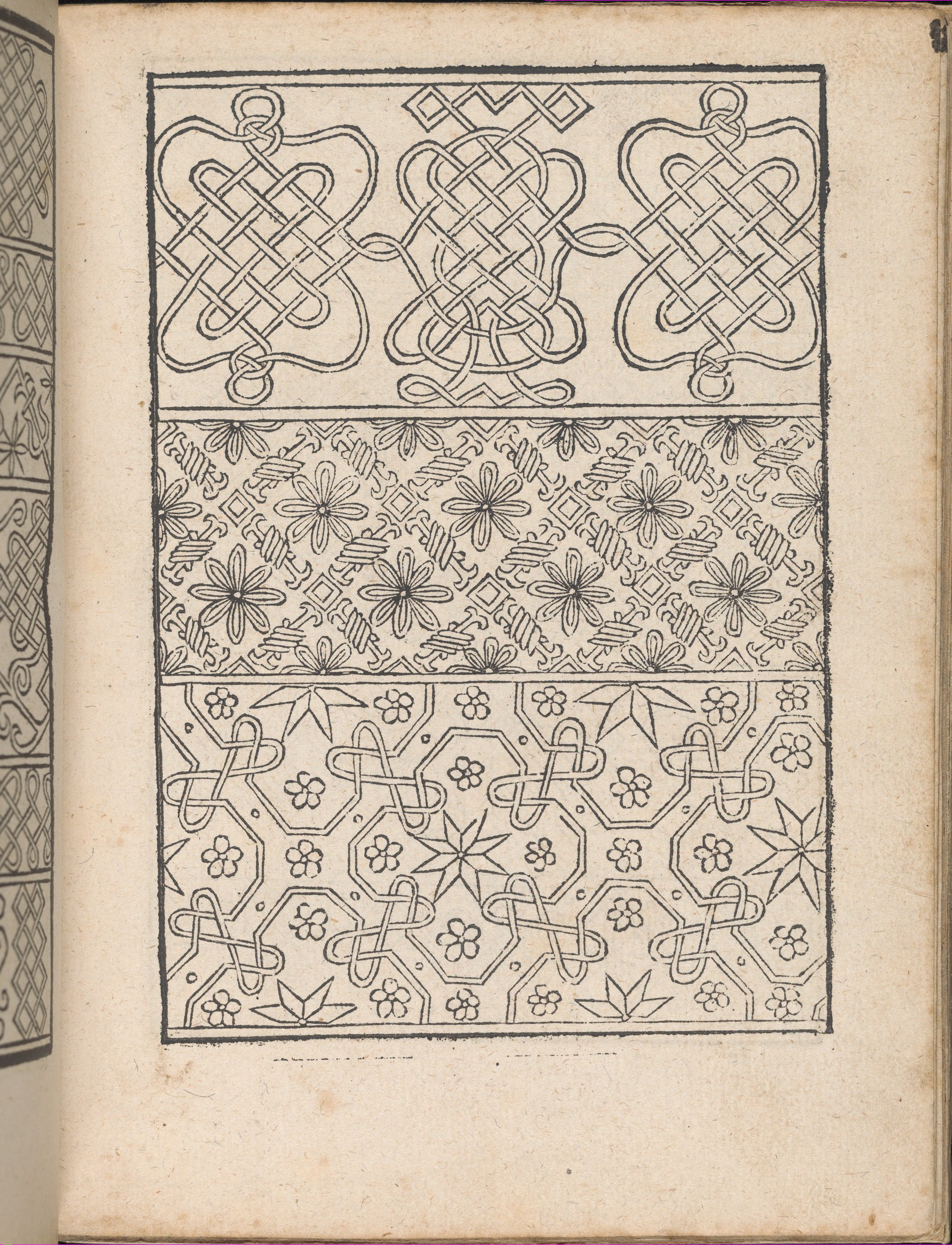
In the hushed, archival realm of textile history, few artifacts speak as eloquently to the interconnectedness of early modern commerce and creativity as the New Modelbüch allen Nägerin u. Sydenstickern (New Pattern Book for All Embroiderers and Silk Stitchers). As a standalone study, this woodcut page—designated here as Page 4r—transcends its physical form as a simple instructional plate. It functions as a complex palimpsest, revealing a globalized aesthetic consciousness that predates our modern understanding of cultural exchange. For Katherine Fashion Lab, this artifact is not merely a historical curiosity; it is a foundational text on the mechanics of design diffusion, offering profound insight into how pattern, technique, and taste moved fluidly across political and geographical borders in the 16th century.
The Woodcut as a Vector of Silent Commerce
To fully appreciate Page 4r, one must first situate it within its revolutionary medium. The woodcut, a relief printing technique, was the era's primary vehicle for mass visual communication. Unlike the illuminated manuscript, which was an exclusive, bespoke luxury, the woodcut was reproducible, affordable, and portable. This particular Modelbüch, likely published in a major German or Swiss printing center such as Nuremberg or Zurich, was part of a flourishing genre of pattern books that emerged in the 1520s. These books were the Instagram feeds of their day—curated, aspirational, and designed for replication.
The materiality of the woodcut itself is crucial to the analysis. The bold, unyielding line of the carved block imposes a specific discipline on the designer. There is no room for the fluid nuance of pen-and-ink; the design must be reduced to its essential, legible geometry. This limitation, however, became a virtue. The woodcut forced a process of stylistic abstraction, distilling complex motifs into bold, repeatable patterns. On Page 4r, we see this principle manifest in the crisp delineation of interlocking vines, stylized flora, and geometric latticework. The very grain of the wood—the physical impression left by the block—becomes a textural signature, a reminder that this image was struck, inked, and pressed by human hands, carrying with it the kinetic energy of its production.
Decoding the Visual Lexicon: A Synthesis of East and West
The iconographic content of Page 4r is where the "Global Heritage" attribution becomes most potent. At first glance, the patterns may appear superficially "European," yet a deeper forensic reading reveals a dense interweaving of foreign influences. The prominent use of the pomegranate motif—a symbol of fertility and abundance—is a direct inheritance from Persian and Ottoman textile design, where it was a staple of imperial silks. The way the fruit is dissected and stylized into a symmetrical, almost architectural form on this page echoes the saz style of the Safavid court, which celebrated naturalistic leaves and blossoms intertwined in rhythmic, continuous lines.
Furthermore, the geometric interlacing and strapwork visible in the lower registers of the page betray a profound debt to Islamic girih patterns. These intricate, star-and-polygon constructions, derived from mathematical principles, were transmitted to Europe not through direct visual contact alone, but through the medium of portable luxury goods: Ottoman silks, Mamluk metalwork, and Venetian-imported carpets. The European woodcut designer, working in a print shop far from the Mediterranean, would have had access to these imported objects as reference material. The resulting pattern is not a copy, but a creative translation—a process whereby Islamic geometric logic is re-rendered with a Northern European sensibility for dense, foliate ornament.
The Gendered Economy of Skill and the "Nägerin"
The book's title, explicitly addressing the Nägerin (embroiderer) and Sydenstickern (silk stitcher), is a critical piece of sociological data. It confirms that the primary audience for these patterns was the professional or semi-professional female artisan. This is not a book of elementary darning for the household novice; it is a professional catalogue for women who possessed specialized, marketable skills. The patterns on Page 4r are complex enough to require a high degree of technical mastery, suggesting that these women were not merely hobbyists but were engaged in a commercial economy of ornament.
This publication empowered the female maker in a specific way. It democratized access to high-end, cosmopolitan design. A needlewoman in a provincial town could now access the same patterns that were being used in the great urban centers of Augsburg or Antwerp. She could, with her needle and silk thread, replicate the look of an imported Italian silk or a Levantine embroidery. The woodcut, therefore, acted as a leveler of aesthetic hierarchy. It provided a blueprint for social aspiration, allowing the bourgeois woman to adorn her garments and home with motifs that carried the prestige of distant, exotic origins. The act of stitching was thus transformed from a simple domestic chore into an act of cultural appropriation and recontextualization, executed with the precision of a master artisan.
Technical Precision and the "Standalone Study" Imperative
Viewing this page as a standalone study—divorced from the full volume—sharpens our focus on its intrinsic design principles. Without the surrounding pages to contextualize it as part of a sequence, Page 4r must be read as a complete, self-contained composition. The layout is masterful: a central, dominant medallion is flanked by smaller, supporting border patterns. This hierarchical arrangement is not accidental. It provides the embroiderer with a flexible design system—the central element could be used for a purse or a cap, while the borders were applicable to cuffs, collars, or edging.
In this isolation, the precision of the cutting becomes even more apparent. The negative space—the white of the paper—is as important as the inked line. The designer has carefully balanced the density of the black ink with the breathing room of the white ground, creating a rhythm of light and shadow. This is the hallmark of a master woodcutter who understood the optical effects of his craft. The line weight varies: thick, robust outlines define the primary forms, while thinner, hairline cuts suggest delicate interior details and veining on leaves. This variation creates a sense of depth and texture, a remarkable feat to achieve with a single, unyielding block of wood.
Implications for Contemporary Couture: The Logic of the Remix
For Katherine Fashion Lab, the study of Page 4r is not an exercise in nostalgia but a lesson in design methodology. The 16th-century pattern book offers a masterclass in what we might today call "remixing." The designer did not invent new motifs ex nihilo; rather, they curated, deconstructed, and recombined existing visual languages from disparate cultures into a cohesive, novel whole. This is the essence of couture: the ability to synthesize diverse references into a singular, coherent aesthetic statement.
The woodcut’s inherent flatness and graphic boldness also prefigures a distinctly modern sensibility. The patterns are not meant to mimic three-dimensional reality; they are abstract, decorative systems. This aligns with the contemporary couture trend toward graphic maximalism and the celebration of two-dimensional surface ornamentation. When we see a modern runway gown covered in dense, geometric jacquard or embroidered with a stylized, oversized pomegranate, we are witnessing a direct descendant of the aesthetic logic codified on pages like this.
The New Modelbüch also teaches us about the value of the template. In an industry obsessed with the "new," this artifact reminds us that innovation often lies in the iterative reconfiguration of established forms. The pattern is a starting point, a grammar, not a finished sentence. The genius lies in the execution—the choice of thread, the manipulation of texture, the placement on the body. The 16th-century embroiderer and the contemporary couturier are engaged in the same fundamental act: taking a two-dimensional idea and breathing life, volume, and movement into it through the skilled manipulation of materials.
Ultimately, Page 4r stands as a monument to the power of print to shape taste, to the agency of the female artisan, and to the profound, often invisible, global currents that have always flowed through the world of fashion. It is a blueprint not just for a stitch, but for a worldview—one that sees the world as a vast, interconnected library of patterns, waiting to be borrowed, recombined, and reborn under the maker's hand.