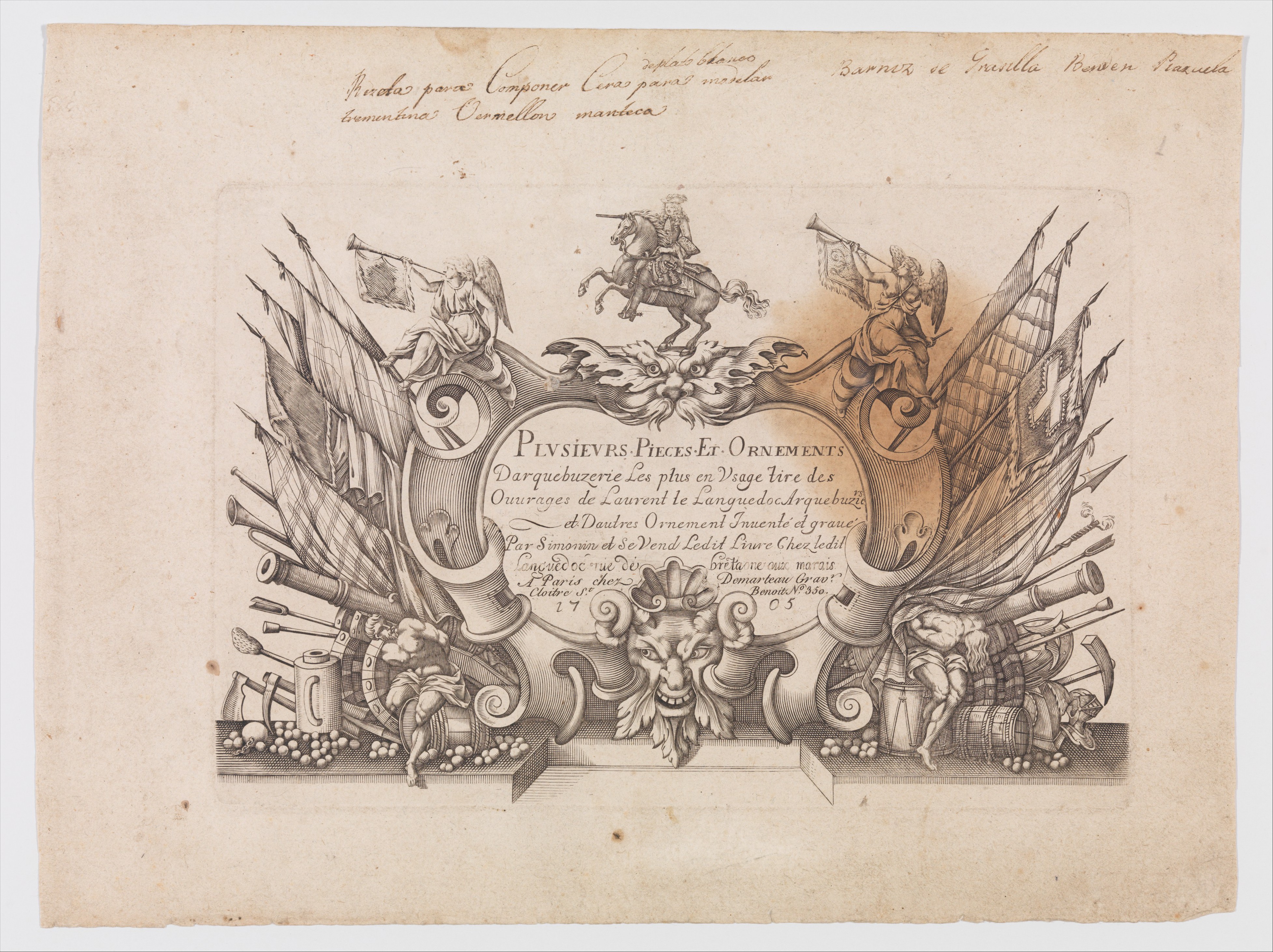
An Archival Excavation: Plusieurs Pieces et Ornements d’Arquebuzerie (4th Extended Edition)
In the rarefied world of couture, where the ephemeral whisper of silk often overshadows the permanence of steel, Katherine Fashion Lab presents a singular curatorial study: the 4th extended edition of Plusieurs Pieces et Ornements d’Arquebuzerie. This is not a garment, nor a sketch for one. It is a foundational text—a French, Parisian artifact rendered in ink on paper—that functions as a silent, rigorous grammar for the architecture of adornment. To examine this volume is to witness the pre-history of haute couture’s structural logic, where the gunsmith’s craft and the couturier’s drape converge in a dialogue of precision, ornament, and power.
The Materiality of Authority: Ink, Paper, and the Parisian Atelier
The physical object itself demands reverence. The 4th extended edition, bound in a manner that suggests both workshop utility and collector’s pride, is a testament to the Parisian print culture of its era. The ink is not a mere vehicle for imagery; it is a medium of assertive permanence. The lines—whether fine as a spider’s thread or boldly hatched to suggest shadow and volume—are executed with a draftsman’s confidence that borders on the calligraphic. The paper, heavy and slightly textured, carries the weight of repeated consultation. It is not a pristine museum piece; rather, it bears the subtle patina of a working document, perhaps passed between master gunsmiths, engravers, and, crucially, the artisans who would translate these designs into three-dimensional reality.
This edition’s extension is not merely paginal. It represents a deliberate expansion of a canon. The original Plusieurs Pieces likely served as a pattern book for the fabrication of firearm furniture—the stocks, the metal mounts, the ornate trigger guards. The 4th edition, however, elevates the subject. It moves beyond simple schematic reproduction into a realm of aesthetic theorization. The added plates and commentary position the arquebus—a heavy, early firearm—not as a tool of war alone, but as a portable sculpture, an object of courtly display where function is inseparable from flamboyant ornament.
Deconstructing the Ornament: A Lexicon for the Couturier’s Eye
For the uninitiated, a treatise on arquebus decoration might seem arcane. Yet, under the analytical lens of Katherine Fashion Lab, the plates reveal a profound taxonomy of design principles that directly prefigure the vocabulary of haute couture. Consider the damascening—the inlay of gold or silver wire into darkened steel. This is not mere embellishment; it is a study in contrast and tension. The matte, almost black ground of the metal is violently yet elegantly interrupted by the luminous, sinuous lines of precious metal. This is the same principle that governs a black velvet gown with a gold bullion embroidery, or a matte crepe suit with a single, liquid satin lapel. The ornament does not sit atop the surface; it becomes the surface’s raison d’être.
Further, the plates dedicated to chiseling and relief offer a masterclass in three-dimensional construction. The intricate scrollwork, the acanthus leaves, and the grotesque masks that populate the firearm’s stock are not flat designs. They are carved, modeled, and undercut to catch light in a specific, calculated manner. The couture parallel is immediate: the soutache braiding that creates raised, tactile patterns on a jacket; the trapunto quilting that inflates a motif from a flat ground; the appliqué of sculptural petals that transforms a bodice into a bas-relief. The gunsmith’s chisel is the ancestor of the couturier’s needle, both seeking to create form from a resistant substrate.
The Extended Edition: A Shift from Function to Fantasy
The genius of this 4th extended edition lies in its re-contextualization. The earlier editions were likely practical manuals, precise in their measurements and utilitarian in their intent. The extended plates, however, begin to detach the ornament from its strict functional moorings. We see designs for firearms that are so heavily adorned, so encrusted with champlevé enamel and niello inlay, that their efficacy as weapons becomes almost secondary. They are objects of parade, intended for diplomatic gifts, royal hunts, and ceremonial display.
This is the critical pivot. In this shift, the Plusieurs Pieces becomes a proto-couture document. It acknowledges that dress—like the decorated firearm—is a system of signs. The ornament is the language. The 4th edition’s inclusion of designs for powder flasks and priming tools, each treated with the same obsessive decorative intensity as the gun itself, reinforces this notion. The entire ensemble—weapon, accoutrements, and personal attire—was conceived as a coherent, totalizing aesthetic statement. This is the same holistic vision that drives a modern couture collection, where a gown, its matching headpiece, and even the embroidered gloves form an indivisible narrative.
Structural Parallels: The Skeleton and the Silhouette
Beyond the ornament, the treatise offers a profound lesson in structural integrity. The arquebus’s stock, typically carved from walnut, is not a simple block. It is ergonomically sculpted to fit the human hand and cheek, its curves dictated by the body’s contours. The metal fittings—the lock plate, the side plate—are not merely attached; they are inletted, seamlessly integrated into the wood so that the union is flawless. This is the couture ideal of construction invisible.
The parallel to a perfectly cut tailored jacket or a bias-cut gown is inescapable. The internal structure—the canvas, the horsehair, the boning—is the unsung hero. It provides the silhouette’s authority, the garment’s ability to stand or flow with intention. Just as the gunsmith’s stock must balance weight and balance to be functional, the couture garment must balance drape and support to be wearable art. The 4th edition’s detailed cross-sections and exploded views of the lock mechanism are, in essence, the same as a couture toile—a technical blueprint that reveals how beauty is engineered from within.
A Standalone Study: The Object as Pure Aesthetic
The designation of this edition as a standalone study is significant. It is not a chapter in a larger history of weaponry, nor an appendix to a biography of a gunsmith. It is presented as a complete, self-sufficient aesthetic artifact. This curatorial choice forces the viewer to engage with the plates on their own terms, as pure design. Divorced from the smoke of battle or the dust of the workshop, the intricate engravings become abstract compositions. The spiraling rinceaux and the symmetrical cartouches are revealed as precursors to the great decorative arts movements—from Baroque to Rococo—that would later dominate French interiors and, by extension, French fashion.
In this light, the Plusieurs Pieces is not a historical curiosity but a living sourcebook. For the contemporary designer, it offers a lexicon of motifs (the grenade, the laurel, the sunburst) and techniques (the interplay of matte and polished surfaces) that can be endlessly recombined. It teaches a philosophy of ornamentation that is neither timid nor excessive, but rather deliberate. Every line, every curve, every negative space is a decision.
Conclusion: The Couture of the Gun
Katherine Fashion Lab’s analysis of the 4th extended edition of Plusieurs Pieces et Ornements d’Arquebuzerie concludes with a resounding thesis: couture is not limited to fabric. It is a mindset, a discipline of transforming raw material into a structured, expressive, and functional object of desire. The Parisian gunsmiths who produced these designs were, in the most profound sense, couturiers of steel and wood. Their ink-on-paper legacy, as captured in this extended edition, is a masterclass in the unity of form and function, of restraint and exuberance.
This standalone study does not merely document a craft; it elevates it. It demonstrates that the principles of haute couture—meticulous construction, sculptural silhouette, and a fearless, intelligent deployment of ornament—are timeless and trans-material. The arquebus, in its gilded glory, is a distant cousin of the embroidered gown. Both are armatures for identity, encrusted with the stories of their makers and the aspirations of their wearers. In the quiet, inked lines of this Parisian volume, we hear the echo of the atelier—a whisper that continues to shape the silhouette of today.